Economic psychology
Lecture 1 - Introduction
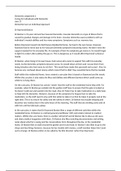
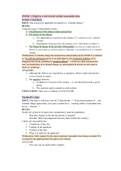
Economic psychology is mostly about decision making.
Utility = the “wellbeing” you get from something a measure of value.
(Article Ward Edwards: The theory of decision making)
The opt-in/opt-out donor-system in the Netherlands is an example of a nudge: giving people a
little push into a certain direction.
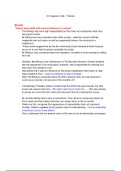
Edwards, W. – The theory of decision making
The economic theory of decision making is a theory about how to predict decisions such as an
individual who chooses A in preference to B. This study is divided into 5 sections.
1. The theory of riskless choices
The most important set of assumptions made in the theory of riskless choices may be
summarized by saying that it is assumed that the person who makes any decision to which the
theory is applied is an economic man. An economic man has three properties:
1) He is completely informed: he is assumed to know not only what all the courses of
action open to him are, but also what the outcome of any action will be.
2) He is infinitely sensitive: the available alternatives are continuous, infinitely divisible
functions and prices are infinitely divisible, so the economic man is assumed to be
infinitely sensitive.
3) He is rational: he can weakly rank the states into which he can get, and he makes his
choices so as to maximize something. Two things are required to be able to put all
available states into a weak ordering:
a. Given any two states into which he can get, he must always be able to prefer
one to another or to be indifferent between them.
b. All preferences must be transitive (if he prefers A to B and B to C, then he
prefers A to C).
The second requirement of rationality (make choices to maximize something) is the
central principle of the theory of choice. In the theory of riskless choices, an economic
man has usually been assumed to maximize utility. The fundamental content of
maximization is that he always chooses the best alternative from among those open to
him, in his perspective.
Early utility maximization theory
Every object or action may be considered from the point of view of pleasure- or pain-giving
properties. These properties are called the utility of the object; pleasure is given by positive
utility and pain is given by negative utility. The goal is to seek the maximum utility.
People choose the alternative, from among those open to them, that leads to the greatest
excess of positive over negative utility. The assumption of independent utilities can be
rejected, because of several reasons such as the existence of competing goods and completing
goods. The same goes for the broad commodity classifications necessary for adequate market
data: also not independent.
Edgeworth introduced the notion of indifference curves to deal with the utilities of
nonindependent goods. An indifference curve is a constant-utility curve: there is an infinite
Lecture 1 - Introduction
Economic psychology is mostly about decision making.
Utility = the “wellbeing” you get from something a measure of value.
(Article Ward Edwards: The theory of decision making)
The opt-in/opt-out donor-system in the Netherlands is an example of a nudge: giving people a
little push into a certain direction.
Edwards, W. – The theory of decision making
The economic theory of decision making is a theory about how to predict decisions such as an
individual who chooses A in preference to B. This study is divided into 5 sections.
1. The theory of riskless choices
The most important set of assumptions made in the theory of riskless choices may be
summarized by saying that it is assumed that the person who makes any decision to which the
theory is applied is an economic man. An economic man has three properties:
1) He is completely informed: he is assumed to know not only what all the courses of
action open to him are, but also what the outcome of any action will be.
2) He is infinitely sensitive: the available alternatives are continuous, infinitely divisible
functions and prices are infinitely divisible, so the economic man is assumed to be
infinitely sensitive.
3) He is rational: he can weakly rank the states into which he can get, and he makes his
choices so as to maximize something. Two things are required to be able to put all
available states into a weak ordering:
a. Given any two states into which he can get, he must always be able to prefer
one to another or to be indifferent between them.
b. All preferences must be transitive (if he prefers A to B and B to C, then he
prefers A to C).
The second requirement of rationality (make choices to maximize something) is the
central principle of the theory of choice. In the theory of riskless choices, an economic
man has usually been assumed to maximize utility. The fundamental content of
maximization is that he always chooses the best alternative from among those open to
him, in his perspective.
Early utility maximization theory
Every object or action may be considered from the point of view of pleasure- or pain-giving
properties. These properties are called the utility of the object; pleasure is given by positive
utility and pain is given by negative utility. The goal is to seek the maximum utility.
People choose the alternative, from among those open to them, that leads to the greatest
excess of positive over negative utility. The assumption of independent utilities can be
rejected, because of several reasons such as the existence of competing goods and completing
goods. The same goes for the broad commodity classifications necessary for adequate market
data: also not independent.
Edgeworth introduced the notion of indifference curves to deal with the utilities of
nonindependent goods. An indifference curve is a constant-utility curve: there is an infinite