3.3 Waves
3.3.1 Progressive and Stationary Waves
Progressive Waves:
Progressive wave = A wave that transfers energy without transferring matter.
A wave is caused when an object vibrates. Mechanical waves need a medium (and the particles
oscillate about fixed points), whereas electromagnetic waves don’t need a medium and can pass
through a vacuum (at the same speed).
Properties of a Progressive Wave:
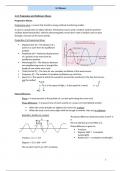
Displacement (x) = The distance of a
point on a wave from its equilibrium
position
Amplitude (A) = Maximum displacement
of a particle in the wave from its
equilibrium position
Wavelength (λ) = The distance between
two neighbouring crests or troughs/the
length of one whole wave cycle
(Time) Period (T) = The time for one complete oscillation of the wave/source
Frequency (f) = The number of complete oscillations per unit time
Speed (v) = The speed at which the wavefront moves (the wavefront is the line that moves,
not the matter)
c = f λ (c is the speed of light, v is the speed of a wave) f = 1/T
Phase Difference:
Phase = A measurement of the position of a certain point along the wave cycle
Phase difference = A measure how of much a point on a wave is in front/behind another
When the crests/troughs are aligned, the waves are in phase
When the crest of one wave aligns with the trough of another, they are in antiphase
Example 1 (points on a wave):
The phase difference between points X and Y is
ø.
We are told that ø is two fifths of λ.
Phase difference is given in:
Fractions
Degrees (360° = 1 complete
wavelength)
Fraction = ø / λ = 2/5 Radians (2π = 1 complete wavelength)
Degrees = 2/5 x 360 = 144°
We say that X and Y are 144° out phase.
1
, Example 2 (two different waves):
When finding the phase difference between two waves, the waves need to be identical.
Longitudinal and Transverse Waves:
Vibrations can’t be described as ‘up/down’ or ‘left/right’ – you must say parallel/perpendicular
Transverse wave = A wave in which the particles oscillate perpendicular to the direction of energy
propagation/transfer
They show areas of crests and troughs
They can be polarised
Examples: electromagnetic waves, vibrations on a guitar string, waves on a string, S-waves
Longitudinal wave = A wave in which the particles oscillate perpendicular to the direction of energy
propagation/transfer
They show areas of compressions (increased pressure) and rarefactions (decreased
pressure)
They can’t be polarised
Examples: sound waves, ultrasound waves, waves on a slinky coil, P-waves
Water waves are a combination of transverse and longitudinal waves.
The Motion of Particles in a Longitudinal Wave:
Particles in a longitudinal wave oscillate on
either side of equilibrium position.
When drawn on a graph, it looks like a
transverse wave, but it is not (if we look at the
axes) as it is a graph, not a picture of the wave.
Polarisation
Polarisation = is when particle oscillations occur in only one of the directions perpendicular
to the direction of wave propagation.
It can only occur in transverse waves as their particles oscillate in any plane perpendicular to
the direction of energy propagation (whereas longitudinal waves’ particles vibrate in the
same plane as the direction of energy propagation).
When transverse waves are polarised, their particles’ vibrations are restricted to one
direction but are still perpendicular to the direction of energy propagation.
Light can be polarised through reflection, refraction and scattering.
2
3.3.1 Progressive and Stationary Waves
Progressive Waves:
Progressive wave = A wave that transfers energy without transferring matter.
A wave is caused when an object vibrates. Mechanical waves need a medium (and the particles
oscillate about fixed points), whereas electromagnetic waves don’t need a medium and can pass
through a vacuum (at the same speed).
Properties of a Progressive Wave:
Displacement (x) = The distance of a
point on a wave from its equilibrium
position
Amplitude (A) = Maximum displacement
of a particle in the wave from its
equilibrium position
Wavelength (λ) = The distance between
two neighbouring crests or troughs/the
length of one whole wave cycle
(Time) Period (T) = The time for one complete oscillation of the wave/source
Frequency (f) = The number of complete oscillations per unit time
Speed (v) = The speed at which the wavefront moves (the wavefront is the line that moves,
not the matter)
c = f λ (c is the speed of light, v is the speed of a wave) f = 1/T
Phase Difference:
Phase = A measurement of the position of a certain point along the wave cycle
Phase difference = A measure how of much a point on a wave is in front/behind another
When the crests/troughs are aligned, the waves are in phase
When the crest of one wave aligns with the trough of another, they are in antiphase
Example 1 (points on a wave):
The phase difference between points X and Y is
ø.
We are told that ø is two fifths of λ.
Phase difference is given in:
Fractions
Degrees (360° = 1 complete
wavelength)
Fraction = ø / λ = 2/5 Radians (2π = 1 complete wavelength)
Degrees = 2/5 x 360 = 144°
We say that X and Y are 144° out phase.
1
, Example 2 (two different waves):
When finding the phase difference between two waves, the waves need to be identical.
Longitudinal and Transverse Waves:
Vibrations can’t be described as ‘up/down’ or ‘left/right’ – you must say parallel/perpendicular
Transverse wave = A wave in which the particles oscillate perpendicular to the direction of energy
propagation/transfer
They show areas of crests and troughs
They can be polarised
Examples: electromagnetic waves, vibrations on a guitar string, waves on a string, S-waves
Longitudinal wave = A wave in which the particles oscillate perpendicular to the direction of energy
propagation/transfer
They show areas of compressions (increased pressure) and rarefactions (decreased
pressure)
They can’t be polarised
Examples: sound waves, ultrasound waves, waves on a slinky coil, P-waves
Water waves are a combination of transverse and longitudinal waves.
The Motion of Particles in a Longitudinal Wave:
Particles in a longitudinal wave oscillate on
either side of equilibrium position.
When drawn on a graph, it looks like a
transverse wave, but it is not (if we look at the
axes) as it is a graph, not a picture of the wave.
Polarisation
Polarisation = is when particle oscillations occur in only one of the directions perpendicular
to the direction of wave propagation.
It can only occur in transverse waves as their particles oscillate in any plane perpendicular to
the direction of energy propagation (whereas longitudinal waves’ particles vibrate in the
same plane as the direction of energy propagation).
When transverse waves are polarised, their particles’ vibrations are restricted to one
direction but are still perpendicular to the direction of energy propagation.
Light can be polarised through reflection, refraction and scattering.
2