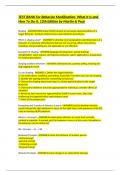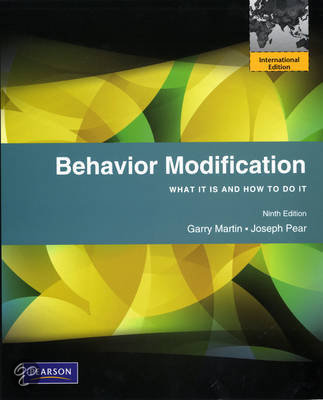
TEST BANK For Behavior Modification: What It Is and
How To Do It, 12th Edition by Martin & Pear
Answer the following terms as used in behaviour Modification?
Behavior - ANSWER:the result of past experiences, environmental interaction, and
"private events". Private events are thoughts, feelings, inner experiences and
perceptions: what we refer to as cognitive and affective behaviors.
Behaviorism - ANSWER:the study of behavior, especially observable behavior.
Termed by John Watson
Applied behavioral analysis - ANSWER:the systematic process of applying the
principles of behavior and learning into improving specific behaviors and
simultaneously evaluating if those changes are attributable to the process of
application.
Applied Behavior Analysis includes... - ANSWER:1) The systematic process: specific
ways it is done: behavioral things with data-based contingencies (showing your
treatment made the change) that are reliable....
2) of applying the principles of behavior and learning: (what you do is borne from
previous studies, data, or evidence based practices.....
3) into improving specific behaviors: (NOT general behaviors)
4) and simultaneously evaluating if those changes are attributable to the process of
application: (examining if what was done really caused the change)
Kant - ANSWER:Introduced positivism: all valid knowledge is objective.
William James - ANSWER:Introduced functionalism, people think and act for
particular reasons (this is an underlying precept of behaviorism)
John Watson - ANSWER:Formally started and named behaviorism. Completely
focused on observable behavior in contrast to unverifiable consciousness (Freud).
Performed the Little Albert experiment. Human activities are paired with emotions:
the stronger the emotion the stronger the change.
Functionalism - ANSWER:people think and act for particular reasons (this is an
underlying precept of behaviorism)
Positivism - ANSWER:all valid knowledge is objective.
Elicit - ANSWER:Use in classical conditioning. Elicit a reflex
, Evoke - ANSWER:Use in operant conditioning.
Pavlov - ANSWER:Introduced classical/respondent/Pavlovian conditioning.
Thorndike - ANSWER:Thorndike's Major laws
1. Law of readiness
2. Law of exercise
3. Law of effect
Law of Readiness - ANSWER:Law refers to the conditions that determine what will
act as satisfiers and annoyers.
Later explains antecedents
Law of Exercise - ANSWER:Responses are connected to situations simply because
they occur frequently in those situations (laws of use & disuse). In other words, the
law of exercise stated that behavior is more strongly established through frequent
connections of stimulus and response.
Later explains how repetition of the relationships increase associations
Law of Effect - ANSWER:Responses are selected and connected to situations or are
disconnected from situations depending upon the consequences they produce
(satisfiers or annoyers).Explains reinforcers and punishers. Stimulus --> response --
>consequence
Of several responses made to the same situation, those which are accompanied or
closely followed by satisfaction to the animal will, other things being equal, be more
firmly connected with the situation
Later explains consequences
B.F. Skinner - ANSWER:The number one guy associated with operant conditioning.
He started with pigeons and after 12 years started exploring its use with humans.
Skinner's two books - ANSWER:1. Behavior of organisms: Where he discussed
reinforcement and shaping behaviors.
2. Science and Human Behavior:where he applied operant conditioning to people
Tollman - ANSWER:Another research but his approach to human behavior involved a
synthesis of Gestalt psychology and behaviorism.
Ogden Lindsly - ANSWER:Introduced precision teaching.
Precision teaching - ANSWER:Ogden Lindsly. Also known as errorless training. Need
small groups or 1:1 situations
How To Do It, 12th Edition by Martin & Pear
Answer the following terms as used in behaviour Modification?
Behavior - ANSWER:the result of past experiences, environmental interaction, and
"private events". Private events are thoughts, feelings, inner experiences and
perceptions: what we refer to as cognitive and affective behaviors.
Behaviorism - ANSWER:the study of behavior, especially observable behavior.
Termed by John Watson
Applied behavioral analysis - ANSWER:the systematic process of applying the
principles of behavior and learning into improving specific behaviors and
simultaneously evaluating if those changes are attributable to the process of
application.
Applied Behavior Analysis includes... - ANSWER:1) The systematic process: specific
ways it is done: behavioral things with data-based contingencies (showing your
treatment made the change) that are reliable....
2) of applying the principles of behavior and learning: (what you do is borne from
previous studies, data, or evidence based practices.....
3) into improving specific behaviors: (NOT general behaviors)
4) and simultaneously evaluating if those changes are attributable to the process of
application: (examining if what was done really caused the change)
Kant - ANSWER:Introduced positivism: all valid knowledge is objective.
William James - ANSWER:Introduced functionalism, people think and act for
particular reasons (this is an underlying precept of behaviorism)
John Watson - ANSWER:Formally started and named behaviorism. Completely
focused on observable behavior in contrast to unverifiable consciousness (Freud).
Performed the Little Albert experiment. Human activities are paired with emotions:
the stronger the emotion the stronger the change.
Functionalism - ANSWER:people think and act for particular reasons (this is an
underlying precept of behaviorism)
Positivism - ANSWER:all valid knowledge is objective.
Elicit - ANSWER:Use in classical conditioning. Elicit a reflex
, Evoke - ANSWER:Use in operant conditioning.
Pavlov - ANSWER:Introduced classical/respondent/Pavlovian conditioning.
Thorndike - ANSWER:Thorndike's Major laws
1. Law of readiness
2. Law of exercise
3. Law of effect
Law of Readiness - ANSWER:Law refers to the conditions that determine what will
act as satisfiers and annoyers.
Later explains antecedents
Law of Exercise - ANSWER:Responses are connected to situations simply because
they occur frequently in those situations (laws of use & disuse). In other words, the
law of exercise stated that behavior is more strongly established through frequent
connections of stimulus and response.
Later explains how repetition of the relationships increase associations
Law of Effect - ANSWER:Responses are selected and connected to situations or are
disconnected from situations depending upon the consequences they produce
(satisfiers or annoyers).Explains reinforcers and punishers. Stimulus --> response --
>consequence
Of several responses made to the same situation, those which are accompanied or
closely followed by satisfaction to the animal will, other things being equal, be more
firmly connected with the situation
Later explains consequences
B.F. Skinner - ANSWER:The number one guy associated with operant conditioning.
He started with pigeons and after 12 years started exploring its use with humans.
Skinner's two books - ANSWER:1. Behavior of organisms: Where he discussed
reinforcement and shaping behaviors.
2. Science and Human Behavior:where he applied operant conditioning to people
Tollman - ANSWER:Another research but his approach to human behavior involved a
synthesis of Gestalt psychology and behaviorism.
Ogden Lindsly - ANSWER:Introduced precision teaching.
Precision teaching - ANSWER:Ogden Lindsly. Also known as errorless training. Need
small groups or 1:1 situations