Chem 116 Exam 3 with Questions &
Correct Verified Answers
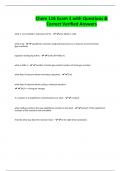
what is not included in expression for Kc - ✔✔pure liquid or solid
what is Kp - ✔✔equilibrium constant using partial pressure as a measure of concentration
(gas reactions)
equation relating Kp and Kc - ✔✔Kp=Kc (RT^delta n)
what is delta n - ✔✔number of moles gas product-number of moles gas reactant
what does Kc become when inverting an equation - ✔✔1/Kc
what does Kc become when scaling a chemical equation -
✔✔(Kc)^n -n being an interger
if a reaction is at equilibrium concentrations are what - ✔✔constant
when adding reactions the new equilibrium constant is the what - ✔✔product of the equilibrium
contacts of the reactions that are added
if Qc<Kc what way does the reaction move - ✔✔to the right (more products)
, if Qc>Kc what way does the reaction move - ✔✔moves to the left (more reactants)
if Qc=Kc what way does the reaction move - ✔✔reaction at equilibrium, no change
when given initial concentrations and one equilibrium constant what can ICE tables determine -
✔✔Kc or Kp
what is Le Chatelier's principle - ✔✔if a reaction is in equilibrium is perturbed (stressed) the
system responds by trying to remove the pertubation
what factors perturb reactions - ✔✔-changing concentrations of reactants/products
-change in temperature
-change in pressure
-changing volume
factors that don't perturb equilibrium - ✔✔-changing pressure using inert gas
-adding a catalyst
what happens to equilibrium if we decrease the pressure (by increasing the volume) - ✔✔the
system moves to the direction of more moles of gas
what happens to equilibrium hone you increase the pressure by decreasing the volume -
✔✔reaction moves to the side with less moles of gas
what gives out heat - ✔✔exothermic
what absorbs heat - ✔✔endothermic
if it is exothermic on the forward direction it is what in the reverse direction - ✔✔endothermic
and vice versa
Correct Verified Answers
what is not included in expression for Kc - ✔✔pure liquid or solid
what is Kp - ✔✔equilibrium constant using partial pressure as a measure of concentration
(gas reactions)
equation relating Kp and Kc - ✔✔Kp=Kc (RT^delta n)
what is delta n - ✔✔number of moles gas product-number of moles gas reactant
what does Kc become when inverting an equation - ✔✔1/Kc
what does Kc become when scaling a chemical equation -
✔✔(Kc)^n -n being an interger
if a reaction is at equilibrium concentrations are what - ✔✔constant
when adding reactions the new equilibrium constant is the what - ✔✔product of the equilibrium
contacts of the reactions that are added
if Qc<Kc what way does the reaction move - ✔✔to the right (more products)
, if Qc>Kc what way does the reaction move - ✔✔moves to the left (more reactants)
if Qc=Kc what way does the reaction move - ✔✔reaction at equilibrium, no change
when given initial concentrations and one equilibrium constant what can ICE tables determine -
✔✔Kc or Kp
what is Le Chatelier's principle - ✔✔if a reaction is in equilibrium is perturbed (stressed) the
system responds by trying to remove the pertubation
what factors perturb reactions - ✔✔-changing concentrations of reactants/products
-change in temperature
-change in pressure
-changing volume
factors that don't perturb equilibrium - ✔✔-changing pressure using inert gas
-adding a catalyst
what happens to equilibrium if we decrease the pressure (by increasing the volume) - ✔✔the
system moves to the direction of more moles of gas
what happens to equilibrium hone you increase the pressure by decreasing the volume -
✔✔reaction moves to the side with less moles of gas
what gives out heat - ✔✔exothermic
what absorbs heat - ✔✔endothermic
if it is exothermic on the forward direction it is what in the reverse direction - ✔✔endothermic
and vice versa