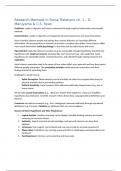
Research Methods in Social Relations ch. 1 – G.
Maruyama & C.S. Ryan
Positivism: reality is objective and can be understood through empirical observation and scientific
methods.
Constructivism: reality is subjective and shaped by personal experiences and social interactions.
Social scientists observe people and settings from various distances as it provides different
information. No one procedure or method can provide a complete description. Social sciences differ
from casual observation (naive psychology) in that they seek to tackle biases and errors.
Operationism holds that abstract concepts must be measurable, though imperfectly. Scientists test
hypotheses with empirical research, knowing they can't be proven true, only supported. Good
hypotheses are repeatedly tested, reviewed by peers, and refined through ongoing research and
replication.
Social science researches need to be aware of how values affect your approach and how they impact
different people and groups. The covariation principle would associate researchers with their
findings instead of separating them.
Challenges in social science:
- Public Perception: Observations by social scientists are often less accepted than those by
physical scientists due to pre-existing opinions.
- Political Sensitivity: Social research often addresses politically charged issues (e.g. stay at
home moms).
We all make casual observations (e.g., "Birds of a feather flock together"). These are simplified
hypotheses about behavior. Scientific research refines these ideas using operational definitions and
theories.
Constructs are abstract concepts (e.g., love, intelligence) measured indirectly through operational
definitions (e.g., IQ tests). Variables are attributes that vary across subjects.
Sources of Naïve Hypotheses and Their Weaknesses
1. Logical Analysis: Intuitive reasoning can be flawed; scientific thinking requires structured
reasoning to overcome biases.
2. Authority: Experts may lack actual knowledge, and personal interests can skew their
opinions.
3. Consensus: Peer support can be biased and may not provide an accurate assessment.
4. Observation: Definitions vary, proving cause and effect is challenging, and observations can
be biased.
5. Past Experience: Memory can be selective and inaccurate.
Maruyama & C.S. Ryan
Positivism: reality is objective and can be understood through empirical observation and scientific
methods.
Constructivism: reality is subjective and shaped by personal experiences and social interactions.
Social scientists observe people and settings from various distances as it provides different
information. No one procedure or method can provide a complete description. Social sciences differ
from casual observation (naive psychology) in that they seek to tackle biases and errors.
Operationism holds that abstract concepts must be measurable, though imperfectly. Scientists test
hypotheses with empirical research, knowing they can't be proven true, only supported. Good
hypotheses are repeatedly tested, reviewed by peers, and refined through ongoing research and
replication.
Social science researches need to be aware of how values affect your approach and how they impact
different people and groups. The covariation principle would associate researchers with their
findings instead of separating them.
Challenges in social science:
- Public Perception: Observations by social scientists are often less accepted than those by
physical scientists due to pre-existing opinions.
- Political Sensitivity: Social research often addresses politically charged issues (e.g. stay at
home moms).
We all make casual observations (e.g., "Birds of a feather flock together"). These are simplified
hypotheses about behavior. Scientific research refines these ideas using operational definitions and
theories.
Constructs are abstract concepts (e.g., love, intelligence) measured indirectly through operational
definitions (e.g., IQ tests). Variables are attributes that vary across subjects.
Sources of Naïve Hypotheses and Their Weaknesses
1. Logical Analysis: Intuitive reasoning can be flawed; scientific thinking requires structured
reasoning to overcome biases.
2. Authority: Experts may lack actual knowledge, and personal interests can skew their
opinions.
3. Consensus: Peer support can be biased and may not provide an accurate assessment.
4. Observation: Definitions vary, proving cause and effect is challenging, and observations can
be biased.
5. Past Experience: Memory can be selective and inaccurate.