Higher Nationals
Introduction
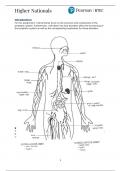
For this assignment, I will primarily focus on the structure and components of the
lymphatic system. Furthermore, I will delve into how disorders affect the functioning of
the lymphatic system as well as the corresponding treatments for these disorders.
What is the lymphatic system?
The lymphatic system is a collection of organs, vessels and tissues which collaboratively
facilitate the movement of a transparent, watery fluid called lymph, back into the
circulatory system, specifically the bloodstream. (Cleveland Clinic, 2023)
1
, Higher Nationals
Function of the lymphatic system
What does the lymphatic system do? (Cleveland Clinic, 2023)
The lymphatic system has a lot of functions however its main functions are:
While most nutrients can easily pass through the small openings in the capillary
walls and be absorbed by the body, there are certain fats and other large
molecules which can’t follow this route. In such cases, the lymphatic system
comes into action by collecting the fluid containing these substances from the
intestines and transporting it back into the bloodstream.
The lymphatic system performs the important task of gathering excess fluid from
the tissue of our body and returning it to the bloodstream. This process helps
maintain a balanced and healthy fluid level throughout our body. Additionally, the
lymphatic system acts as a filter, removing waste products and abnormal cells
from this fluid.
The lymphatic system serves as a defender for our body, working in conjunction
with our immune system. It plays an important part in generating and releasing
lymphocytes, a specific type of white blood cell, as well as other immune cells.
These cells actively search for and eliminate invaders, including viruses, parasites
bacteria, and fungi, which have the potential to enter our body and cause harm to
our normal wellbeing.
Absorption of fats from the digestive system
The products resulting from the process of digestion are absorbed through the wall of the
ileum, which is a part of the small intestine. The inner lining of the ileum is folded and
contains finger-like structures called villi.
Each villus contains a small vessel called a lacteal. When fats are digested, the resulting
products enter the lacteal within each villus. This mixture, known as chyle, then travels
through lymph vessels. Eventually, the chyle enters the bloodstream when the lymph
ducts connect with blood vessels in the neck region. (Annets, et al., 2016)
Removal of intestinal fluid from tissues
Interstitial fluid, also known as tissue fluid, is the fluid which resides in the spaces
between cells within our tissues. It originates from plasma, which a fluid portion of our
blood, and is pushed out of the blood capillaries at the arterial end. The interstitial fluid
serves as a bath for cells and facilitates the exchange of substances. Oxygen and
nutrients move through diffusion from the tissue fluid into cells, providing them with
necessary resources. Conversely, carbon dioxide, other waste products, and certain
proteins pass from cells into the tissue fluid, allowing for their removal or transport.
In tissues, the excess fluid which has escaped from blood capillaries enters the lymph
capillaries. Unlike the smaller openings in the walls of blood capillaries, the holes in the
walls of lymph capillaries are larger. This allows not only excess fluid but also large
protein molecules present in the tissue fluid to pass into the lymph capillaries. These
protein molecules are subsequently transported away from the tissues. If these proteins
weren’t carried away, they would create osmotic effects, preventing the removal of
tissue fluid and resulting in swelling or oedema. (Annets, et al., 2016)
Maintenance of hydrostatic pressure
When the lymph fluid merges with the blood vessels in the neck area, it contributes to an
increase in blood volume. This increase in blood volume plays a role in maintaining
2
Introduction
For this assignment, I will primarily focus on the structure and components of the
lymphatic system. Furthermore, I will delve into how disorders affect the functioning of
the lymphatic system as well as the corresponding treatments for these disorders.
What is the lymphatic system?
The lymphatic system is a collection of organs, vessels and tissues which collaboratively
facilitate the movement of a transparent, watery fluid called lymph, back into the
circulatory system, specifically the bloodstream. (Cleveland Clinic, 2023)
1
, Higher Nationals
Function of the lymphatic system
What does the lymphatic system do? (Cleveland Clinic, 2023)
The lymphatic system has a lot of functions however its main functions are:
While most nutrients can easily pass through the small openings in the capillary
walls and be absorbed by the body, there are certain fats and other large
molecules which can’t follow this route. In such cases, the lymphatic system
comes into action by collecting the fluid containing these substances from the
intestines and transporting it back into the bloodstream.
The lymphatic system performs the important task of gathering excess fluid from
the tissue of our body and returning it to the bloodstream. This process helps
maintain a balanced and healthy fluid level throughout our body. Additionally, the
lymphatic system acts as a filter, removing waste products and abnormal cells
from this fluid.
The lymphatic system serves as a defender for our body, working in conjunction
with our immune system. It plays an important part in generating and releasing
lymphocytes, a specific type of white blood cell, as well as other immune cells.
These cells actively search for and eliminate invaders, including viruses, parasites
bacteria, and fungi, which have the potential to enter our body and cause harm to
our normal wellbeing.
Absorption of fats from the digestive system
The products resulting from the process of digestion are absorbed through the wall of the
ileum, which is a part of the small intestine. The inner lining of the ileum is folded and
contains finger-like structures called villi.
Each villus contains a small vessel called a lacteal. When fats are digested, the resulting
products enter the lacteal within each villus. This mixture, known as chyle, then travels
through lymph vessels. Eventually, the chyle enters the bloodstream when the lymph
ducts connect with blood vessels in the neck region. (Annets, et al., 2016)
Removal of intestinal fluid from tissues
Interstitial fluid, also known as tissue fluid, is the fluid which resides in the spaces
between cells within our tissues. It originates from plasma, which a fluid portion of our
blood, and is pushed out of the blood capillaries at the arterial end. The interstitial fluid
serves as a bath for cells and facilitates the exchange of substances. Oxygen and
nutrients move through diffusion from the tissue fluid into cells, providing them with
necessary resources. Conversely, carbon dioxide, other waste products, and certain
proteins pass from cells into the tissue fluid, allowing for their removal or transport.
In tissues, the excess fluid which has escaped from blood capillaries enters the lymph
capillaries. Unlike the smaller openings in the walls of blood capillaries, the holes in the
walls of lymph capillaries are larger. This allows not only excess fluid but also large
protein molecules present in the tissue fluid to pass into the lymph capillaries. These
protein molecules are subsequently transported away from the tissues. If these proteins
weren’t carried away, they would create osmotic effects, preventing the removal of
tissue fluid and resulting in swelling or oedema. (Annets, et al., 2016)
Maintenance of hydrostatic pressure
When the lymph fluid merges with the blood vessels in the neck area, it contributes to an
increase in blood volume. This increase in blood volume plays a role in maintaining
2