H5: OXIDATIEVE FOSFORYLATIE
• In de binnenste membraan ipv matrix (krebs)
• Laatste deel oxidatieve verbranding => doel ATP uit NADH en (FADH2)/QH2
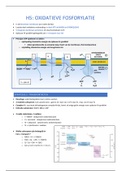
• 5 integrale membraan proteïnen of enzymcomplexen (I-V)
• Opbouw H+ gradiënt gekoppeld aan e- transport naar O2
• Principe: ATP synthese in 2 delen:
o opstapeling chemische energie via opbouw H+ gradiënt
▪ (door gereduceerde co-enzymes lang 1 kant van de membraan, thermodynamica)
o vrijstelling chemische energie via terugstroom H+
I III IV V
II = plan B
STRATEGIE E- TRANSPORTKETEN
• Recyclage: ademhalingsketen kan continu werken
• 2 mobiele coënzymen: Q & cytochroom c, geven 2e- door van I of II naar III, resp. van III naar IV
• Complex II = succinaat dehydrogenase complex Krebs, levert als enige géén energie voor opbouw H+ gradiënt
• Kritische substraten: NADH, O2 en ADP
• 3 oxido-reductasen, 1 oxidase:
o I = NADH - ubiquinone oxidoreductase
o II = succinaat - ubiquinone oxidoreductase
o III = ubiquinol - cytochroomc oxidoreductase
o IV = cytochroom c oxidase
• Welke coënzymen zijn belangrijk in
het e- transport ?
o NAD+ + H- => NADH
o FAD + 2e- + 2H+ => FADH2
o Q + 2e-+ 2H+ => QH2
o Cyt a, b of c met Fe 3+ => Fe 2+
• In de binnenste membraan ipv matrix (krebs)
• Laatste deel oxidatieve verbranding => doel ATP uit NADH en (FADH2)/QH2
• 5 integrale membraan proteïnen of enzymcomplexen (I-V)
• Opbouw H+ gradiënt gekoppeld aan e- transport naar O2
• Principe: ATP synthese in 2 delen:
o opstapeling chemische energie via opbouw H+ gradiënt
▪ (door gereduceerde co-enzymes lang 1 kant van de membraan, thermodynamica)
o vrijstelling chemische energie via terugstroom H+
I III IV V
II = plan B
STRATEGIE E- TRANSPORTKETEN
• Recyclage: ademhalingsketen kan continu werken
• 2 mobiele coënzymen: Q & cytochroom c, geven 2e- door van I of II naar III, resp. van III naar IV
• Complex II = succinaat dehydrogenase complex Krebs, levert als enige géén energie voor opbouw H+ gradiënt
• Kritische substraten: NADH, O2 en ADP
• 3 oxido-reductasen, 1 oxidase:
o I = NADH - ubiquinone oxidoreductase
o II = succinaat - ubiquinone oxidoreductase
o III = ubiquinol - cytochroomc oxidoreductase
o IV = cytochroom c oxidase
• Welke coënzymen zijn belangrijk in
het e- transport ?
o NAD+ + H- => NADH
o FAD + 2e- + 2H+ => FADH2
o Q + 2e-+ 2H+ => QH2
o Cyt a, b of c met Fe 3+ => Fe 2+