Emerging Markets Lectures
Emerging Markets Lectures
Lecture 1 – Introduction to Emerging Economies
Cons
- Extreme poverty and inequality
- Huge unmet demands but inadequate provisions
Pros
- Being new and raising new technologies; power of new technologies and innovations
- Aspirational population
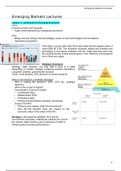
Over time it can be seen that China and India had the largest share of
world GDP till 1700. The industrial revolution started and suddenly the
technology in the hands of Britain, US etc. made that they took over
the world economy (China almost gone). From 2000 the re-emergence
from China and Japan.
Strategic Decisions
Strategy: major decision, you only take it once in a while
depending on certain changes (acquiring another brand/firm).
Long-term oriented, goal-directed decision.
Tactic: small decision, 20% discount on certain products
When is the decision a strategic decision?
- Who is making the decision? CEO, CFO etc.: strategic
decisions.
- What is the scope of impact?
- Commitment: in terms of money
o Investments (big)
o Relationships (JVs)
o Promotions (ads)
o Policies and procedures (systems, structures)
- Scope of the firm:
o Where is your market, what kind of products?
o How will the decision have any impact on the
economic value of the value of the firm.
Strategy is the dynamics between ‘firm’ and its
‘environment (business, institutional, political etc.) due to
the ‘actions’ taken and the use of resources in order to
achieve goals (increase performance).
1
, Emerging Markets Lectures
Naming Emerging Markets
- BRICS: Brazil, Russia, India, China
- MINT: Mexico, Indonesia, Nigeria, Turkey
- CIVETS: Colombia, Indonesia, Vietnam, Egypt, Turkey, South Africa
- Emerging Markets
- Transition economies
- Newly industrialized economies
Common factors
1. Low income; low income per capita
2. Rapid Growth; high GDP growth (5% or higher), high economic growth rate
3. Undergone major market reforms or liberalization
o Reduced role of government (facilitator); competition is the leader and decides the regulation.
o Privatization of SOEs (state owned enterprise)
o Lowered barriers to trade and investment
o Level playing field for business activities; everyone gets the same treatment, laws and
regulations are the same for all the firms in the particular market.
FDI going into emerging countries is
increasingly going up, FDI out of emerging
markets has risen but is still dominated by
developed countries.
2014: shrinking of economic growth Europe.
Emerging countries cannot take it for granted
that they keep growing. E.g. Brazil, South
Africa, Venezuela. The growth markets are
dynamic and constant evaluation is needed.
What makes emerging markets unique for
business?
Pros:
- Huge unmet demand for products, services and technology.
- Young and growing population: tremendous opportunities for growth
- Heterogeneous market segments: something for everyone. So much difference in terms of choice
and preferences.
- Low cost and skilled labour: global production centre.
- Unique conditions: new frontiers for innovation. New requirements of consumers
Cons:
- Difficult and unstable market conditions; no first mover advantage
- Poor infrastructure and information flows
- Heterogeneous demand: hard to focus on several products, you cannot easily push costs down.
- High income inequality
- Huge intra-national diversity: e.g. 23 languages in India.
Lecture Two – Emerging Market Features
Emerging economies – The Economist
Emerging Market Features
A. Frequently prone to market failures; supply and demand will not meet.
1. Information problems
2
, Emerging Markets Lectures
Rodamas as a reliable partner to comply with local regulations
2. Misguided regulations (political gains over efficiency)
E.g. Indonesian laws and policies changed with the dictator power
3. Inefficient or lax enforcement or contracts/law
Indonesian courts could not be trsuted with property rights cases
B. Rapidly evolving institutions (e.g. dictators in Indonesia)
1. Too much too fast (unexpected events)
Asia financial crisis (1997), India and Russia debt default (1990s)
2. Dismanteling existing systems and building new ones
New system for tax collection in India (2017); privatization and listing firms in
Chinese stock exchanges
3. Political and economic instability/uncertainties
Frequent government changes: India (1990s) witnessed 4 national elections
and several govt.
Dictatorship preferences: Indonesia, Philippines, Turkey etc.
Dictatorship ideology swings: Argentina in 1990s, Brazil in 2010s
Policy shifts: form import substitution to export promotion in Indonesia
(Rodamas).
C. Underdeveloped strategic factor markets (outside of the company; infrastructure, labour etc.)
1. Capital markets: high costs of capital, forex restrictions
Connections with local banks helped Rodamas
2. Labour markets: shortfall and mobility constraints
Lack of qualified people in management and sales (Rodamas)
Labour regulation and policies (hoe easy/hard to hire and fire)
3. Product markets: input quality; infrastructural voids
Poor distribution infrastructure in Indonesia
D. Missing intermediaries (bringing services to bring sellers and buyers together); Impact of
Missing Intermediaries: ease of doing business rankings
1. Credibility enhancers
EQUIS (education), ISO (quality), Credit rating (BKR)
2. Information analyst/advisors
Market research, investment banks, financial advisors
3. Aggregators/distributors
Private equity, incubators, mutual funds
4. Regulators and enforces
Russia lacked equivalent of OSHA (safety) or FDA (equity)
5. Adjudicators
Huurcommissie NL
E. Governmental intervention and control over economic activities
1. Direct participation via SOEs
Nationalization of banks in Indonesia
2. Facilitate national strategic interests
Chinese government’s backing
3. Political opportunism to stay in power
E.g. to provide jobs, develop specific regions etc; Suharto in Indonesia
preferring select group of ethnic Chinese business leaders etc.
F. High intra-national and sub-national diversity
1. Income levels
4.4 billion people earn less than $10 a day
2. Tastes and preferences
G. Informal economy (grey market) dominates the formal (white market)
1. Too costly or complicated to operate formally
Mom & pop stores; roadside vendors
2. Need for unorganized support groups
Home assistants in Indian and Chinese megacities
3
Emerging Markets Lectures
Lecture 1 – Introduction to Emerging Economies
Cons
- Extreme poverty and inequality
- Huge unmet demands but inadequate provisions
Pros
- Being new and raising new technologies; power of new technologies and innovations
- Aspirational population
Over time it can be seen that China and India had the largest share of
world GDP till 1700. The industrial revolution started and suddenly the
technology in the hands of Britain, US etc. made that they took over
the world economy (China almost gone). From 2000 the re-emergence
from China and Japan.
Strategic Decisions
Strategy: major decision, you only take it once in a while
depending on certain changes (acquiring another brand/firm).
Long-term oriented, goal-directed decision.
Tactic: small decision, 20% discount on certain products
When is the decision a strategic decision?
- Who is making the decision? CEO, CFO etc.: strategic
decisions.
- What is the scope of impact?
- Commitment: in terms of money
o Investments (big)
o Relationships (JVs)
o Promotions (ads)
o Policies and procedures (systems, structures)
- Scope of the firm:
o Where is your market, what kind of products?
o How will the decision have any impact on the
economic value of the value of the firm.
Strategy is the dynamics between ‘firm’ and its
‘environment (business, institutional, political etc.) due to
the ‘actions’ taken and the use of resources in order to
achieve goals (increase performance).
1
, Emerging Markets Lectures
Naming Emerging Markets
- BRICS: Brazil, Russia, India, China
- MINT: Mexico, Indonesia, Nigeria, Turkey
- CIVETS: Colombia, Indonesia, Vietnam, Egypt, Turkey, South Africa
- Emerging Markets
- Transition economies
- Newly industrialized economies
Common factors
1. Low income; low income per capita
2. Rapid Growth; high GDP growth (5% or higher), high economic growth rate
3. Undergone major market reforms or liberalization
o Reduced role of government (facilitator); competition is the leader and decides the regulation.
o Privatization of SOEs (state owned enterprise)
o Lowered barriers to trade and investment
o Level playing field for business activities; everyone gets the same treatment, laws and
regulations are the same for all the firms in the particular market.
FDI going into emerging countries is
increasingly going up, FDI out of emerging
markets has risen but is still dominated by
developed countries.
2014: shrinking of economic growth Europe.
Emerging countries cannot take it for granted
that they keep growing. E.g. Brazil, South
Africa, Venezuela. The growth markets are
dynamic and constant evaluation is needed.
What makes emerging markets unique for
business?
Pros:
- Huge unmet demand for products, services and technology.
- Young and growing population: tremendous opportunities for growth
- Heterogeneous market segments: something for everyone. So much difference in terms of choice
and preferences.
- Low cost and skilled labour: global production centre.
- Unique conditions: new frontiers for innovation. New requirements of consumers
Cons:
- Difficult and unstable market conditions; no first mover advantage
- Poor infrastructure and information flows
- Heterogeneous demand: hard to focus on several products, you cannot easily push costs down.
- High income inequality
- Huge intra-national diversity: e.g. 23 languages in India.
Lecture Two – Emerging Market Features
Emerging economies – The Economist
Emerging Market Features
A. Frequently prone to market failures; supply and demand will not meet.
1. Information problems
2
, Emerging Markets Lectures
Rodamas as a reliable partner to comply with local regulations
2. Misguided regulations (political gains over efficiency)
E.g. Indonesian laws and policies changed with the dictator power
3. Inefficient or lax enforcement or contracts/law
Indonesian courts could not be trsuted with property rights cases
B. Rapidly evolving institutions (e.g. dictators in Indonesia)
1. Too much too fast (unexpected events)
Asia financial crisis (1997), India and Russia debt default (1990s)
2. Dismanteling existing systems and building new ones
New system for tax collection in India (2017); privatization and listing firms in
Chinese stock exchanges
3. Political and economic instability/uncertainties
Frequent government changes: India (1990s) witnessed 4 national elections
and several govt.
Dictatorship preferences: Indonesia, Philippines, Turkey etc.
Dictatorship ideology swings: Argentina in 1990s, Brazil in 2010s
Policy shifts: form import substitution to export promotion in Indonesia
(Rodamas).
C. Underdeveloped strategic factor markets (outside of the company; infrastructure, labour etc.)
1. Capital markets: high costs of capital, forex restrictions
Connections with local banks helped Rodamas
2. Labour markets: shortfall and mobility constraints
Lack of qualified people in management and sales (Rodamas)
Labour regulation and policies (hoe easy/hard to hire and fire)
3. Product markets: input quality; infrastructural voids
Poor distribution infrastructure in Indonesia
D. Missing intermediaries (bringing services to bring sellers and buyers together); Impact of
Missing Intermediaries: ease of doing business rankings
1. Credibility enhancers
EQUIS (education), ISO (quality), Credit rating (BKR)
2. Information analyst/advisors
Market research, investment banks, financial advisors
3. Aggregators/distributors
Private equity, incubators, mutual funds
4. Regulators and enforces
Russia lacked equivalent of OSHA (safety) or FDA (equity)
5. Adjudicators
Huurcommissie NL
E. Governmental intervention and control over economic activities
1. Direct participation via SOEs
Nationalization of banks in Indonesia
2. Facilitate national strategic interests
Chinese government’s backing
3. Political opportunism to stay in power
E.g. to provide jobs, develop specific regions etc; Suharto in Indonesia
preferring select group of ethnic Chinese business leaders etc.
F. High intra-national and sub-national diversity
1. Income levels
4.4 billion people earn less than $10 a day
2. Tastes and preferences
G. Informal economy (grey market) dominates the formal (white market)
1. Too costly or complicated to operate formally
Mom & pop stores; roadside vendors
2. Need for unorganized support groups
Home assistants in Indian and Chinese megacities
3