Lecture 2
Q&S
Using knowledge and learning to improve quality and safety
Objectives
- Students are able to describe learning concepts in their own words.
- Students are able to describe the relevance of learning concepts for quality and
safety issues.
- Students are able to describe the differences and similarities between learning
concepts.
- Students are able to critically reflect on organizing and learning approaches based on
the ideas of Clegg.
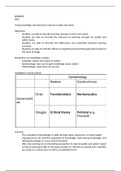
Researchers as knowledge creators
- Ontology: what is the nature of reality?
- Epistemology: how can we gain knowledge about reality?
- Methodology: what tools can we use?
Paradigms in social science
Learning
- The acquisition of knowledge or skills through study, experience, or being taught
- Learning has to do with the acquisition of knowledge, with sharing knowledge, and
utilizing knowledge in a new context/situation
- Why may learning be an interesting perspective to look at quality and safety? (good
to look at what goes right & what goes wrong) it is relevant at a group level, mistakes
are made at a system level as well as an individual level.
, - Systems require learning to understand what went wrong and to improve it for next
time
From individual to organizational learning
- Individual learning: an individual learns new skills or ideas, and the quality of his
work may increase as he gains expertise
- Group learning: group learning happens when individuals within a group acquire,
share and combine knowledge through experience with one another
- Organizational learning: the process of creating, retaining and transferring
knowledge within an organization
- A learning organization is the term given to a company that facilitates the learning of
its members and continuously transforms itself
- Individuals are predominantly seen as the functional mechanisms for organizational
learning by creating knowledge through experience. However, individuals'
knowledge only facilitates learning within the organization as a whole if it is
transferred. Individuals may withhold their knowledge or exit the organization.
Knowledge that is embedded into the organization, in addition to its individuals, can
be retained. Methods to embed knowledge extend beyond retaining individuals to
using knowledge repositories such as communication tools, processes, routines,
networks, and transactive memory systems
Technical or social process?
- The technical view assumes that group learning is about the effective processing of
and response to information both inside and outside the group
- The social perspective focusses on the way people make sense of their work and
learn from/with each other in work settings
From research (evidence) to practice
- Evidence: objective facts that are portable form one domain to another (Dopson)
- Knowledge: the ability to use skills and make judgments within a specific context:
contextualized
- Its difficult to talk about evidence in social science
- But even when there is hard evidence, medical evidence does not easily translate (it
takes 10-15 years in hc before evidence becomes normal practice)
- Bridging the gap? - Comprehensively collecting and summarizing clinical trial reports,
scoring and ranking these according to their level of evidence, exploring and
synthesizing the data using meta-analysis, summarizing these results, representing
them in easily understandable form, and transmitting the overview findings to
prescribers at the time they need them.
Classical models and learning concepts
- Competence model Maslow
- Explicit vs Tacit knowledge
- Kolb’ learning style model
- Single vs double loop learning
Q&S
Using knowledge and learning to improve quality and safety
Objectives
- Students are able to describe learning concepts in their own words.
- Students are able to describe the relevance of learning concepts for quality and
safety issues.
- Students are able to describe the differences and similarities between learning
concepts.
- Students are able to critically reflect on organizing and learning approaches based on
the ideas of Clegg.
Researchers as knowledge creators
- Ontology: what is the nature of reality?
- Epistemology: how can we gain knowledge about reality?
- Methodology: what tools can we use?
Paradigms in social science
Learning
- The acquisition of knowledge or skills through study, experience, or being taught
- Learning has to do with the acquisition of knowledge, with sharing knowledge, and
utilizing knowledge in a new context/situation
- Why may learning be an interesting perspective to look at quality and safety? (good
to look at what goes right & what goes wrong) it is relevant at a group level, mistakes
are made at a system level as well as an individual level.
, - Systems require learning to understand what went wrong and to improve it for next
time
From individual to organizational learning
- Individual learning: an individual learns new skills or ideas, and the quality of his
work may increase as he gains expertise
- Group learning: group learning happens when individuals within a group acquire,
share and combine knowledge through experience with one another
- Organizational learning: the process of creating, retaining and transferring
knowledge within an organization
- A learning organization is the term given to a company that facilitates the learning of
its members and continuously transforms itself
- Individuals are predominantly seen as the functional mechanisms for organizational
learning by creating knowledge through experience. However, individuals'
knowledge only facilitates learning within the organization as a whole if it is
transferred. Individuals may withhold their knowledge or exit the organization.
Knowledge that is embedded into the organization, in addition to its individuals, can
be retained. Methods to embed knowledge extend beyond retaining individuals to
using knowledge repositories such as communication tools, processes, routines,
networks, and transactive memory systems
Technical or social process?
- The technical view assumes that group learning is about the effective processing of
and response to information both inside and outside the group
- The social perspective focusses on the way people make sense of their work and
learn from/with each other in work settings
From research (evidence) to practice
- Evidence: objective facts that are portable form one domain to another (Dopson)
- Knowledge: the ability to use skills and make judgments within a specific context:
contextualized
- Its difficult to talk about evidence in social science
- But even when there is hard evidence, medical evidence does not easily translate (it
takes 10-15 years in hc before evidence becomes normal practice)
- Bridging the gap? - Comprehensively collecting and summarizing clinical trial reports,
scoring and ranking these according to their level of evidence, exploring and
synthesizing the data using meta-analysis, summarizing these results, representing
them in easily understandable form, and transmitting the overview findings to
prescribers at the time they need them.
Classical models and learning concepts
- Competence model Maslow
- Explicit vs Tacit knowledge
- Kolb’ learning style model
- Single vs double loop learning