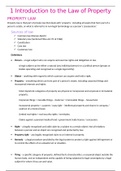
1 Introduction to the Law of Property
PROPERTY LAW
Property law is that part of private law that deals with ‘property’, including all assets that form part of a
person’s estate, or what is referred to in non-legal terminology as a person’s ‘possessions’.
Sources of law
Common law (Roman-Dutch)
Statutory law (Sectional Titles Act 95 of 1986)
Constitution
Case law
Customary law
Definitions
Person – a legal subject who can acquire and exercise rights and obligations in law.
A legal subject can be either a natural (any individual person) or a juridical person (groups or
bodies operating and recognised as a single legal entity).
Object – anything with regard to which a person can acquire and hold a right.
Property – everything which can form part of a person’s estate, including corporeal things and
incorporeal interests and rights.
Most important categories of property are physical or incorporeal and corporeal or immaterial
property.
Corporeal things = movable things – book/car = immovable things – house/land.
Incorporeal property = a patent / copy right – intellectual property and shares in company /
usufruct of a mineral lease.
Limited real rights = real security rights / servitudes.
Claims against a pension/medical fund / government trade license / concession.
Right – a legally recognised and valid claim by a subject to a certain object. Not all relations
between a person and an object are recognised and protected by law.
Property right – any legally recognised claim to or interest in property.
Remedy – a legal procedure provided by the legal system to protect a right against infringement or
to control the effects of an unlawful act or situation.
Thing – a specific category of property, defined by its characteristics; a corporeal object outside the
human body, and an independent entity capable of being subjected to legal sovereignty by a legal
subject for whom it has use and value.
, Corporeal things are defined as independent parts of nature which can be controlled by
humans and which have some use or value for humans.
Incorporeal things are recognised as legal objects.
Claim or action is lawful: when it is acknowledged and protected by existing legal principals;
unlawful when it is in conflict with or not acknowledged by the law.
2 Things As Legal Objects
PROPERTY LAW
Property law is that part of private law that deals with ‘property’, including all assets that form part of a
person’s estate, or what is referred to in non-legal terminology as a person’s ‘possessions’.
Sources of law
Common law (Roman-Dutch)
Statutory law (Sectional Titles Act 95 of 1986)
Constitution
Case law
Customary law
Definitions
Person – a legal subject who can acquire and exercise rights and obligations in law.
A legal subject can be either a natural (any individual person) or a juridical person (groups or
bodies operating and recognised as a single legal entity).
Object – anything with regard to which a person can acquire and hold a right.
Property – everything which can form part of a person’s estate, including corporeal things and
incorporeal interests and rights.
Most important categories of property are physical or incorporeal and corporeal or immaterial
property.
Corporeal things = movable things – book/car = immovable things – house/land.
Incorporeal property = a patent / copy right – intellectual property and shares in company /
usufruct of a mineral lease.
Limited real rights = real security rights / servitudes.
Claims against a pension/medical fund / government trade license / concession.
Right – a legally recognised and valid claim by a subject to a certain object. Not all relations
between a person and an object are recognised and protected by law.
Property right – any legally recognised claim to or interest in property.
Remedy – a legal procedure provided by the legal system to protect a right against infringement or
to control the effects of an unlawful act or situation.
Thing – a specific category of property, defined by its characteristics; a corporeal object outside the
human body, and an independent entity capable of being subjected to legal sovereignty by a legal
subject for whom it has use and value.
, Corporeal things are defined as independent parts of nature which can be controlled by
humans and which have some use or value for humans.
Incorporeal things are recognised as legal objects.
Claim or action is lawful: when it is acknowledged and protected by existing legal principals;
unlawful when it is in conflict with or not acknowledged by the law.
2 Things As Legal Objects