14 PROTECTION OF POSSESSION AND
HOLDERSHIP
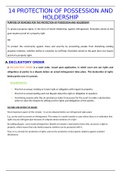
PURPOSE OF REMEDIES FOR THE PROTECTION OF POSSESSION AND HOLDERSHIP
To protect property rights, in the form of lawful Holdership, against infringement. Remedies aimed at this
goal requires proof of a property right
OR
To protect the community against chaos and anarchy by preventing people from disturbing existing
property relations, whether lawful or unlawful, by self-help. Remedies aimed at this goal does not require
proof of a property right.
A.DECLRATORY ORDER
A DECLARATORY ORDER is a court order, issued upon application, in which court sets out rights and
obligations of parties to a dispute before an actual infringement takes place. This declaration of rights
binds parties once it is proven.
REQUIREMENTS:
Proof of an actual, existing or future right or obligation with regard to property.
Proof of an actual existing and real dispute about the right or obligation in question.
Convincing reasons why the circumstances make it necessary for the court to make a declaratory
order to solve the dispute by setting out the rights and obligations of the parties.
NATURE AND EXTENT OF RELIEF:
Most important aspect of this remedy - it can be obtained before an infringement takes place
E.g. can be used to prevent an infringement. This makes it a useful remedy in cases where there is an indication that
rights may be infringed upon because of a dispute about existence of a right.
By settling dispute, court avoids infringement. Benefit of remedy is restricted to those who can prove a right to
property, which means that only lawful property relations can be protected with it.
Thus, it is a remedy for protection of rights, and not for protection of all property relations against unlawful
disturbance.
, B.INTERDICT
An INTERDICT is a summary court order, usually issued upon urgent application, by which a person is
ordered to either do something, stop doing something or refrain from doing anything, in order to stop or
prevent an infringement of property rights.
It is usually given at short notice and sets out the rights of the parties but also orders one of the parties to do or
refrain from ding something or either to stop an ongoing infringement or to prevent an imminent infringement.
REQUIREMENTS (Setlogelo v Setlogelo):
Proof of a clear right with regard to property.
Proof that the respondent infringes upon the right unlawfully and in an ongoing and continuing way, or that
there is a reasonable expectation that such infringement will occur in the future; and that it will cause the
applicant damage.
Reasons why there is no other effective remedy available to the applicant.
NATURE AND EXTENT OF RELIEF:
Interdict is meant to protect property rights against infringement (A right must be proved)
Used only by lawful controllers of property, who can prove a right to property.
Interdict is used either to stop ongoing infringements upon property rights, or to prevent imminent infringements
from taking place.
It cannot be used to do anything about infringements that have been completed – they have to be addressed by
means of other remedies.
Fact that interdict is a remedy of last resort does not mean that applicant must wait for infringement to take place
and damage to result from it if she can obtain a remedy to rectify damage – interdict can and should be used to
prevent or stop infringement if possible.
No other effective remedy must be able to do same, if so interdict will not be available.
If refusal of application for an interdict would amount to judicial condonation of illegal acts, interdict should also be
granted.
Candid Electronics v Merchandise Buying Syndicate:
Applicant borrowed money from respondent and pledged a large number of video cassette recorders (VCRs) with
respondent as security.
Idea was that applicant would repay debt and retrieve VCRs in due course.
However, soon afterwards, applicant discovered that respondent was selling VCRs unlawfully and it (applicant)
applied for an interdict to prohibit sale of further VCRs.
Respondent argued that interdict should be denied because applicant could always use delictual action for damages
at a later stage to recover any damage that was caused.
Court rejected this argument, pointing out that interdict can and should be used to prevent damage from being
caused in 1st place.
Any other effective remedy should be able to do at least same.
HOLDERSHIP
PURPOSE OF REMEDIES FOR THE PROTECTION OF POSSESSION AND HOLDERSHIP
To protect property rights, in the form of lawful Holdership, against infringement. Remedies aimed at this
goal requires proof of a property right
OR
To protect the community against chaos and anarchy by preventing people from disturbing existing
property relations, whether lawful or unlawful, by self-help. Remedies aimed at this goal does not require
proof of a property right.
A.DECLRATORY ORDER
A DECLARATORY ORDER is a court order, issued upon application, in which court sets out rights and
obligations of parties to a dispute before an actual infringement takes place. This declaration of rights
binds parties once it is proven.
REQUIREMENTS:
Proof of an actual, existing or future right or obligation with regard to property.
Proof of an actual existing and real dispute about the right or obligation in question.
Convincing reasons why the circumstances make it necessary for the court to make a declaratory
order to solve the dispute by setting out the rights and obligations of the parties.
NATURE AND EXTENT OF RELIEF:
Most important aspect of this remedy - it can be obtained before an infringement takes place
E.g. can be used to prevent an infringement. This makes it a useful remedy in cases where there is an indication that
rights may be infringed upon because of a dispute about existence of a right.
By settling dispute, court avoids infringement. Benefit of remedy is restricted to those who can prove a right to
property, which means that only lawful property relations can be protected with it.
Thus, it is a remedy for protection of rights, and not for protection of all property relations against unlawful
disturbance.
, B.INTERDICT
An INTERDICT is a summary court order, usually issued upon urgent application, by which a person is
ordered to either do something, stop doing something or refrain from doing anything, in order to stop or
prevent an infringement of property rights.
It is usually given at short notice and sets out the rights of the parties but also orders one of the parties to do or
refrain from ding something or either to stop an ongoing infringement or to prevent an imminent infringement.
REQUIREMENTS (Setlogelo v Setlogelo):
Proof of a clear right with regard to property.
Proof that the respondent infringes upon the right unlawfully and in an ongoing and continuing way, or that
there is a reasonable expectation that such infringement will occur in the future; and that it will cause the
applicant damage.
Reasons why there is no other effective remedy available to the applicant.
NATURE AND EXTENT OF RELIEF:
Interdict is meant to protect property rights against infringement (A right must be proved)
Used only by lawful controllers of property, who can prove a right to property.
Interdict is used either to stop ongoing infringements upon property rights, or to prevent imminent infringements
from taking place.
It cannot be used to do anything about infringements that have been completed – they have to be addressed by
means of other remedies.
Fact that interdict is a remedy of last resort does not mean that applicant must wait for infringement to take place
and damage to result from it if she can obtain a remedy to rectify damage – interdict can and should be used to
prevent or stop infringement if possible.
No other effective remedy must be able to do same, if so interdict will not be available.
If refusal of application for an interdict would amount to judicial condonation of illegal acts, interdict should also be
granted.
Candid Electronics v Merchandise Buying Syndicate:
Applicant borrowed money from respondent and pledged a large number of video cassette recorders (VCRs) with
respondent as security.
Idea was that applicant would repay debt and retrieve VCRs in due course.
However, soon afterwards, applicant discovered that respondent was selling VCRs unlawfully and it (applicant)
applied for an interdict to prohibit sale of further VCRs.
Respondent argued that interdict should be denied because applicant could always use delictual action for damages
at a later stage to recover any damage that was caused.
Court rejected this argument, pointing out that interdict can and should be used to prevent damage from being
caused in 1st place.
Any other effective remedy should be able to do at least same.