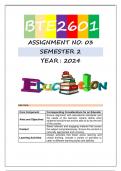
BTE2601
ASSIGNMENT NO: 03
SEMESTER 2
YEAR : 2024
PREVIEW:
Core Component Corresponding Considerations for an Educator
Ensure alignment with educational standards and
the needs of the learners. Clearly define what
Aims and Objectives
students should know and be able to do by the end
of the course.
Select relevant and engaging material that covers
Content the subject comprehensively. Ensure the content is
culturally appropriate and inclusive.
Design activities that foster active learning and
Learning Activities critical thinking. Include a variety of activities to
cater to different learning styles and abilities.
, QUESTION 1
Core Component Corresponding Considerations for an Educator
Ensure alignment with educational standards and
the needs of the learners. Clearly define what
Aims and Objectives
students should know and be able to do by the end
of the course.
Select relevant and engaging material that covers
Content the subject comprehensively. Ensure the content is
culturally appropriate and inclusive.
Design activities that foster active learning and
Learning Activities critical thinking. Include a variety of activities to
cater to different learning styles and abilities.
Develop fair and transparent assessment methods
that accurately measure student understanding and
Assessment Methods
progress. Use formative and summative
assessments appropriately.
Choose resources that are accessible and enhance
Resources and
learning. Consider the availability and cost of
Materials
materials, and incorporate technology effectively.
Plan a realistic timeline for covering the curriculum.
Time Allocation Ensure sufficient time for each topic, balancing
depth and breadth of coverage.
Implement strategies to address diverse learning
Differentiation needs. Provide support for struggling students and
challenge for advanced learners.
Establish mechanisms for regular feedback from
Evaluation and students and other stakeholders. Use feedback to
Feedback continuously improve the curriculum and teaching
practices.
QUESTION 2
2.1 Formative assessments are ongoing evaluations during the learning
process, providing feedback to teachers and students about student progress
and understanding. They help identify areas where students need additional
support or remediation and inform instruction to improve student learning. On
the other hand, summative assessments occur at the end of a lesson, unit, or
course and are used to evaluate student learning at a particular time. They are
often high-stakes, such as final exams or projects, and are used to determine
whether students have met learning goals or standards.
Formative and summative assessments contribute to the overall assessment
process by providing a comprehensive picture of student learning. Formative
assessments help teachers adjust instruction to meet student needs, while
summative assessments provide a snapshot of student achievement at a
particular time. By using both types of assessments, teachers can better
understand student learning and make informed decisions about instruction.
ASSIGNMENT NO: 03
SEMESTER 2
YEAR : 2024
PREVIEW:
Core Component Corresponding Considerations for an Educator
Ensure alignment with educational standards and
the needs of the learners. Clearly define what
Aims and Objectives
students should know and be able to do by the end
of the course.
Select relevant and engaging material that covers
Content the subject comprehensively. Ensure the content is
culturally appropriate and inclusive.
Design activities that foster active learning and
Learning Activities critical thinking. Include a variety of activities to
cater to different learning styles and abilities.
, QUESTION 1
Core Component Corresponding Considerations for an Educator
Ensure alignment with educational standards and
the needs of the learners. Clearly define what
Aims and Objectives
students should know and be able to do by the end
of the course.
Select relevant and engaging material that covers
Content the subject comprehensively. Ensure the content is
culturally appropriate and inclusive.
Design activities that foster active learning and
Learning Activities critical thinking. Include a variety of activities to
cater to different learning styles and abilities.
Develop fair and transparent assessment methods
that accurately measure student understanding and
Assessment Methods
progress. Use formative and summative
assessments appropriately.
Choose resources that are accessible and enhance
Resources and
learning. Consider the availability and cost of
Materials
materials, and incorporate technology effectively.
Plan a realistic timeline for covering the curriculum.
Time Allocation Ensure sufficient time for each topic, balancing
depth and breadth of coverage.
Implement strategies to address diverse learning
Differentiation needs. Provide support for struggling students and
challenge for advanced learners.
Establish mechanisms for regular feedback from
Evaluation and students and other stakeholders. Use feedback to
Feedback continuously improve the curriculum and teaching
practices.
QUESTION 2
2.1 Formative assessments are ongoing evaluations during the learning
process, providing feedback to teachers and students about student progress
and understanding. They help identify areas where students need additional
support or remediation and inform instruction to improve student learning. On
the other hand, summative assessments occur at the end of a lesson, unit, or
course and are used to evaluate student learning at a particular time. They are
often high-stakes, such as final exams or projects, and are used to determine
whether students have met learning goals or standards.
Formative and summative assessments contribute to the overall assessment
process by providing a comprehensive picture of student learning. Formative
assessments help teachers adjust instruction to meet student needs, while
summative assessments provide a snapshot of student achievement at a
particular time. By using both types of assessments, teachers can better
understand student learning and make informed decisions about instruction.