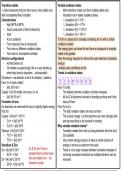
Transition metals Variable oxidation states
= d-block elements that can form one or more stable ions - Most transition metals can form multiple stable ions
with incompletely filled d-orbitals - Vanadium has 4 stable oxidation states
Characteristics ⤷ Vanadium (II) = V^2+
- High MPTs & BPTs ⤷ Vanadium (III) = V^3+
- Good conductors of heat & electricity ⤷ Vanadium (IV) = VO^2+
- Hard ⤷ Vanadium (V) = VO2^+
- Act as catalysts To form a compound or complex containing an ion with a certain
- Form coloured ions & compounds oxidation number:
- Form ions w/ different oxidation states The energy given out when the ion forms a compound or complex
- Form ions w/ incomplete d-orbitals needs to be greater
Electron configurations Than the energy required to remove the outer electrons (ionisation
- 4s filled before 3d energy)
- 3d orbitals occupied singly, the e-’s only double up - entropy also contributes to this
when they have to (repulsion ∴ unfavourable) Trends in oxidation states
Chromium = one electron in 4s & 3d orbitals (↑ stable to
have 1e- in each orbital)
- [Ar] 3d^5 4s^1 From Ti to Mn:
Copper = full 3d orbital, only one e- in 4s - The highest common oxidation number increases
- [Ar] 3d^10 4s^1 - All 4s & 3d electrons involved in bonding as there aren't that
Formation of ions many of them
(4s electrons are removed first due to slightly higher energy From Fe to Cu:
that 3d) - The high oxidation states are less common
Copper = [Ar] 4s^1 3d^10 - The nuclear charge ↑ so the electrons are more strongly held
- Cu^+ = [Ar] 3d^10 and are less likely to be involved in bonding
- Cu^2+ = [Ar] 3d^9 Why variable oxidation states?
Titanium = [Ar] 4s^2 3d^2 - Transition metals form ions by losing electrons from the 4s &
- Ti^2+ = [Ar] 3d^2 3d subshells
- Ti^3+ = [Ar] 3d^1 - Very similar energy levels so it takes a similar amount of
Scandium & Zinc energy to remove an electron from each
Sc = [Ar] 4s^2 3d^1 Sc & Zn don’t have a - There is not a large increase between ionisation energies of
- Sc^3+ = [Ar] partially filled d-orbital when removing successive electrons so multiple electrons can be
Zn = [Ar] 4s^2 3d^10 they are stable ions ∴ not removed
- Zn^2+ = [Ar] 3d^10 transition metals
, Complex ions Complex ions - charge
= metal ions surrounded by dative covalent bonded ligands - The overall charge on the complex ion is its oxidation number
Ligand = an atom, ion or molecule that donates a pair of - Written outside the square brackets
electrons to a central metal atom or ion. A ligand must have - Can be used to work out the oxidation state of the metal
at least one lone pair of electrons (to form a dative covalent - Oxidation number of metal = total - sum of ligands
bond) [Fe(H2O)6]^2+ Fe = 2+
- Monodentate
No charge
= one lone pair of electrons [Fe(CN)6]^4- Fe = 2+
⤷NoHcharge
2O (can 2 lone pairs but can only form 1) Number of ligands
⤷ :NH3, :Cl-, :OH-, :CN- Coordination number = number of dative covalent (coordinate)
- Bidentate = two lone pairs No charge bonds formed with the central metal ion
⤷ 1,2-diaminoethane (NH2CH2CH2NH2) - Usually 4 - 6
- Multidentate = more than two lone pairs - Small ligands (e.g. H2O & OH-) = 6 can fit around central
⤷ EDTA^4- (six lone pairs) metal ion
⤷ COO- (4 lone pairs) - Large ligands (e.g. Cl-) = only 4 can fit around the central
Ligand Formula Charge Name in complex
metal ion
- Ligands do not have to be the same
Water HO
2 0 Aqua - The bonding electrons in the dative covalent bonds repel
each other, therefore the ligands need to be as far away from
Hydroxide OH- -1 Hydroxo
each other as possible (min repulsion, max separation)
Ammonia NH 3 0 Ammine - Causes complexes with different coordination numbers to
have different shapes
Chlorine Cl- -1 Chloro Coordination number 6 (6 fold coordination)
Shape = octahedral
Fluorine F- -1 Fluoro
Bond angle = 90°
Cyanide CN- -1 Cyano Examples = [Fe(H2O)6]^2+ [Fe(H2O)6]^3+ [Cu(H2O)6]^2+
[Co(NH3)6]^3+
Naming complexes Hexa = 6
1. Number of ligands →→→→→→→→→→→→→→ Tetra = 4
2. Name of ligand Tri = 3
- If two different ligands, do in alphabetical order Di = 2
1. Name of the metal ion Mono = 1
- Metal ion becomes ‘ate’ if it’s part of a -vely charged
complex
- Iron → ferrate when -ve
- Copper → cuprate when -ve
= d-block elements that can form one or more stable ions - Most transition metals can form multiple stable ions
with incompletely filled d-orbitals - Vanadium has 4 stable oxidation states
Characteristics ⤷ Vanadium (II) = V^2+
- High MPTs & BPTs ⤷ Vanadium (III) = V^3+
- Good conductors of heat & electricity ⤷ Vanadium (IV) = VO^2+
- Hard ⤷ Vanadium (V) = VO2^+
- Act as catalysts To form a compound or complex containing an ion with a certain
- Form coloured ions & compounds oxidation number:
- Form ions w/ different oxidation states The energy given out when the ion forms a compound or complex
- Form ions w/ incomplete d-orbitals needs to be greater
Electron configurations Than the energy required to remove the outer electrons (ionisation
- 4s filled before 3d energy)
- 3d orbitals occupied singly, the e-’s only double up - entropy also contributes to this
when they have to (repulsion ∴ unfavourable) Trends in oxidation states
Chromium = one electron in 4s & 3d orbitals (↑ stable to
have 1e- in each orbital)
- [Ar] 3d^5 4s^1 From Ti to Mn:
Copper = full 3d orbital, only one e- in 4s - The highest common oxidation number increases
- [Ar] 3d^10 4s^1 - All 4s & 3d electrons involved in bonding as there aren't that
Formation of ions many of them
(4s electrons are removed first due to slightly higher energy From Fe to Cu:
that 3d) - The high oxidation states are less common
Copper = [Ar] 4s^1 3d^10 - The nuclear charge ↑ so the electrons are more strongly held
- Cu^+ = [Ar] 3d^10 and are less likely to be involved in bonding
- Cu^2+ = [Ar] 3d^9 Why variable oxidation states?
Titanium = [Ar] 4s^2 3d^2 - Transition metals form ions by losing electrons from the 4s &
- Ti^2+ = [Ar] 3d^2 3d subshells
- Ti^3+ = [Ar] 3d^1 - Very similar energy levels so it takes a similar amount of
Scandium & Zinc energy to remove an electron from each
Sc = [Ar] 4s^2 3d^1 Sc & Zn don’t have a - There is not a large increase between ionisation energies of
- Sc^3+ = [Ar] partially filled d-orbital when removing successive electrons so multiple electrons can be
Zn = [Ar] 4s^2 3d^10 they are stable ions ∴ not removed
- Zn^2+ = [Ar] 3d^10 transition metals
, Complex ions Complex ions - charge
= metal ions surrounded by dative covalent bonded ligands - The overall charge on the complex ion is its oxidation number
Ligand = an atom, ion or molecule that donates a pair of - Written outside the square brackets
electrons to a central metal atom or ion. A ligand must have - Can be used to work out the oxidation state of the metal
at least one lone pair of electrons (to form a dative covalent - Oxidation number of metal = total - sum of ligands
bond) [Fe(H2O)6]^2+ Fe = 2+
- Monodentate
No charge
= one lone pair of electrons [Fe(CN)6]^4- Fe = 2+
⤷NoHcharge
2O (can 2 lone pairs but can only form 1) Number of ligands
⤷ :NH3, :Cl-, :OH-, :CN- Coordination number = number of dative covalent (coordinate)
- Bidentate = two lone pairs No charge bonds formed with the central metal ion
⤷ 1,2-diaminoethane (NH2CH2CH2NH2) - Usually 4 - 6
- Multidentate = more than two lone pairs - Small ligands (e.g. H2O & OH-) = 6 can fit around central
⤷ EDTA^4- (six lone pairs) metal ion
⤷ COO- (4 lone pairs) - Large ligands (e.g. Cl-) = only 4 can fit around the central
Ligand Formula Charge Name in complex
metal ion
- Ligands do not have to be the same
Water HO
2 0 Aqua - The bonding electrons in the dative covalent bonds repel
each other, therefore the ligands need to be as far away from
Hydroxide OH- -1 Hydroxo
each other as possible (min repulsion, max separation)
Ammonia NH 3 0 Ammine - Causes complexes with different coordination numbers to
have different shapes
Chlorine Cl- -1 Chloro Coordination number 6 (6 fold coordination)
Shape = octahedral
Fluorine F- -1 Fluoro
Bond angle = 90°
Cyanide CN- -1 Cyano Examples = [Fe(H2O)6]^2+ [Fe(H2O)6]^3+ [Cu(H2O)6]^2+
[Co(NH3)6]^3+
Naming complexes Hexa = 6
1. Number of ligands →→→→→→→→→→→→→→ Tetra = 4
2. Name of ligand Tri = 3
- If two different ligands, do in alphabetical order Di = 2
1. Name of the metal ion Mono = 1
- Metal ion becomes ‘ate’ if it’s part of a -vely charged
complex
- Iron → ferrate when -ve
- Copper → cuprate when -ve