Lecture 2 – Media Technologies
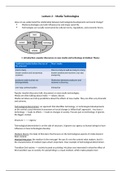
How can we understand the relationship between technological developments and social change?
Media technologies are both influences by and shape social life.
Technologies are socially constructed by cultural norms, regulations, and economic forces.
1. Introduction: popular discourses on new media and technology & Medium Theory
Popular (media) discourse (talk, discussion) on new media technologies.
Media are often talking about media --> robots, bitcoin.
Media narratives are full op predictions about the effects of new media. They are often very dramatic
and extreme.
Technological determinism: an approach that identifies technology, or technological developments
as the central causal element in processes of social change (a 'billiard ball' approach). You have a
technology --> leads to effects --> leads to changes in society. Focuses just on technology, it ignores
the bigger context.
Structure <-----> Agency
Technological determinism is on the side of structure, it ignores our agency as human beings to have
influence on how technologies develop.
Medium theory: the body of literature that focuses on the technological aspects of media beyond
their content.
Marshall McLuhan: the medium is the message! He says it's not the content what matters, but it's
the characteristics of medium types what's important. Clear example of technological determinism.
Transition Oral society --> society focused on printing. McLuhan was interested in what the effect of
this transition was on society. He said printing is a visual medium, which makes people more
, individualistic, more rationalistic, he said print let to a more rational society, it would create different
specialties and fragmentation.
He also focused on the transition of print media to electronic media. E.M. led to a retribalisation
New media technologies rework the balance of our senses
Print media: intensifies the visual
Electronic media (e.g. TV): reconnect the senses fragmented by print and a global extension
of our senses
It's impossible to test the theories of McLuhan --> criticism.
Media is the extension of parts of the human body/senses.
He tended to be positive about media.
2. Critical approaches
When there's a new technology being developed, concerns are emerging about the negative aspects.
A problem with many of these critical theories is that a lot of technological determinism is involved.
Pseudo-events (Daniel Boorstin): events planned for the express purpose of producing
(dramatic) images that can be disseminated or reported.
Red carpet event is being organised to get media attention. Boorstin was scared that it was getting
about the appearance in society. Example: presidents shaking hands. This is done for the media.
Pseudo-events are also used by social movements (climate change etc.). You want to create
something that will get some attention by the media. Boorstin is critical about what this is doing to
our society.
Hyperreality (Jean Baudrillard, 1988): blurring boundaries between the image and reality.
It's hard to distinct facts from fiction.
Example: opinion polls. People are being asked about their political preferences, which creates
statistics. In some countries opinion polls are forbidden on the day of the election. They are a
representation of people's opinion. The results of the poll are going to be a thing on itself. When you
hear someone is leading in the campaign, this could change your opinion.
Example: Disney land. You can visit castles, New Orleans, but it's a fake world.
Example: Las Vegas. There are monuments like the Eiffel Tower who are actually not together.
Example: reality TV. Media can blur the distinction between reality and fiction. It's actually often
scripted.
Neil Postman focused on television. He said TV would lead to a decline of the seriousness of
public life. It would all be about entertainment, would not focus on serious/political news.
Book: amusing ourselves to death.
Postman is talking about TV, but he sees how this development already started with the invention of
the telegraph. People started to communicate over a longer distance. Postman said that as a
consequence this would lead to irrelevant news. Because of this invention journalists can report
about events which are happening far away, which is not relevant for the people consuming the
news. People are reading about things, on which they don't have an influence --> powerlessness. He
also said that media are jumping from story to story. There's no connection between different stories
in the media --> sacrificing context.
3. Social constructionism
How can we understand the relationship between technological developments and social change?
Media technologies are both influences by and shape social life.
Technologies are socially constructed by cultural norms, regulations, and economic forces.
1. Introduction: popular discourses on new media and technology & Medium Theory
Popular (media) discourse (talk, discussion) on new media technologies.
Media are often talking about media --> robots, bitcoin.
Media narratives are full op predictions about the effects of new media. They are often very dramatic
and extreme.
Technological determinism: an approach that identifies technology, or technological developments
as the central causal element in processes of social change (a 'billiard ball' approach). You have a
technology --> leads to effects --> leads to changes in society. Focuses just on technology, it ignores
the bigger context.
Structure <-----> Agency
Technological determinism is on the side of structure, it ignores our agency as human beings to have
influence on how technologies develop.
Medium theory: the body of literature that focuses on the technological aspects of media beyond
their content.
Marshall McLuhan: the medium is the message! He says it's not the content what matters, but it's
the characteristics of medium types what's important. Clear example of technological determinism.
Transition Oral society --> society focused on printing. McLuhan was interested in what the effect of
this transition was on society. He said printing is a visual medium, which makes people more
, individualistic, more rationalistic, he said print let to a more rational society, it would create different
specialties and fragmentation.
He also focused on the transition of print media to electronic media. E.M. led to a retribalisation
New media technologies rework the balance of our senses
Print media: intensifies the visual
Electronic media (e.g. TV): reconnect the senses fragmented by print and a global extension
of our senses
It's impossible to test the theories of McLuhan --> criticism.
Media is the extension of parts of the human body/senses.
He tended to be positive about media.
2. Critical approaches
When there's a new technology being developed, concerns are emerging about the negative aspects.
A problem with many of these critical theories is that a lot of technological determinism is involved.
Pseudo-events (Daniel Boorstin): events planned for the express purpose of producing
(dramatic) images that can be disseminated or reported.
Red carpet event is being organised to get media attention. Boorstin was scared that it was getting
about the appearance in society. Example: presidents shaking hands. This is done for the media.
Pseudo-events are also used by social movements (climate change etc.). You want to create
something that will get some attention by the media. Boorstin is critical about what this is doing to
our society.
Hyperreality (Jean Baudrillard, 1988): blurring boundaries between the image and reality.
It's hard to distinct facts from fiction.
Example: opinion polls. People are being asked about their political preferences, which creates
statistics. In some countries opinion polls are forbidden on the day of the election. They are a
representation of people's opinion. The results of the poll are going to be a thing on itself. When you
hear someone is leading in the campaign, this could change your opinion.
Example: Disney land. You can visit castles, New Orleans, but it's a fake world.
Example: Las Vegas. There are monuments like the Eiffel Tower who are actually not together.
Example: reality TV. Media can blur the distinction between reality and fiction. It's actually often
scripted.
Neil Postman focused on television. He said TV would lead to a decline of the seriousness of
public life. It would all be about entertainment, would not focus on serious/political news.
Book: amusing ourselves to death.
Postman is talking about TV, but he sees how this development already started with the invention of
the telegraph. People started to communicate over a longer distance. Postman said that as a
consequence this would lead to irrelevant news. Because of this invention journalists can report
about events which are happening far away, which is not relevant for the people consuming the
news. People are reading about things, on which they don't have an influence --> powerlessness. He
also said that media are jumping from story to story. There's no connection between different stories
in the media --> sacrificing context.
3. Social constructionism