100% satisfaction guarantee Immediately available after payment Both online and in PDF No strings attached 4.2 TrustPilot
logo-home
Exam (elaborations)

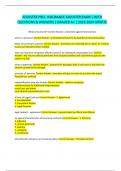
Basic Dysrhythmia-Relias questions and correct answers

Rating
-
Sold
-
Pages
5
Grade
A+
Uploaded on
31-07-2024
Written in
2023/2024

  normal sinus rhythm - Correct Answers:heart rhythm originating in the sinoatrial node with a rate in patients at rest of 60 to 100 beats per minute Sinus Arrhythmia - Correct Answers:Appearance is ALMOST NORMAL: Respiratory - Circulatory interaction Rate INCREASES with INSPIRATION (IN=IN) Sinus Bradycardia - Correct Answers:<60 normal sinus rhythm Sinus Tachycardia - Correct Answers:>100 (100-150) normal sinus rhythm Premature Atrial Contraction (PAC) - Correct Answers:Heart Rate: Depends on underlying rhythm Regularity: Interrupts the regularity of underlying rhythm P-Wave: can be flattened, notched, or unusual. May be hidden within the T wave PRI: measures between .12-.20 seconds and can be prolonged; can be different from other complexes QRS: <.12 seconds Sinus Arrest/Pause - Correct Answers:- SA node doesn't fire - notice absence of P-wave for a complete cycle (a missed cycle) length of pause ≠ multiple of normal rate (block) Atrial Fibrillation (A-Fib) - Correct Answers:an irregular and often very fast heart rate originating from abnormal conduction in the atria Atrial Flutter - Correct Answers:irregular beating of the atria; often described as "a-flutter with 2 to 1 block or 3 to 1 block" Junctional Rhythm - Correct Answers:40-60 Regular! -impulse from AV node w/ retro/antegrade transmission - P wave often inverted/buried/follow QRS - slow rate - narrow QRS (not wide like ventricular) Junctional Tachycardia - Correct Answers:>60 bpm (ms. K; 150-250) - KEY: will be regular (consistent) - AV junction produces a rapid sequence of QRS-T cycles - p-wave often inverted/buried/follow QRS Premature Junctional Contraction - Correct Answers:Inverted p wave or hidden p wave PRI<0.12 or none Normal QRS Supraventricular Tachycardia (SVT) - Correct Answers:an abnormal heart rhythm arising from aberrant electrical activity in the heart; originates at or above the AV node First degree heart block - Correct Answers:atrioventricular (AV) block in which the atrial electrical impulses are delayed by a fraction of a second before being conducted to the ventricles 2nd degree heart block type 1 (Wenkebach) - Correct Answers:Progressively longer PR interval until the P wave is not followed by a QPR 2nd Degree Heart Block (Mobitz II) - Correct Answers:Rare, but more serious Sudden appearance of a nonconducted P-wave P-waves are nl, but some aren't followed by a QRS complex PR & RR intervals are constant 3rd degree heart block - Correct Answers:no obvious correlation between p and qrs, need pace maker premature ventricular contraction (PVC) - Correct Answers:a ventricular contraction preceding the normal impulse initiated by the SA node (pacemaker) Bigeminy PVC - Correct Answers:every other beat is a PVC PVC couplets - Correct Answers:PVC occurring in pairs, no adequate C.O. when this occurs monomorphic ventricular tachycardia - Correct Answers:presents with wide QRS complexes of a common shape. Torsades de pointes - Correct Answers:Rate: 120 - 200 usually P wave: Obscured by ventricular waves QRS: Wide QRS - "Twisting of the Points" Conduction: Ventricular only Rhythm: Slightly irregular Ventricular fibrillation (V-fib) - Correct Answers:abnormal heart rhythm which results in quivering of ventricles Idioventricular Rhythm - Correct Answers:<40 *looks like vtach but slow* - no P waves (from vent foci) - Wide QRS (serious, death like rhythm) - called "dying heart" rhythm...occasional ventric beat b4 death (asystole) Accelerated Idioventricular Rhythm - Correct Answers:Rate: 50 - 100 usually (usually slow) P wave: Obscured by ventricular waves (occur during ventricular contraction) - SA node slower than faster ventricular pacing than should be QRS: Wide QRS Conduction: Ventricular only Rhythm: Regular - benign rhythm that is sometimes seen during acute MI or early after reperfusion. - Rarely sustained, does not progress to vfib, rarely requires treatment asystole - Correct Answers:absence of contractions of the heart Failure to capture (pacemaker) - Correct Answers: failure to sense (pacemaker) - Correct Answers: Atrial paced rhythm - Correct Answers:spike before P wave Ventricular paced rhythm - Correct Answers:ventricular contractions which occur in cases of complete heart block.

Show more Read less
Institution
Course


Whoops! We can’t load your doc right now. Try again or contact support.

Written for

Course

Document information

Uploaded on
July 31, 2024
Number of pages
5
Written in
2023/2024
Type
Exam (elaborations)
Contains
Questions & answers

Subjects

Content preview

Basic Dysrhythmia-Relias questions and
correct answers


ADMIN
[COMPANY NAME] [Company address]

, normal sinus rhythm - Correct Answers:heart rhythm originating in the sinoatrial node with a rate in
patients at rest of 60 to 100 beats per minute


Sinus Arrhythmia - Correct Answers:Appearance is ALMOST NORMAL:

Respiratory - Circulatory interaction

Rate INCREASES with INSPIRATION (IN=IN)


Sinus Bradycardia - Correct Answers:<60

normal sinus rhythm


Sinus Tachycardia - Correct Answers:>100 (100-150)

normal sinus rhythm


Premature Atrial Contraction (PAC) - Correct Answers:Heart Rate: Depends on underlying rhythm

Regularity: Interrupts the regularity of underlying rhythm

P-Wave: can be flattened, notched, or unusual. May be hidden within the T wave

PRI: measures between .12-.20 seconds and can be prolonged; can be different from other complexes

QRS: <.12 seconds


Sinus Arrest/Pause - Correct Answers:- SA node doesn't fire

- notice absence of P-wave for a complete cycle (a missed cycle)

length of pause ≠ multiple of normal rate (block)


Atrial Fibrillation (A-Fib) - Correct Answers:an irregular and often very fast heart rate originating from
abnormal conduction in the atria


Atrial Flutter - Correct Answers:irregular beating of the atria; often described as "a-flutter with 2 to 1
block or 3 to 1 block"


Junctional Rhythm - Correct Answers:40-60 Regular!
R129,45
Get access to the full document:

100% satisfaction guarantee
Immediately available after payment
Both online and in PDF
No strings attached

Get to know the seller
Seller avatar
assignmenthandlers

Get to know the seller

Seller avatar
assignmenthandlers (self)
Follow You need to be logged in order to follow users or courses
Sold
0
Member since
2 year
Number of followers
0
Documents
155
Last sold
-

0,0

0 reviews

5
0
4
0
3
0
2
0
1
0

Recently viewed by you

Why students choose Stuvia

Created by fellow students, verified by reviews

Quality you can trust: written by students who passed their exams and reviewed by others who've used these notes.

Didn't get what you expected? Choose another document

No worries! You can immediately select a different document that better matches what you need.

Pay how you prefer, start learning right away

No subscription, no commitments. Pay the way you're used to via credit card or EFT and download your PDF document instantly.

Student with book image

“Bought, downloaded, and aced it. It really can be that simple.”

Alisha Student

Frequently asked questions