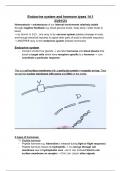
Endocrine system and hormone types 14.1
23/01/23
Homeostasis = maintenance of our internal environment relatively stable
through negative feedback e.g. blood glucose levels / body temp / water levels in
blood
→ as learnt in b13 , one way is by nervous system p(detect changes in body
and through electrical impulses to signal other parts of body to stimulate response)
→ ANOTHER way is the endocrine system (release hormones)
Endocrine system
- Contain endocrine glands → secrete hormones into blood plasma that
travel to target cells which have receptors specific to a hormone → can
coordinate a particular response
This is a cell surface membrane with a particular protein + receptor on top. Then
we got the nuclear membrane with pores and DNA on the inside.
2 types of hormones:
1) Peptide hormone
- Peptide hormone e.g. Adrenaline ( released during fight or flight response)
- Peptide hormone means its hydrophilic → so cant go through cell
membrane due to hydrophobic core →so it can instead bind to cell
surface membrane on receptor → this can cause other signals
,- So peptide hormone is the first messenger
- The protein below the receptor is called adenyl cyclase which is an enzyme
( so through the binding of the hormone , it can activate AC which can turn
ATP into Cyclic AMP (cAMP)
- cAMP can then go create an enzyme cascade for reaction (enzyme
cascade refers to a series of diff enzymes being activated one after the
other e.g. cAMP can go to activate protein kinase which is activated to
activate another anyme and keeps going until the actual enzyme they want
to activated to do the reaction they want. an example of a reaction is
turning glycogen → glucose for respiration to occur)
2) Steroid hormone
- e.g. oestrogen
- They are lipid soluble / lipid based
- So they can simply diffuse across membrane → and enter cell
- Here the receptor exists within the cell in the cytoplasm (e.g. steroid
hormone receptor)
- When steroid hormone receptor bind to oestrogen → they can do
various functions → this is a hormone receptor complex
- In the case of oestrogen , they can pass through the nuclear membrane
and become a transcription factor (so they can up/down regulate
transcription of DNA)
, Structure and function of the adrenal gland
- It is found on top of the kidney
(had 2 parts)
Adrenal cortex
- Adrenal cortex (outer layer of gland) mainly gets signalled or controlled by
hormones that are sent from the pg (pg releases hormones to signal the
adrenal cortex to release more hormones) (pg is a master gland as can
produce hormones of its own and produce hormones to have secondary
effects on other endocrine glands)
- Adrenal cortex releases 3 types of steroid hormones (lipid soluble):
1) Glucocorticoids = cortisol regulates glucose + protein metabolism
+ BP. another example of this is corticosterone which regulate
immune response and suppress inflammatory response
2) Mineralocorticoids = maintain salt concentration to control bp
e.g. aldosterone
3) Androgens = sex hormone with little effect
23/01/23
Homeostasis = maintenance of our internal environment relatively stable
through negative feedback e.g. blood glucose levels / body temp / water levels in
blood
→ as learnt in b13 , one way is by nervous system p(detect changes in body
and through electrical impulses to signal other parts of body to stimulate response)
→ ANOTHER way is the endocrine system (release hormones)
Endocrine system
- Contain endocrine glands → secrete hormones into blood plasma that
travel to target cells which have receptors specific to a hormone → can
coordinate a particular response
This is a cell surface membrane with a particular protein + receptor on top. Then
we got the nuclear membrane with pores and DNA on the inside.
2 types of hormones:
1) Peptide hormone
- Peptide hormone e.g. Adrenaline ( released during fight or flight response)
- Peptide hormone means its hydrophilic → so cant go through cell
membrane due to hydrophobic core →so it can instead bind to cell
surface membrane on receptor → this can cause other signals
,- So peptide hormone is the first messenger
- The protein below the receptor is called adenyl cyclase which is an enzyme
( so through the binding of the hormone , it can activate AC which can turn
ATP into Cyclic AMP (cAMP)
- cAMP can then go create an enzyme cascade for reaction (enzyme
cascade refers to a series of diff enzymes being activated one after the
other e.g. cAMP can go to activate protein kinase which is activated to
activate another anyme and keeps going until the actual enzyme they want
to activated to do the reaction they want. an example of a reaction is
turning glycogen → glucose for respiration to occur)
2) Steroid hormone
- e.g. oestrogen
- They are lipid soluble / lipid based
- So they can simply diffuse across membrane → and enter cell
- Here the receptor exists within the cell in the cytoplasm (e.g. steroid
hormone receptor)
- When steroid hormone receptor bind to oestrogen → they can do
various functions → this is a hormone receptor complex
- In the case of oestrogen , they can pass through the nuclear membrane
and become a transcription factor (so they can up/down regulate
transcription of DNA)
, Structure and function of the adrenal gland
- It is found on top of the kidney
(had 2 parts)
Adrenal cortex
- Adrenal cortex (outer layer of gland) mainly gets signalled or controlled by
hormones that are sent from the pg (pg releases hormones to signal the
adrenal cortex to release more hormones) (pg is a master gland as can
produce hormones of its own and produce hormones to have secondary
effects on other endocrine glands)
- Adrenal cortex releases 3 types of steroid hormones (lipid soluble):
1) Glucocorticoids = cortisol regulates glucose + protein metabolism
+ BP. another example of this is corticosterone which regulate
immune response and suppress inflammatory response
2) Mineralocorticoids = maintain salt concentration to control bp
e.g. aldosterone
3) Androgens = sex hormone with little effect