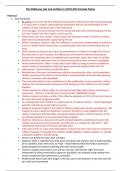
Mrs Dalloway (set and written in 1923) AO3 Context Notes
Historical
1. First World War
BL Article: shows how the First World War continued to affect those who had lived through
it (5 years after it ended), unprecedented devastation still raw and ineradicable for the
relatives, friends and loved ones of the unreturned
Time and again, the novel reveals how the myriad anxieties and overwhelming grief of the
war were etched into every aspect of post-war life
Planes that hover over London create unease and ominously brings to mind the German
planes that had attacked the capital during the war
While it is obvious, however, that Mrs Dalloway is an eloquent condemnation of militarism
and war, Woolf's fourth novel is also a commemorative text which memorialises the war
dead
Every element of the post-war culture of remembrance is evoked or brought into focus in
the novel and, on each occasion, the official sites and rituals of national mourning are
treated with something akin to straightforward veneration, rather than satire or hostility
Moments of silent observance that are almost ceremonial in their reverence and dignity
Novel commemorates ‘fallen’ in ways which seem either to bring to mind or parallel the
various rituals of remembrance which the government had instituted after the ToV
Fallen leaves = ancient literary symbol for dead
Remembrance Day does not emphasise collective mourning but rather social integration -
Woolf’s purpose at this point in a novel which is more generally concerned with exposing
divisions, exclusions and inequalities
The novel also makes its own contributions to the proliferation of war memorials, military
statuary and commemorative monuments that sprang up in the 1920s across the United
Kingdom
Clarissa spends her solitary nights in a narrow bed with tight white sheets restricting her
movement – almost as if she has been trussed up like a battlefield casualty
Clarissa is almost certainly a victim of the influenza pandemic of 1918–20, but she is also to
be one of the novel’s lingering wraiths
Her meeting with Peter Walsh has a suppressed air of violence about it – Peter fingering his
penknife and Clarissa armed with her scissors
Septimus and Evans fought in the battle of Vittorio Veneto where Evans was blown up - the
tragedy of Evans’s death and Septimus’s torment, therefore, is only heightened by the
reader’s awareness that this battle was almost wholly pointless, with the outcome of the
war already decided (as it was days before the armistice)
Septimus’ distress was also due to his grief and guilt about his powerful and homoerotic
feelings towards Evans (homosexuality was still seen as a criminal act until 1967) – their
relationship reflects that off Clarissa and Sally Seton
Take note of how so many of the descriptions of day-to-day life in the novel are couched in
military language or language that could be readily applied to military exploits e.g. ‘plunge’
anticipates Septimus’ suicidal plunge
Novel is set barely five years after armistice
Septimus Smith is suffering from shell shock and deals with society’s lack of understanding
of his condition (now referred to as PTSD) – Woolf believed that the medical profession
lacked empathy for patients suffering with their mental health
Clarissa is largely untouched by war but has seen her male friends suffer from poor
treatments for being conscientious objectors (pacifists), her husband being exempt from
service would have been perceived as cowardice
Woolf herself knew many who fought in the war such as her brothers-in-law who were hit
by a shell and traumatised
, She was also close to other veterans of WW1, Ralph Partridge and Gerald Brenan, who may
have served for inspiration for Septimus’ character, she wrote letters to Brenan to provide
comfort (could be reflected by novel’s exploration of the connection between Clarissa and
Spetimus)
Woolf’s novel sees every character in dialogue with their personal and national pasts – only
Septimus deals with traumatic memories and repressed emotions – this connectedness is
part of the novel’s extension of empathy
2. Spanish Flu Epidemic 1918-1919
Estimates vary, but it is thought that the pandemic killed 228, 917 Britons and well over
twenty million people worldwide.
Clarissa has just recovered from an illness which is almost certainly Spanish Flu. She and
Septimus, then, are both survivors (another link between the two characters). Her tentative
but enthusiastic re-entry into life at the start of the novel account for the reader's feeling of
vibrancy and alertness in the language.
3. Society
George V is king from 1910-1936 during this novel
The Summer Time Act 1916 introduced Daylight saving time (where clocks are moved
forward for the longer summer days to give more daylight hours)
Big Ben was first heard on the radio on New Year’s Eve 1923. The chimes of Big Ben are
heard throughout the novel and are used to structure the book into its 12 sections. The
working title for the novel was ‘The Hours’
First use of skywriting for advertising purposes was recorded in Derby in 1922. In the novel,
the ‘ominous’ overhead engine reminds Londoners of the recent risks posed by wartime air
raids
Suggesting of softening of rigid class definitions – Peter Walsh observing women wearing
makeup, Clarissa buying her own flowers and staying in an attic (usually reserved for
servants)
These new aspects of society are contrasted in the novel’s flashbacks where Sally Seton’s
behaviour was met with astonishment and disapproval at (Victorian era) Bourton. Indeed,
Sally can be read as a prototypical 'New Woman' in these scenes (a figure associated with
first wave feminism in the late 19th century)
Mrs Dalloway celebrates the new freedom enjoyed by women in being able to explore the
streets alone (or ride an omnibus). When Woolf was young, she had to accompany her sister
on visits to London as it was considered improper for a young woman of her social class to
walk alone in the city
4. Interwar Politics
In 1923 Stanley Baldwin was the newly elected Conservative PM, his appearance at
Clarissa’s party is met with some excitement
Baldwin, however, resigned in January 1924 and was replaced by the first Labour PM
Ramsay MacDonald (yet was later back in power the same year)
Richard Dalloway is a Conservative MP – mentions threat of an impending Labour
Government (Miss Kilman is certainly a character who might welcome this shift in political
power)
The Muslim Turks’ massacre of the Christian Armenians in 1915 (Turks drove out 2/3 of
Armenian population and 1 million Armenians were either killed or died of starvation –
prompted a great deal of debate in the British press about how to protect the Armenians)
might be considered the century’s first act of genocide. Earlier slaughters of the Armenians
had occurred in 1894-1896
Clarissa confuses her Armenians and her Turks, showing that she can be shockingly ignorant
of the matters of the world (and of her husband’s work)
5. Imperialism & Eugenics
Historical
1. First World War
BL Article: shows how the First World War continued to affect those who had lived through
it (5 years after it ended), unprecedented devastation still raw and ineradicable for the
relatives, friends and loved ones of the unreturned
Time and again, the novel reveals how the myriad anxieties and overwhelming grief of the
war were etched into every aspect of post-war life
Planes that hover over London create unease and ominously brings to mind the German
planes that had attacked the capital during the war
While it is obvious, however, that Mrs Dalloway is an eloquent condemnation of militarism
and war, Woolf's fourth novel is also a commemorative text which memorialises the war
dead
Every element of the post-war culture of remembrance is evoked or brought into focus in
the novel and, on each occasion, the official sites and rituals of national mourning are
treated with something akin to straightforward veneration, rather than satire or hostility
Moments of silent observance that are almost ceremonial in their reverence and dignity
Novel commemorates ‘fallen’ in ways which seem either to bring to mind or parallel the
various rituals of remembrance which the government had instituted after the ToV
Fallen leaves = ancient literary symbol for dead
Remembrance Day does not emphasise collective mourning but rather social integration -
Woolf’s purpose at this point in a novel which is more generally concerned with exposing
divisions, exclusions and inequalities
The novel also makes its own contributions to the proliferation of war memorials, military
statuary and commemorative monuments that sprang up in the 1920s across the United
Kingdom
Clarissa spends her solitary nights in a narrow bed with tight white sheets restricting her
movement – almost as if she has been trussed up like a battlefield casualty
Clarissa is almost certainly a victim of the influenza pandemic of 1918–20, but she is also to
be one of the novel’s lingering wraiths
Her meeting with Peter Walsh has a suppressed air of violence about it – Peter fingering his
penknife and Clarissa armed with her scissors
Septimus and Evans fought in the battle of Vittorio Veneto where Evans was blown up - the
tragedy of Evans’s death and Septimus’s torment, therefore, is only heightened by the
reader’s awareness that this battle was almost wholly pointless, with the outcome of the
war already decided (as it was days before the armistice)
Septimus’ distress was also due to his grief and guilt about his powerful and homoerotic
feelings towards Evans (homosexuality was still seen as a criminal act until 1967) – their
relationship reflects that off Clarissa and Sally Seton
Take note of how so many of the descriptions of day-to-day life in the novel are couched in
military language or language that could be readily applied to military exploits e.g. ‘plunge’
anticipates Septimus’ suicidal plunge
Novel is set barely five years after armistice
Septimus Smith is suffering from shell shock and deals with society’s lack of understanding
of his condition (now referred to as PTSD) – Woolf believed that the medical profession
lacked empathy for patients suffering with their mental health
Clarissa is largely untouched by war but has seen her male friends suffer from poor
treatments for being conscientious objectors (pacifists), her husband being exempt from
service would have been perceived as cowardice
Woolf herself knew many who fought in the war such as her brothers-in-law who were hit
by a shell and traumatised
, She was also close to other veterans of WW1, Ralph Partridge and Gerald Brenan, who may
have served for inspiration for Septimus’ character, she wrote letters to Brenan to provide
comfort (could be reflected by novel’s exploration of the connection between Clarissa and
Spetimus)
Woolf’s novel sees every character in dialogue with their personal and national pasts – only
Septimus deals with traumatic memories and repressed emotions – this connectedness is
part of the novel’s extension of empathy
2. Spanish Flu Epidemic 1918-1919
Estimates vary, but it is thought that the pandemic killed 228, 917 Britons and well over
twenty million people worldwide.
Clarissa has just recovered from an illness which is almost certainly Spanish Flu. She and
Septimus, then, are both survivors (another link between the two characters). Her tentative
but enthusiastic re-entry into life at the start of the novel account for the reader's feeling of
vibrancy and alertness in the language.
3. Society
George V is king from 1910-1936 during this novel
The Summer Time Act 1916 introduced Daylight saving time (where clocks are moved
forward for the longer summer days to give more daylight hours)
Big Ben was first heard on the radio on New Year’s Eve 1923. The chimes of Big Ben are
heard throughout the novel and are used to structure the book into its 12 sections. The
working title for the novel was ‘The Hours’
First use of skywriting for advertising purposes was recorded in Derby in 1922. In the novel,
the ‘ominous’ overhead engine reminds Londoners of the recent risks posed by wartime air
raids
Suggesting of softening of rigid class definitions – Peter Walsh observing women wearing
makeup, Clarissa buying her own flowers and staying in an attic (usually reserved for
servants)
These new aspects of society are contrasted in the novel’s flashbacks where Sally Seton’s
behaviour was met with astonishment and disapproval at (Victorian era) Bourton. Indeed,
Sally can be read as a prototypical 'New Woman' in these scenes (a figure associated with
first wave feminism in the late 19th century)
Mrs Dalloway celebrates the new freedom enjoyed by women in being able to explore the
streets alone (or ride an omnibus). When Woolf was young, she had to accompany her sister
on visits to London as it was considered improper for a young woman of her social class to
walk alone in the city
4. Interwar Politics
In 1923 Stanley Baldwin was the newly elected Conservative PM, his appearance at
Clarissa’s party is met with some excitement
Baldwin, however, resigned in January 1924 and was replaced by the first Labour PM
Ramsay MacDonald (yet was later back in power the same year)
Richard Dalloway is a Conservative MP – mentions threat of an impending Labour
Government (Miss Kilman is certainly a character who might welcome this shift in political
power)
The Muslim Turks’ massacre of the Christian Armenians in 1915 (Turks drove out 2/3 of
Armenian population and 1 million Armenians were either killed or died of starvation –
prompted a great deal of debate in the British press about how to protect the Armenians)
might be considered the century’s first act of genocide. Earlier slaughters of the Armenians
had occurred in 1894-1896
Clarissa confuses her Armenians and her Turks, showing that she can be shockingly ignorant
of the matters of the world (and of her husband’s work)
5. Imperialism & Eugenics