Exam (elaborations) .M22058 Course Code: 2410213
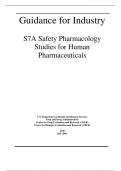
A. Objectives of the Guidance (1.1) This guidance was developed to help protect clinical trial participants and patients receiving marketed products from potential adverse effects of pharmaceuticals, while avoiding unnecessary use of animals and other resources. This guidance provides a definition, general principles, and recommendations for safety pharmacology studies. B. Background (1.2) Pharmacology studies have been performed worldwide for many years as part of the nonclinical evaluation of pharmaceuticals for human use. There have been, however, no internationally accepted definitions, objectives or recommendations on the design and conduct of safety pharmacology studies. (Note 1) The term safety pharmacology studies first appeared in ICH M3 Timing of Nonclinical Safety Studies for the Conduct of Human Clinical Trials for Pharmaceuticals and S6 Preclinical Safety Evaluation of Biotechnology-Derived Pharmaceuticals as studies that should be conducted to support use of therapeutics in humans (1, 2). Details of the safety pharmacology studies, including their definition and objectives, were left for future discussion. 1 This guidance was developed within the Expert Working Group (Safety) of the International Conference on Harmonisation of Technical Requirements for Registration of Pharmaceuticals for Human Use (ICH) and has been subject to consultation by the regulatory parties, in accordance with the ICH process. This document has been endorsed by the ICH Steering Committee at Step 4 of the ICH process, November 8, 2000. At Step 4 of the process, the final draft is recommended for adoption to the regulatory bodies of the European Union, Japan, and the United States. 2 Arabic numbers reflect the organizational breakdown in the document endorsed by the ICH Steering Committee at Step 4 of the ICH process, November 8, 2000. This guidance represents the Food and Drug Administration=s current thinking on this topic. It does not create or confer any rights for or on any person and does not operate to bind FDA or the public. An alternative approach may be used if such approach satisfies the requirements of the applicable statutes and regulations. 2 C. Scope of the Guidance (1.3) This guidance generally applies to new chemical entities and biotechnology-derived products for human use. This guidance can be applied to marketed pharmaceuticals when appropriate (e.g., when adverse clinical events, a new patient population, or a new route of administration raises concerns not previously addressed). D. General Principle (1.4) It is important to adopt a rational approach when selecting and conducting safety pharmacology studies. The specific studies that should be conducted and their design will vary based on the individual properties and intended uses of the pharmaceuticals. Scientifically valid methods should be used, and when there are internationally recognized methods that are applicable to pharmaceuticals, these methods are preferable. Moreover, the use of new technologies and methodologies in accordance with sound scientific principles is encouraged. Some safety pharmacology endpoints can be incorporated in the design of toxicology, kinetic, and clinical studies, while in other cases these endpoints should be evaluated in specific safety pharmacology studies. Although adverse effects of a substance may be detectable at exposures that fall within the therapeutic range in appropriately designed safety pharmacology studies, such effects may not be evident from observations and measurements used to detect toxicity in conventional animal toxicity studies. E. Definition of Safety Pharmacology (1.5) Pharmacology studies can be divided into three categories: primary pharmacodynamic, secondary pharmacodynamic, and safety pharmacology studies. For the purpose of this document, safety pharmacology studies are defined as those studies that investigate the potential undesirable pharmacodynamic effects of a substance on physiological functions in relation to exposure in the therapeutic range and above. (See Note 2 for definitions of primary pharmacodynamic and secondary pharmacodynamic studies.) In some cases, information on the primary and secondary pharmacodynamic properties of the substance contributes to the safety evaluation for potential adverse effects in humans and should be considered along with the findings of safety pharmacology studies. II. GUIDANCE (2) A. Objectives of Studies (2.1) The objectives of safety pharmacology studies are (1) to identify undesirable pharmacodynamic properties of a substance that may have relevance to its human safety, (2) to evaluate adverse pharmacodynamic and/or pathophysiological effects of a substance observed in toxicology and/or clinical studies, and (3) to investigate the mechanism of the adverse pharmacodynamic effects observed and/or suspected. The investigational plan to meet these objectives should be clearly identified and delineated. 3 B. General Considerations in Selection and Design of Safety Pharmacology Studies (2.2) Since pharmacological effects vary depending on the specific properties of each test substance, the studies should be selected and designed accordingly. The following factors should be considered (the list is not comprehensive). 1. Effects related to the therapeutic class of the test substance, since the mechanism of action may suggest specific adverse effects (e.g., proarrhythmia is a common feature of antiarrhythmic agents) 2. Adverse effects associated with members of the chemical or therapeutic class, but independent of the primary pharmacodynamic effects (e.g., antipsychotics and QT prolongation) 3. Ligand binding or enzyme assay data suggesting a potential for adverse effects 4. Results from previous safety pharmacology studies, from secondary pharmacodynamic studies, from toxicology studies, or from human use that warrant further investigation to establish and characterize the relevance of these findings to potential adverse effects in humans During early development, sufficient information (e.g., comparative metabolism) may not always be available to rationally select or design the studies in accordance with the points stated above; in such circumstances, a more general approach in safety pharmacology investigations can be applied. A hierarchy of organ systems can be developed according to their importance with respect to life-supporting functions. Vital organs or systems, the functions of which are acutely critical for life (e.g., the cardiovascular, respiratory, and central nervous systems), are considered to be the most important ones to assess in safety pharmacology studies. Other organ systems (e.g., the renal or gastrointestinal system), the functions of which can be transiently disrupted by adverse pharmacodynamic effects without causing irreversible harm, are of less immediate investigative concern. Safety pharmacology evaluation of effects on these other systems may be of particular importance when considering factors such as the likely clinical trial or patient population (e.g., gastrointestinal tract in Crohn’s disease, renal function in primary renal hypertension, immune system in immunocompromised patients.). C. Test Systems (2.3) 1. General Considerations on Test Systems (2.3.1) Consideration should be given to the selection of relevant animal models or other test systems so that scientifically valid information can be derived. Selection factors can include the pharmacodynamic responsiveness of the model, pharmacokinetic profile, species, strain, gender and age of the experimental animals, the susceptibility, sensitivity, and reproducibility of the test system and ava
Written for
- Institution
- .M22058 Course Code: 2410213
- Course
- .M22058 Course Code: 2410213
Document information
- Uploaded on
- July 10, 2024
- Number of pages
- 14
- Written in
- 2023/2024
- Type
- Exam (elaborations)
- Contains
- Questions & answers
Subjects
-
s7a safety pharmacology studies for human pharmace

Document also available in package deal