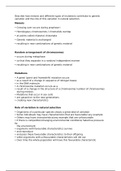
Describe how meiosis and different types of mutations contribute to genetic
variation and the role of this variation in natural selection.
Meiosis
• Crossing over occurs during prophase I
• Homologous chromosomes / chromatids overlap
• at points called chiasma/ chiasmata
• Genetic material is exchanged
• resulting in new combinations of genetic material
Random arrangement of chromosomes
• occurs during metaphase
• so that they separate in a random/ independent manner
• resulting in new combinations of genetic material
Mutations
• A gene/ (point and frameshift) mutation occurs
• as a result of a change in sequence of nitrogen bases
• in the DNA molecule
• A chromosome mutation occurs as a
• result of a change in the structure of a chromosome/ number of chromosomes
during meiosis
• Mutations that occur in sex cells
• are passed on to the new generations
• creating new characteristics
Role of variation in natural selection
• Organisms of a particular species shows a great deal of variation
• Some individuals may have characteristics that are favourable/ any example
• Others may have characteristics/any example that are unfavourable
• If there is competition/changing environmental conditions/ Selective pressure
by
the environment
• organisms with favourable characteristics survive
• and reproduce
• and pass these favourable characteristics to their offspring
• while organisms with unfavourable characteristics will die out
• Over time the whole population will have this favourable characteristic
variation and the role of this variation in natural selection.
Meiosis
• Crossing over occurs during prophase I
• Homologous chromosomes / chromatids overlap
• at points called chiasma/ chiasmata
• Genetic material is exchanged
• resulting in new combinations of genetic material
Random arrangement of chromosomes
• occurs during metaphase
• so that they separate in a random/ independent manner
• resulting in new combinations of genetic material
Mutations
• A gene/ (point and frameshift) mutation occurs
• as a result of a change in sequence of nitrogen bases
• in the DNA molecule
• A chromosome mutation occurs as a
• result of a change in the structure of a chromosome/ number of chromosomes
during meiosis
• Mutations that occur in sex cells
• are passed on to the new generations
• creating new characteristics
Role of variation in natural selection
• Organisms of a particular species shows a great deal of variation
• Some individuals may have characteristics that are favourable/ any example
• Others may have characteristics/any example that are unfavourable
• If there is competition/changing environmental conditions/ Selective pressure
by
the environment
• organisms with favourable characteristics survive
• and reproduce
• and pass these favourable characteristics to their offspring
• while organisms with unfavourable characteristics will die out
• Over time the whole population will have this favourable characteristic