Managing Business Strategically
Teece, D.J. 2010. Business models, business strategy and innovation. Long
Range Planning, 43(2-3): 172-194.
- An established enterprise employs a certain business model that describes the
design or architecture of the value creation, delivery, and capture mechanisms it
employs.
- The business model reflects management’s hypothesis about what customers
want, how they want it, and how the enterprise can organize to best meet those
needs, get paid for doing so, and make a profit. It outlines the architecture of
revenues, costs, and profits associated with the business enterprise delivering
that value.
- Due to developments in the global economy, business need to be more
customer-centric - they have to re-evaluate the value propositions they present
to customers.
- In short, a business model is a conceptual model of business, not a financial
one. It makes implicit assumptions about customers, the behaviour of revenues
and costs, the changing nature of user needs, and competitor responses.
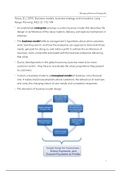
- The elements of business model design:
1
, Managing Business Strategically
- In itself, the concept of a business model lacks theoretical grounding in
economics/business studies. Sorting out business models for a product or
business is an unnecessary step in textbook economics, where it is common to
work with theoretical constructs which assume fully developed spot and forward
markets, strong property rights, the costless transfer of information, perfect
arbitrage, and no innovation.
- This article argues that "Business models are necessary features of market
economies where there is consumer choice, transaction costs, and
heterogeneity amongst consumers and producers, and competition." For
instance, the razor-razor blade model is a classic case of a well known business
revenue model (note: this is just one component of a business model), which
involves pricing razors inexpensively, but aggressively marking-up the
consumables (razor blades).
- The information industries have raised challenging business model issues
because information is often difficult to price, and consumers have many ways to
obtain certain types without paying. For that reason, companies adopt business
models pioneered in one space into another. For instance, Freemium or multiple
revenue stream models.
- Freemium: a standard form of the software is licensed under an open source
license and then a premium version with additional features and/or associated
services is made available under commercial license terms.
- A business model is more generic than a business strategy. Integrating strategy
and business model analysis is required to protect competitive advantage
resulting from new business model design.
- Successful business models often become shared by multiple competitors.
- Integrating competitive strategy analysis to business model design requires:
1. Segmenting the market
2. Creating a value proposition for each segment
3. Setting up the apparatus to deliver that value
4. Figuring out various ‘isolating mechanisms’ that can be used to prevent the
business model/strategy from being undermined through imitation by
competitors or disintermediation by customers
2
, Managing Business Strategically
Here, strategy analysis is an essential step in designing a competitively
sustainable business model.
- Business model choices define the architecture of the business, and expansion
paths develop from there onwards.
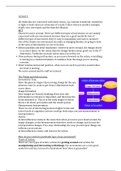
- Steps to achieve sustainable business models:
- Understanding how to capture value from innovation is a key element of
business model design. Technological innovation does not guarantee business
success. New product development efforts should be integrated in a business
model by defining their go to market and capturing value strategies.
- The Profiting from Innovation framework can be considered as a tool to help
design business models, and using it allows one to map business model
selection to type of innovation, while simultaneously enabling one to figure out
where intellectual property monetization through licensing is likely to be viable,
and where it’s not, or where some kind of vertical integration is indicated.
3
Teece, D.J. 2010. Business models, business strategy and innovation. Long
Range Planning, 43(2-3): 172-194.
- An established enterprise employs a certain business model that describes the
design or architecture of the value creation, delivery, and capture mechanisms it
employs.
- The business model reflects management’s hypothesis about what customers
want, how they want it, and how the enterprise can organize to best meet those
needs, get paid for doing so, and make a profit. It outlines the architecture of
revenues, costs, and profits associated with the business enterprise delivering
that value.
- Due to developments in the global economy, business need to be more
customer-centric - they have to re-evaluate the value propositions they present
to customers.
- In short, a business model is a conceptual model of business, not a financial
one. It makes implicit assumptions about customers, the behaviour of revenues
and costs, the changing nature of user needs, and competitor responses.
- The elements of business model design:
1
, Managing Business Strategically
- In itself, the concept of a business model lacks theoretical grounding in
economics/business studies. Sorting out business models for a product or
business is an unnecessary step in textbook economics, where it is common to
work with theoretical constructs which assume fully developed spot and forward
markets, strong property rights, the costless transfer of information, perfect
arbitrage, and no innovation.
- This article argues that "Business models are necessary features of market
economies where there is consumer choice, transaction costs, and
heterogeneity amongst consumers and producers, and competition." For
instance, the razor-razor blade model is a classic case of a well known business
revenue model (note: this is just one component of a business model), which
involves pricing razors inexpensively, but aggressively marking-up the
consumables (razor blades).
- The information industries have raised challenging business model issues
because information is often difficult to price, and consumers have many ways to
obtain certain types without paying. For that reason, companies adopt business
models pioneered in one space into another. For instance, Freemium or multiple
revenue stream models.
- Freemium: a standard form of the software is licensed under an open source
license and then a premium version with additional features and/or associated
services is made available under commercial license terms.
- A business model is more generic than a business strategy. Integrating strategy
and business model analysis is required to protect competitive advantage
resulting from new business model design.
- Successful business models often become shared by multiple competitors.
- Integrating competitive strategy analysis to business model design requires:
1. Segmenting the market
2. Creating a value proposition for each segment
3. Setting up the apparatus to deliver that value
4. Figuring out various ‘isolating mechanisms’ that can be used to prevent the
business model/strategy from being undermined through imitation by
competitors or disintermediation by customers
2
, Managing Business Strategically
Here, strategy analysis is an essential step in designing a competitively
sustainable business model.
- Business model choices define the architecture of the business, and expansion
paths develop from there onwards.
- Steps to achieve sustainable business models:
- Understanding how to capture value from innovation is a key element of
business model design. Technological innovation does not guarantee business
success. New product development efforts should be integrated in a business
model by defining their go to market and capturing value strategies.
- The Profiting from Innovation framework can be considered as a tool to help
design business models, and using it allows one to map business model
selection to type of innovation, while simultaneously enabling one to figure out
where intellectual property monetization through licensing is likely to be viable,
and where it’s not, or where some kind of vertical integration is indicated.
3