Introduction to Anatomy Questions and Answers 100% pass
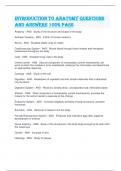
Introduction to Anatomy Questions and Answers 100% pass Anatomy - ANS- Study of the structure and shape of the body Andreas Vesalius - ANS- Father of human anatomy Atoms - ANS- Smallest stable units of matter Cardiovascular System - ANS- Moves blood through blood vessels and transports substances throughout the body Cells - ANS- Smallest living units in the body Control center - ANS- Second component of homeostatic control mechanisms; set point at which the variable is to be maintained; analyzes the information and determines an appropriate response Cytology - ANS- Study of the cell Digestion - ANS- Breakdown of ingested food into simple molecules that is absorbed into the blood Digestive System - ANS- Receives, breaks down, and absorbs food; eliminates waste Effector - ANS- Third component of homeostatic control mechanisms; provides the means for the control center's response to the change Endocrine System - ANS- Controls metabolic activities of body structures; secretes hormones Excretion - ANS- Removal of wastes from the body Female Reproductive System - ANS- Produces and maintains egg cells; supports development of embryo Gross anatomy - ANS- Study of the structures in the body large enough to be seen with the naked eye Growth - ANS- Increase in size Histology - ANS- Study of tissues Homeostasis - ANS- The ability to maintain a relatively stable internal environment in an ever-changing outside world Integumentary System - ANS- Provides sensory information; helps regulate body temperature Lymphatic System - ANS- Defends against infection and diseases; returns tissue fluid to blood Maintaining Boundaries - ANS- The internal environment remains distinct from the external environment Male Reproductive System - ANS- Produces and maintains sperm cells Metabolism - ANS- Regulates the ability to convert nutrients to energy Microscopic anatomy - ANS- Study of the structures in the body seen with only a microscope or magnifying instrument Molecules - ANS- Complex shapes of two or more atoms Movement - ANS- Locomotion; circulation; absorption; respiration Muscular System - ANS- Provides movement; maintains posture; produces heat Negative feedback - ANS- The output shuts off or reverses the original stimulus; most homeostatic control mechanisms are negative feedback Nervous System - ANS- Detects changes; interprets sensory information; stimulates muscles and glands Organ system - ANS- A group of organs that cooperate to accomplish a common purpose Organelles - ANS- Components of cells
Written for
- Institution
- Introduction to Anatomy
- Course
- Introduction to Anatomy
Document information
- Uploaded on
- July 4, 2024
- Number of pages
- 3
- Written in
- 2023/2024
- Type
- Exam (elaborations)
- Contains
- Questions & answers
Subjects
-
introduction to anatomy questions and answers 100

Document also available in package deal