PMIC – Economics Ch 12
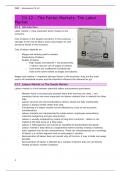
Ch 12 – The Factor Markets: The Labor
Market
12.1 Introduction
Labor market = most important factor market in the
economy.
Cost of labour is the largest cost factor in the economy. ∴
changes in the cost of labour have a big impact on cost
and price trends in the economy.
Cost of labour depends on:
- Wages and salaries paid to workers
- Productivity of labour.
- Quality of labour
o High wages and salaries + low productivity
= labour cost per unit of output increases
o Cost levels are unaffected if productivity
rises to the same extent as wages and salaries.
Wages and salaries = important demand factor in the economy, they are the main
source of household income and the therefore influence the demand for g/s.
12.2 Labour Market vs The Goods Market
Labour market is a link between potential sellers and potential purchasers.
- Workers have to be physically present when their services are used ∴ non-
monetary factors are more important inn labour markets than in markets for other
fops.
- Labour services are not transferable to others. Goods are fully transferable
- Labour is always rented rather than sold.
- Functioning of a labour market can be effected by a lots of non-economic
considerations
- Labour markets are characterised by trade unions, employees associations,
collective bargaining and gov intervention.
- Labour is usually employed by means of long-term contracts ∴ labour is not
traded at the best price on a daily basis
- Labour is heterogenous and cannot be classified of standardised like goods
- Labour market is described as a segmented market (variety of labour markets),
each segment has its own characteristics. There can simultaneously be a shortage
of labour is a certain segment and an oversupply in another
- Remuneration of labour does not consist only of its price, it may include non-wage
benefits
- Remuneration of labour is affected by a number of factors that are not directly
related to labour market conditions
1
, PMIC – Economics Ch 12
BASIC CONCEPTS RELATING TO THE REMUNERATION OF LABOUR
Wage = basic payment for labour, excluding benefits or allowances
- The wage rate is the price of labour, expressed as an amount of money per hour,
day, week, month, or year.
- There is no distinction between wages and salaries – both referred to as wages /
wage rate
Nominal wages = the actual money received.
Real wages = represent the purchasing power of these wages, determined by the prices
of goods and services.
- Reflect the quantity of goods and services that can be bought with nominal
wages.
- If nominal wages increase faster than prices, real wages rise, improving the
workers' standard of living
- If prices increase faster than nominal wages, real wages decline, reducing
purchasing power.
12.3 A Perfect Competitive Labour Market
Requirements for perfect competition
We use perfect competition as a benchmark against which the performance of other
market structures could be compared
The requirements for perfect competition in the labour market include the following:
- There must be a large number of buyers (employers) and a large number of
sellers(employees) in the market.
o Number must be so large that no individual can influence the price of
labour.
o All participants must be price takers
- Labour must be homogeneous – all workers have identical skills
- Workers must be completely mobile, must move freely from one employer to
another.
- No gov intervention influencing employers or workers
- All participants must have perfect knowledge of market conditions.
- Perfect competition in the goods market
o No employer must be able to pass increased labour costs onto customers
in the form of higher prices
Equilibrium in the labour market
In a perfectly competitive labour market, the equilibrium wage rate and the equilibrium
qty are determined by the interaction of supply and demand.
2
Ch 12 – The Factor Markets: The Labor
Market
12.1 Introduction
Labor market = most important factor market in the
economy.
Cost of labour is the largest cost factor in the economy. ∴
changes in the cost of labour have a big impact on cost
and price trends in the economy.
Cost of labour depends on:
- Wages and salaries paid to workers
- Productivity of labour.
- Quality of labour
o High wages and salaries + low productivity
= labour cost per unit of output increases
o Cost levels are unaffected if productivity
rises to the same extent as wages and salaries.
Wages and salaries = important demand factor in the economy, they are the main
source of household income and the therefore influence the demand for g/s.
12.2 Labour Market vs The Goods Market
Labour market is a link between potential sellers and potential purchasers.
- Workers have to be physically present when their services are used ∴ non-
monetary factors are more important inn labour markets than in markets for other
fops.
- Labour services are not transferable to others. Goods are fully transferable
- Labour is always rented rather than sold.
- Functioning of a labour market can be effected by a lots of non-economic
considerations
- Labour markets are characterised by trade unions, employees associations,
collective bargaining and gov intervention.
- Labour is usually employed by means of long-term contracts ∴ labour is not
traded at the best price on a daily basis
- Labour is heterogenous and cannot be classified of standardised like goods
- Labour market is described as a segmented market (variety of labour markets),
each segment has its own characteristics. There can simultaneously be a shortage
of labour is a certain segment and an oversupply in another
- Remuneration of labour does not consist only of its price, it may include non-wage
benefits
- Remuneration of labour is affected by a number of factors that are not directly
related to labour market conditions
1
, PMIC – Economics Ch 12
BASIC CONCEPTS RELATING TO THE REMUNERATION OF LABOUR
Wage = basic payment for labour, excluding benefits or allowances
- The wage rate is the price of labour, expressed as an amount of money per hour,
day, week, month, or year.
- There is no distinction between wages and salaries – both referred to as wages /
wage rate
Nominal wages = the actual money received.
Real wages = represent the purchasing power of these wages, determined by the prices
of goods and services.
- Reflect the quantity of goods and services that can be bought with nominal
wages.
- If nominal wages increase faster than prices, real wages rise, improving the
workers' standard of living
- If prices increase faster than nominal wages, real wages decline, reducing
purchasing power.
12.3 A Perfect Competitive Labour Market
Requirements for perfect competition
We use perfect competition as a benchmark against which the performance of other
market structures could be compared
The requirements for perfect competition in the labour market include the following:
- There must be a large number of buyers (employers) and a large number of
sellers(employees) in the market.
o Number must be so large that no individual can influence the price of
labour.
o All participants must be price takers
- Labour must be homogeneous – all workers have identical skills
- Workers must be completely mobile, must move freely from one employer to
another.
- No gov intervention influencing employers or workers
- All participants must have perfect knowledge of market conditions.
- Perfect competition in the goods market
o No employer must be able to pass increased labour costs onto customers
in the form of higher prices
Equilibrium in the labour market
In a perfectly competitive labour market, the equilibrium wage rate and the equilibrium
qty are determined by the interaction of supply and demand.
2