Philosophy Overview
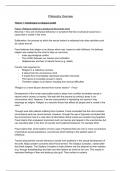
Theme 1: Challenges to religious belief
Freud - Religious belief as a product of the human mind
Neurosis = Any sort of physical behaviour or symptom that has no physical cause but a
cause that is rooted in the mind
Sublimation: the process by which the sexual instinct is redirected into other activities such
as culture and art.
Freud believes that religion is an illusion which was based on wish fulfilment. He believes
religion was created by the mind to help us overcome;
- Inner psychological conflict
- The conflict between our natures and civilisation
- Helplessness and fear of natural forces (e.g. death)
Freud's main argument is:
- Religion is a collective neurosis
- It stems from the unconscious mind
- It results from incompletely repressed traumatic memories
- The trauma is invariably sexual in nature
- Therefore religion is an illusion resulting from sexual difficulties
"Religion is a mere illusion derived from human wishes" - Freud
Development of the human personality leads to deep inner conflicts (invariably sexual in
nature) which causes us trauma. We deal with this trauma by locking it away in our
unconscious mind. However, if we are unsuccessful in repressing our trauma it may
reemerge as religion. Religion is a neurotic illness that affects all people and is rooted in the
mind.
Through work with patients suffering from hysteria, Freud concluded that the mind contains
unconscious parts we cannot access. However, through the use of hypnosis concluded that
the unconscious mind is a vast store of information about events we consider long forgotten.
Freud claims that unpleasant memories (such as trauma) are trapped in the unconscious but
can resurface later in the form of neurotic and hysterical behaviour, for example OCD.
Freud claims that at the bottom of every case of hysteria there are one or more occurrences
of premature sexual experience, occurrences which belong to the earliest years of
childhood.
Trauma lying behind neurotic behaviour results from problems in the sexual development of
the child. Major problem concerns what Freud termed ‘The Oedipus Complex’, named after
the Greek tragedy. The Oedipus Complex is male children are first attached to their mothers
(e.g. through breastfeeding) and later see their fathers as rivals for her love. This results in
repressed feelings of fear and jealousy plus guilt. They surface in puberty.
,Desire to possess mother + Ambivalence towards father = The Oedipus Complex
Unable to carry out his wishes the child represses the conflict and guilt deep in the
unconscious mind however repression is only partially effective. The mind continues to
struggle to prevent them from re-emerging into the consciousness and as a result they are
channelled out in the form of neurotic symptoms, one symptom being religion.
"(religion is) universal obsessional neurosis of humanity ... (that) arouse out of the Oedipus
Complex"- Freud
In Totem and Taboo (Freud's 1913 book), Frued claims that the origins of collective neurosis
come from the primal horde, that humans used to live in small ‘hordes’ or groups (Darwin).
Freud went on to say there was one dominant male that the younger males of the horde
were jealous of, because of this the younger males united and killed the dominant male so
they could become dominant over the horde. Young males felt guilty afterwards as despite
their jealousy they loved (and feared) the dominant male. Faced with collapse of social order
they form a tribe and create a totem to take the place of the father (the dominant male). The
totem units the tribe. The totem is usually an animal that became worshipped (animism).
Each year the killing of the father is commemorated by the killing of the totem. Act of ritual
killing reflected belief that rituals and actions could control objects and living things. The
Totem and Taboo theory is the Oedipus complex in action.
Frued goes on to argue that religion is also wishful thinking to combat psychological turmoil.
The sources of turmoil are:
- Stress from the way society functions
- Fear of the natural world
The human mind creates images and beliefs that fulfil basic needs and desires.
Frued observed collective neurosis in his patients claiming that common behaviours include:
- Hysterical behaviour
- Phobias and anxiety
- Obsessive behaviour
All of which are found in religion. For example:
Hysterical behaviour = Toronto Blessing (s a form of religious experience characterised by
many unusual physical phenomena — such as bodily weakness and falling to the ground;
shaking, trembling and convulsive bodily movements)
Phobias and anxiety = Fear of hell / Catholic guilt
Obsessive behaviour = The Eucharist (Wine and bread)
Our society is in conflict with our most basic desires, if we acted on them society would not
be able to operate. We depend on structure and order but the government will inevitably
conflict with our own desires. We need a reason to submit to authority, Religion gives us a
, reason. We need to obey an omnipotent God, it promises reward for suffering in the afterlife
therefore it makes society bearable.
Religion provides the necessary motivation for sublimation to occur our natural outlet is
forbidden so our libidos are forced into other areas.
Religion also helps us overcome our fear of natural forces including death as in religion there
is an afterlife. This creates belief that natural forces are not impersonal, that we are not
powerless and by devotion we can control them.
Religious belief is a reaction against helplessness and provides adults with a father figure to
protect them just as the father protects the child. God is the ultimate ideal of a father as He is
omnipotent and omnibenevolent.
Support for Freud’s theory of religion
The primal horde was based on Freud’s understanding of Darwinism.
Hume agreed with Freud that humans had constructed religion in order to help them deal
with the misery of life and the dread of death.
Totem and Taboo:
- This shows that the Oedipus Complex is not simply a personal trauma, but one that
has affected all societies at a historical level.
- Explains why religion is a collective neurosis and why the concept of God is such a
powerful one.
- In some kind of psychological mechanism, the guilt for the original crime is passed on
genetically.
The Wolf Man: had a phobia of animals, more specifically white wolves. After much
hypnosis, Freud traced the phobia back to when he was young and he witnessed sexual
acts between his parents. Freud reasoned that over time, the repressed trauma resulted in
the fear of wolves and of God.
Summary:
- Wolf man had a childhood phobia of animals
- As a child he witnessed sexual acts between his parents several times
- He had periods of being religious
- He had become obsessive over religious rituals
- He sought Freud's help over his depression
Freud concludes:
- He had associated his parents with animals having sex
- His desire was to be copulated with by his father
- He feared what would happen if he did
- The repressed trauma resulted in the fear of wolves and God.
Little Hans: Little Hans was a 5-year-old boy who was afraid of horses, more specifically
afraid that a horse would bite him. Especially after watching a horse collapse in the street.
Theme 1: Challenges to religious belief
Freud - Religious belief as a product of the human mind
Neurosis = Any sort of physical behaviour or symptom that has no physical cause but a
cause that is rooted in the mind
Sublimation: the process by which the sexual instinct is redirected into other activities such
as culture and art.
Freud believes that religion is an illusion which was based on wish fulfilment. He believes
religion was created by the mind to help us overcome;
- Inner psychological conflict
- The conflict between our natures and civilisation
- Helplessness and fear of natural forces (e.g. death)
Freud's main argument is:
- Religion is a collective neurosis
- It stems from the unconscious mind
- It results from incompletely repressed traumatic memories
- The trauma is invariably sexual in nature
- Therefore religion is an illusion resulting from sexual difficulties
"Religion is a mere illusion derived from human wishes" - Freud
Development of the human personality leads to deep inner conflicts (invariably sexual in
nature) which causes us trauma. We deal with this trauma by locking it away in our
unconscious mind. However, if we are unsuccessful in repressing our trauma it may
reemerge as religion. Religion is a neurotic illness that affects all people and is rooted in the
mind.
Through work with patients suffering from hysteria, Freud concluded that the mind contains
unconscious parts we cannot access. However, through the use of hypnosis concluded that
the unconscious mind is a vast store of information about events we consider long forgotten.
Freud claims that unpleasant memories (such as trauma) are trapped in the unconscious but
can resurface later in the form of neurotic and hysterical behaviour, for example OCD.
Freud claims that at the bottom of every case of hysteria there are one or more occurrences
of premature sexual experience, occurrences which belong to the earliest years of
childhood.
Trauma lying behind neurotic behaviour results from problems in the sexual development of
the child. Major problem concerns what Freud termed ‘The Oedipus Complex’, named after
the Greek tragedy. The Oedipus Complex is male children are first attached to their mothers
(e.g. through breastfeeding) and later see their fathers as rivals for her love. This results in
repressed feelings of fear and jealousy plus guilt. They surface in puberty.
,Desire to possess mother + Ambivalence towards father = The Oedipus Complex
Unable to carry out his wishes the child represses the conflict and guilt deep in the
unconscious mind however repression is only partially effective. The mind continues to
struggle to prevent them from re-emerging into the consciousness and as a result they are
channelled out in the form of neurotic symptoms, one symptom being religion.
"(religion is) universal obsessional neurosis of humanity ... (that) arouse out of the Oedipus
Complex"- Freud
In Totem and Taboo (Freud's 1913 book), Frued claims that the origins of collective neurosis
come from the primal horde, that humans used to live in small ‘hordes’ or groups (Darwin).
Freud went on to say there was one dominant male that the younger males of the horde
were jealous of, because of this the younger males united and killed the dominant male so
they could become dominant over the horde. Young males felt guilty afterwards as despite
their jealousy they loved (and feared) the dominant male. Faced with collapse of social order
they form a tribe and create a totem to take the place of the father (the dominant male). The
totem units the tribe. The totem is usually an animal that became worshipped (animism).
Each year the killing of the father is commemorated by the killing of the totem. Act of ritual
killing reflected belief that rituals and actions could control objects and living things. The
Totem and Taboo theory is the Oedipus complex in action.
Frued goes on to argue that religion is also wishful thinking to combat psychological turmoil.
The sources of turmoil are:
- Stress from the way society functions
- Fear of the natural world
The human mind creates images and beliefs that fulfil basic needs and desires.
Frued observed collective neurosis in his patients claiming that common behaviours include:
- Hysterical behaviour
- Phobias and anxiety
- Obsessive behaviour
All of which are found in religion. For example:
Hysterical behaviour = Toronto Blessing (s a form of religious experience characterised by
many unusual physical phenomena — such as bodily weakness and falling to the ground;
shaking, trembling and convulsive bodily movements)
Phobias and anxiety = Fear of hell / Catholic guilt
Obsessive behaviour = The Eucharist (Wine and bread)
Our society is in conflict with our most basic desires, if we acted on them society would not
be able to operate. We depend on structure and order but the government will inevitably
conflict with our own desires. We need a reason to submit to authority, Religion gives us a
, reason. We need to obey an omnipotent God, it promises reward for suffering in the afterlife
therefore it makes society bearable.
Religion provides the necessary motivation for sublimation to occur our natural outlet is
forbidden so our libidos are forced into other areas.
Religion also helps us overcome our fear of natural forces including death as in religion there
is an afterlife. This creates belief that natural forces are not impersonal, that we are not
powerless and by devotion we can control them.
Religious belief is a reaction against helplessness and provides adults with a father figure to
protect them just as the father protects the child. God is the ultimate ideal of a father as He is
omnipotent and omnibenevolent.
Support for Freud’s theory of religion
The primal horde was based on Freud’s understanding of Darwinism.
Hume agreed with Freud that humans had constructed religion in order to help them deal
with the misery of life and the dread of death.
Totem and Taboo:
- This shows that the Oedipus Complex is not simply a personal trauma, but one that
has affected all societies at a historical level.
- Explains why religion is a collective neurosis and why the concept of God is such a
powerful one.
- In some kind of psychological mechanism, the guilt for the original crime is passed on
genetically.
The Wolf Man: had a phobia of animals, more specifically white wolves. After much
hypnosis, Freud traced the phobia back to when he was young and he witnessed sexual
acts between his parents. Freud reasoned that over time, the repressed trauma resulted in
the fear of wolves and of God.
Summary:
- Wolf man had a childhood phobia of animals
- As a child he witnessed sexual acts between his parents several times
- He had periods of being religious
- He had become obsessive over religious rituals
- He sought Freud's help over his depression
Freud concludes:
- He had associated his parents with animals having sex
- His desire was to be copulated with by his father
- He feared what would happen if he did
- The repressed trauma resulted in the fear of wolves and God.
Little Hans: Little Hans was a 5-year-old boy who was afraid of horses, more specifically
afraid that a horse would bite him. Especially after watching a horse collapse in the street.