‘Wage di erentials can be explained by economic theory. They are a sign of the
power of a rm to exploit its workforce and are unjust.’ Do you agree with this view?
[25]
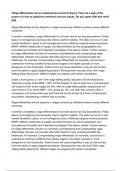
Wage di erentials are the disparity in wages received by di erent workers across di erent
industries.
In perfect competition, wage di erentials do not exist due to two key assumptions. Firstly,
labour is homogenous and secondly, there is perfect mobility. This does not occur in real
market situations. Labour is not homogenous due to di ering marginal revenue products
(MRP), di erent elasticities of supply, and discrimination as well as geographic and
occupational immobility and imperfect knowledge of the labour market. Further reasons
for wage di erentials include non monetary considerations and compensating wage
di erentials. Workers will consider alternative factors to pay including bene ts like
healthcare, for example. Compensating wage di erentials, for example, can be due to
unattractive working conditions that causes wages to be higher, typically in more
dangerous or anti-social jobs. Trade Unions will cause disparities in pay as well as they
have the ability to apply bargaining pressure. Monopsonies may also exist; their wage
setting ability allowing for di erent wages non aligned with perfect competition.
Under a monopsony or a rm with wage setting ability, labourers will be employed to
maximise revenue where MRP = MCl. IN this diagram, it can be seen how a monopsonies
will employ at Qm where wages are Wm. With no wage setting ability, employment will
exist where D=S or where MRP = ACl, giving Qc, Wc. It is clear that workers under a
monopsony will received less pay and there will not be as high of a level of employment
as possible, representing a welfare loss to society.
Wage di erentials are the disparity in wages received by di erent workers across di erent
industries.
In perfect competition, wage di erentials do not exist due to two key assumptions. Firstly,
labour is homogenous and secondly, there is perfect mobility. This does not occur in real
market situations. Labour is not homogenous due to di ering marginal revenue products
(MRP), di erent elasticities of supply, and discrimination as well as geographic and
occupational immobility and imperfect knowledge of the labour market. Further reasons
for wage di erentials include non monetary considerations and compensating wage
di erentials. Workers will consider alternative factors to pay including bene ts like
healthcare, for example. Compensating wage di erentials, for example, can be due to
unattractive working conditions that causes wages to be higher, typically in more
dangerous or anti-social jobs. Trade Unions will cause disparities in pay as well as they
have the ability to apply bargaining pressure. Monopsonies may also exist; their wage
setting ability allowing for di erent wages non aligned with perfect competition.
ff
ffff fffi fi ff ff ff ff ff fi ff
power of a rm to exploit its workforce and are unjust.’ Do you agree with this view?
[25]
Wage di erentials are the disparity in wages received by di erent workers across di erent
industries.
In perfect competition, wage di erentials do not exist due to two key assumptions. Firstly,
labour is homogenous and secondly, there is perfect mobility. This does not occur in real
market situations. Labour is not homogenous due to di ering marginal revenue products
(MRP), di erent elasticities of supply, and discrimination as well as geographic and
occupational immobility and imperfect knowledge of the labour market. Further reasons
for wage di erentials include non monetary considerations and compensating wage
di erentials. Workers will consider alternative factors to pay including bene ts like
healthcare, for example. Compensating wage di erentials, for example, can be due to
unattractive working conditions that causes wages to be higher, typically in more
dangerous or anti-social jobs. Trade Unions will cause disparities in pay as well as they
have the ability to apply bargaining pressure. Monopsonies may also exist; their wage
setting ability allowing for di erent wages non aligned with perfect competition.
Under a monopsony or a rm with wage setting ability, labourers will be employed to
maximise revenue where MRP = MCl. IN this diagram, it can be seen how a monopsonies
will employ at Qm where wages are Wm. With no wage setting ability, employment will
exist where D=S or where MRP = ACl, giving Qc, Wc. It is clear that workers under a
monopsony will received less pay and there will not be as high of a level of employment
as possible, representing a welfare loss to society.
Wage di erentials are the disparity in wages received by di erent workers across di erent
industries.
In perfect competition, wage di erentials do not exist due to two key assumptions. Firstly,
labour is homogenous and secondly, there is perfect mobility. This does not occur in real
market situations. Labour is not homogenous due to di ering marginal revenue products
(MRP), di erent elasticities of supply, and discrimination as well as geographic and
occupational immobility and imperfect knowledge of the labour market. Further reasons
for wage di erentials include non monetary considerations and compensating wage
di erentials. Workers will consider alternative factors to pay including bene ts like
healthcare, for example. Compensating wage di erentials, for example, can be due to
unattractive working conditions that causes wages to be higher, typically in more
dangerous or anti-social jobs. Trade Unions will cause disparities in pay as well as they
have the ability to apply bargaining pressure. Monopsonies may also exist; their wage
setting ability allowing for di erent wages non aligned with perfect competition.
ff
ffff fffi fi ff ff ff ff ff fi ff