Contact Avi, an A* student, for A-Level Maths, Philosophy & Economics
tutoring – +447881294948 (WhatsApp). 1 FREE session included with this
purchase.
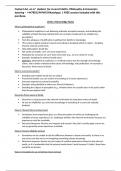
Limits of Knowledge Notes
What is philosophical scepticism?
Philosophical scepticism is not believing ordinarily accepted concepts, and doubting the
reliability of belief-forming methods that are normally considered to be reliable (e.g.,
perception).
Tests the adequacy of justification in getting from beliefs to knowledge.
This creates a global sceptical scenario (everything is doubted) which is radical – doubting
that the external world exists,
Only philosophers doubt this.
Not easily resolvable: can’t use sense experience.
Motivated by scenarios we can’t show to be false (e.g., we are a brain-in-a-vat).
Example: doubting the external world exists
Definition: philosophical scepticism is a method used to test the strength of knowledge
claims, and to better understand the nature of knowledge and justification. An example is
Descartes’ three waves of doubt.
What is normal incredulity?
Doubting some beliefs (local) but not radical
Provisional (doubt): you can resolve it by looking at it (sense experience).
Everyone experiences normal incredulity.
Example: being doubtful of when your friend’s birthday is.
Doubting the subject of perception (e.g., whether there are actually deer in the park) rather
than the perception itself.
Descartes three waves of doubt
Descartes is trying to prove the external world exists by using three waves of doubt.
He was an infallibilist: you only have knowledge of something if it cannot be radically
doubted.
Wave 1: Illusion [Not a serious issue]
Sometimes sense experience gives us a false perception of reality (so challenging the
reliability of sense experience). So, challenges whether the external world exists because our
experience could be unreliable.
Descartes Response: illusions are irregular and unusual, they don’t usually apply, and so we
can say generally sense experience is reliable.
Wave 2: Dreams [Slightly serious]
Sometimes we are unable to tell the difference between a dream and reality, so there is no
way to be sure that we’re not imagining everything (always dreaming).
Descartes response: dreams are just copies of veridical experiences based on the external
world, so it is implausible that the external world doesn’t exist because if it didn’t then there
would be no dreams.
Wave 3: Deception by an evil demon [most serious]
tutoring – +447881294948 (WhatsApp). 1 FREE session included with this
purchase.
Limits of Knowledge Notes
What is philosophical scepticism?
Philosophical scepticism is not believing ordinarily accepted concepts, and doubting the
reliability of belief-forming methods that are normally considered to be reliable (e.g.,
perception).
Tests the adequacy of justification in getting from beliefs to knowledge.
This creates a global sceptical scenario (everything is doubted) which is radical – doubting
that the external world exists,
Only philosophers doubt this.
Not easily resolvable: can’t use sense experience.
Motivated by scenarios we can’t show to be false (e.g., we are a brain-in-a-vat).
Example: doubting the external world exists
Definition: philosophical scepticism is a method used to test the strength of knowledge
claims, and to better understand the nature of knowledge and justification. An example is
Descartes’ three waves of doubt.
What is normal incredulity?
Doubting some beliefs (local) but not radical
Provisional (doubt): you can resolve it by looking at it (sense experience).
Everyone experiences normal incredulity.
Example: being doubtful of when your friend’s birthday is.
Doubting the subject of perception (e.g., whether there are actually deer in the park) rather
than the perception itself.
Descartes three waves of doubt
Descartes is trying to prove the external world exists by using three waves of doubt.
He was an infallibilist: you only have knowledge of something if it cannot be radically
doubted.
Wave 1: Illusion [Not a serious issue]
Sometimes sense experience gives us a false perception of reality (so challenging the
reliability of sense experience). So, challenges whether the external world exists because our
experience could be unreliable.
Descartes Response: illusions are irregular and unusual, they don’t usually apply, and so we
can say generally sense experience is reliable.
Wave 2: Dreams [Slightly serious]
Sometimes we are unable to tell the difference between a dream and reality, so there is no
way to be sure that we’re not imagining everything (always dreaming).
Descartes response: dreams are just copies of veridical experiences based on the external
world, so it is implausible that the external world doesn’t exist because if it didn’t then there
would be no dreams.
Wave 3: Deception by an evil demon [most serious]