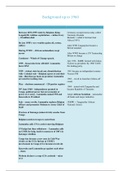
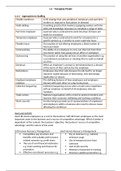
Background up to 1960
Congo Tanzania
Between 1878-1959 ruled by Belgium (King Germany occupied areas today called
Leopold II) ruthless exploitation – rubber/ivory Tanzania, Rwanda
– 10 million died Burundi = called it German East
Africa (1891)
By late 1950’s very wealthy (palm oil, cotton,
coffee) After WWI Tanganyika became a
British mandate
During WWII – African nationalism swept
across After WWII became a UN Trusteeship,
Britain in charge
Continent – Winds of Change speech.
July 1954 –TANU formed with Julius
1959 – Kasavuba form ABAKO Lumumba Nyerere as president. By 1960 TANU
form MNC the leading party.
1959 – violent riots break out, dissatisfaction 1961 became an independent country –
with Colonial rule – Belgium agrees to end their Nyerere PM
rule. (But then go back on promise) Lumumba
arrested for inciting riots 1963 – revolt in Zanzibar (36kms off
coast)
May – elections announced – 120 parties register
1964 – joined with Tanganyika and
30th June 1960 – independence granted to became Republic of Tanzania
Congo, political power but not economic or
power over army. Lumumba named PM and Adopt African Socialism – nationalise
Kasavuba is President all banks and major industries
July – army revolts, Lumumba replaces Belgian (TANU = Tanganyika African
officers and promotes Mobutu to Army Chief of National Union)
Staff
Province of Katanga (mineral rich) secedes from
Congo
Belgium sends in troops to assist them
Lumumba calls UN to assist removing Belgians
UN helps but then withdraws – Lumumba calls
on USSR for help, leads to massacre of 100’s in
Katanga rebellion
Congo has become a new zone in Cold War
rivalry as the US is furious at USSR’s
involvement in Congo (CIA becomes involved)
Kasavuba and Lumumba go against each other
– chaos
Mobutu declares a coup (CIA assisted) – takes
over
, Political aims and ideologies
Congo Tanzania
Mobutu ruled as a military dictator Nyerere’s TANU was the only political party
Official policy called Authenticite: Gave Political ideology contained in Arusha
Congo new name of Zaire Declaration
1967 – Mobutu founded MPR – became Adopted in 1967 – goal to create a more equal
the only legal political party. society
Use of force to achieve “stability” Egalitarian = all benefitted, based on Socialism
Socialist economy called “Ujamaa”- self
reliance through mutual cooperation. Swahili
word for “familyhood” (freedom, equality
and unity)
Both wanted strong national identity based on the power of the state, and were distinctively
African.
Aims were similar, but their visions differed.
Both were members of the OAU and effectively both were one party states.
Congo Tanzania
Between 1878-1959 ruled by Belgium (King Germany occupied areas today called
Leopold II) ruthless exploitation – rubber/ivory Tanzania, Rwanda
– 10 million died Burundi = called it German East
Africa (1891)
By late 1950’s very wealthy (palm oil, cotton,
coffee) After WWI Tanganyika became a
British mandate
During WWII – African nationalism swept
across After WWII became a UN Trusteeship,
Britain in charge
Continent – Winds of Change speech.
July 1954 –TANU formed with Julius
1959 – Kasavuba form ABAKO Lumumba Nyerere as president. By 1960 TANU
form MNC the leading party.
1959 – violent riots break out, dissatisfaction 1961 became an independent country –
with Colonial rule – Belgium agrees to end their Nyerere PM
rule. (But then go back on promise) Lumumba
arrested for inciting riots 1963 – revolt in Zanzibar (36kms off
coast)
May – elections announced – 120 parties register
1964 – joined with Tanganyika and
30th June 1960 – independence granted to became Republic of Tanzania
Congo, political power but not economic or
power over army. Lumumba named PM and Adopt African Socialism – nationalise
Kasavuba is President all banks and major industries
July – army revolts, Lumumba replaces Belgian (TANU = Tanganyika African
officers and promotes Mobutu to Army Chief of National Union)
Staff
Province of Katanga (mineral rich) secedes from
Congo
Belgium sends in troops to assist them
Lumumba calls UN to assist removing Belgians
UN helps but then withdraws – Lumumba calls
on USSR for help, leads to massacre of 100’s in
Katanga rebellion
Congo has become a new zone in Cold War
rivalry as the US is furious at USSR’s
involvement in Congo (CIA becomes involved)
Kasavuba and Lumumba go against each other
– chaos
Mobutu declares a coup (CIA assisted) – takes
over
, Political aims and ideologies
Congo Tanzania
Mobutu ruled as a military dictator Nyerere’s TANU was the only political party
Official policy called Authenticite: Gave Political ideology contained in Arusha
Congo new name of Zaire Declaration
1967 – Mobutu founded MPR – became Adopted in 1967 – goal to create a more equal
the only legal political party. society
Use of force to achieve “stability” Egalitarian = all benefitted, based on Socialism
Socialist economy called “Ujamaa”- self
reliance through mutual cooperation. Swahili
word for “familyhood” (freedom, equality
and unity)
Both wanted strong national identity based on the power of the state, and were distinctively
African.
Aims were similar, but their visions differed.
Both were members of the OAU and effectively both were one party states.