TAXI VIOLENCE:
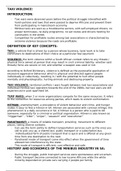
INTRODUCTION:
- Taxi wars were observed years before the political struggle intensified with
harsh policies and laws that were passed to deprive Africans and prevent them
from participating in mainstream economy.
- Minibus taxis are seen as a troublesome sectors, with self-employed drivers; no
proper terminuses, no daily programme, no set routes and drivers hooting for
commuters in the street.
- Competition for profitable routes among taxi associations is characterised by
extreme violence because the roads are profitable.
DEFINITION OF KEY CONCEPTS:
TAXI: a vehicle that is driven by a person whose business, task/ work is to take
commuters to destinations of their choice at a particular fee/ payment.
VIOLENCE: the term violence within a South African context refers to any threats /
physical force aimed at person that may result in civil/ criminal liability, whether said
threats/ force are severe or not, and whether a weapon was used or not.
According to Oxford Dictionary, violence is defined as the purposeful application of
excessive aggressive behaviour which is physical and directed against people
individually or collectively, resulting in / with the potential to hurt other people
mentally and physiologically, hurting animals and destroying property.
TAXI VIOLENCE: territorial conflicts / wars fought between rival taxi associations and
individual minibus taxi operators towards the end of the 1980s, but taxi wars are still
experienced in post-apartheid SA.
TURF WARS: when 2 or more organisations compete for the same resources. It refers
to the contention for resources among parties, which leads to violent confrontation.
HITMAN: unemployment, a prevalence of violent behaviour and crime, and hunger
makes it easy to find a hitman in SA. Hitmen are associated with contract killings; this
phenomenon is a daily occurrence in SA. A hitman is a person who is paid to kill
someone, especially for a criminal or political organisation. Hitmen is also known as
“triggerman” , “killer”, “sniper”, “assassin” and “executioner”
PARATRANSIT: a means of reliable transport, providing movement to different
places, taking diverse outlooks.
- Can use the term jointly to define transportation services such as the ones you
call to pick you up, a shared taxi, public transport or a subscription bus.
- Individualised form of public transport that is quick and is offered at any given
time from one destination to the next.
- Paratransit mode of transport came into effect when the government of time
allowed non-interference by the state.
- This mode of transport is efficient, cost effective and safe.
HISTORY AND ECONOMICS OF THE MINIBUS INDUSTRY IN SA:
- During the struggle, public transport services were spontaneous and uncertain.
- Public transport become connected to low income Africans while the white
minority depended on private cars carrying 2 people per family.
, - The Motor Carrier Transportation Act of 1930 banned the transportation of
passengers by road without a permit. The Act also attempted to guard the state-
owned railways against competition form any road transport, resulting in taxis
being limited to transport no more than 4 passengers.
- Municipality buses and PUTCO bused founded in 1945, were tasked to transport
black people into cities.
- Black people who were privileged to own a car began providing lifts to
commuters, charging a small fee for the service. This resulted in many taxis
working illegally in rural areas where there were no transport services.
- The original taxi permits were areas based and authorised taxi drivers worked in
districts within a radius of 100 km around a central point.
- Rivalry for commuters became ferocious and conflict between drivers over
ownership of routes caused violent clashes.
- Many “mother bodies” claimed to represent the taxi sector.
- On 15 September 2001 the South African National Taxi Council (SANTACO) were
voted into power.
- Due to the deregulation, the taxi industry became over traded and competition
for profitable routes became a fierce terrain.
- Unclear permits, associations claiming ranks and subsequent conflicts between
local and long-distance taxi associations at the ranks resulted in violent clashes.
- The rising violence forced the Transport, Safety and Justice Departments to
establish task forces to curb the taxi violence in SA.
-
RESEARCH DONE BY THE INTERNATIONAL LABOUR ORGANISATION
ON THE TAXI INDUSTRY IN SA:
- Minibus industry is regarded as the biggest employer in the South African
economic sector
- Provides the most reliable type of public transport, catering for commuters from
economically marginalised black communities.
- A typical driver’s workday schedule starts at 5am and ends at 7pm, with no paid
leave.
- Minibuses are often unsafe and not roadworthy.
- Minibus drivers are known for their disregard of the rules of the road and for
overloading their taxis.
- Apartheid policies and laws made it extremely difficult for black people to obtain
a permit to operate a taxi. In the past, black people need public transport to
travel to and from work.
- Minibus taxi industry was established in the late 1970s to meet the demand for
transport. But it was difficult to get a permit, resulting in operators working
without a permit.
- In 1986 the government made it legal to operate 16-seater taxis, but restricted
the number of permits.
- 1989, more than 50 000 minibus taxis were in operation.
- 1990, the taxi wars had begun, with many taxi associations fighting for control
over taxi routes. These taxi conflicts led to killing many taxi owners, commuters,
drivers.
- In many cases, taxi drivers bribed government officials to be able to operate,
illegally.
- The minibus industry transport 60% of South Africa’s commuters.
- Regulations on transport stipulated that no transportation of merchandise or
commuters were allowed without a permit form the LRTB.
INTRODUCTION:
- Taxi wars were observed years before the political struggle intensified with
harsh policies and laws that were passed to deprive Africans and prevent them
from participating in mainstream economy.
- Minibus taxis are seen as a troublesome sectors, with self-employed drivers; no
proper terminuses, no daily programme, no set routes and drivers hooting for
commuters in the street.
- Competition for profitable routes among taxi associations is characterised by
extreme violence because the roads are profitable.
DEFINITION OF KEY CONCEPTS:
TAXI: a vehicle that is driven by a person whose business, task/ work is to take
commuters to destinations of their choice at a particular fee/ payment.
VIOLENCE: the term violence within a South African context refers to any threats /
physical force aimed at person that may result in civil/ criminal liability, whether said
threats/ force are severe or not, and whether a weapon was used or not.
According to Oxford Dictionary, violence is defined as the purposeful application of
excessive aggressive behaviour which is physical and directed against people
individually or collectively, resulting in / with the potential to hurt other people
mentally and physiologically, hurting animals and destroying property.
TAXI VIOLENCE: territorial conflicts / wars fought between rival taxi associations and
individual minibus taxi operators towards the end of the 1980s, but taxi wars are still
experienced in post-apartheid SA.
TURF WARS: when 2 or more organisations compete for the same resources. It refers
to the contention for resources among parties, which leads to violent confrontation.
HITMAN: unemployment, a prevalence of violent behaviour and crime, and hunger
makes it easy to find a hitman in SA. Hitmen are associated with contract killings; this
phenomenon is a daily occurrence in SA. A hitman is a person who is paid to kill
someone, especially for a criminal or political organisation. Hitmen is also known as
“triggerman” , “killer”, “sniper”, “assassin” and “executioner”
PARATRANSIT: a means of reliable transport, providing movement to different
places, taking diverse outlooks.
- Can use the term jointly to define transportation services such as the ones you
call to pick you up, a shared taxi, public transport or a subscription bus.
- Individualised form of public transport that is quick and is offered at any given
time from one destination to the next.
- Paratransit mode of transport came into effect when the government of time
allowed non-interference by the state.
- This mode of transport is efficient, cost effective and safe.
HISTORY AND ECONOMICS OF THE MINIBUS INDUSTRY IN SA:
- During the struggle, public transport services were spontaneous and uncertain.
- Public transport become connected to low income Africans while the white
minority depended on private cars carrying 2 people per family.
, - The Motor Carrier Transportation Act of 1930 banned the transportation of
passengers by road without a permit. The Act also attempted to guard the state-
owned railways against competition form any road transport, resulting in taxis
being limited to transport no more than 4 passengers.
- Municipality buses and PUTCO bused founded in 1945, were tasked to transport
black people into cities.
- Black people who were privileged to own a car began providing lifts to
commuters, charging a small fee for the service. This resulted in many taxis
working illegally in rural areas where there were no transport services.
- The original taxi permits were areas based and authorised taxi drivers worked in
districts within a radius of 100 km around a central point.
- Rivalry for commuters became ferocious and conflict between drivers over
ownership of routes caused violent clashes.
- Many “mother bodies” claimed to represent the taxi sector.
- On 15 September 2001 the South African National Taxi Council (SANTACO) were
voted into power.
- Due to the deregulation, the taxi industry became over traded and competition
for profitable routes became a fierce terrain.
- Unclear permits, associations claiming ranks and subsequent conflicts between
local and long-distance taxi associations at the ranks resulted in violent clashes.
- The rising violence forced the Transport, Safety and Justice Departments to
establish task forces to curb the taxi violence in SA.
-
RESEARCH DONE BY THE INTERNATIONAL LABOUR ORGANISATION
ON THE TAXI INDUSTRY IN SA:
- Minibus industry is regarded as the biggest employer in the South African
economic sector
- Provides the most reliable type of public transport, catering for commuters from
economically marginalised black communities.
- A typical driver’s workday schedule starts at 5am and ends at 7pm, with no paid
leave.
- Minibuses are often unsafe and not roadworthy.
- Minibus drivers are known for their disregard of the rules of the road and for
overloading their taxis.
- Apartheid policies and laws made it extremely difficult for black people to obtain
a permit to operate a taxi. In the past, black people need public transport to
travel to and from work.
- Minibus taxi industry was established in the late 1970s to meet the demand for
transport. But it was difficult to get a permit, resulting in operators working
without a permit.
- In 1986 the government made it legal to operate 16-seater taxis, but restricted
the number of permits.
- 1989, more than 50 000 minibus taxis were in operation.
- 1990, the taxi wars had begun, with many taxi associations fighting for control
over taxi routes. These taxi conflicts led to killing many taxi owners, commuters,
drivers.
- In many cases, taxi drivers bribed government officials to be able to operate,
illegally.
- The minibus industry transport 60% of South Africa’s commuters.
- Regulations on transport stipulated that no transportation of merchandise or
commuters were allowed without a permit form the LRTB.