

100% satisfaction guarantee Immediately available after payment Both online and in PDF No strings attached 4.2 TrustPilot
logo-home
Exam (elaborations)

NST1501 Assignment 3 (COMPLETE ANSWERS) 2024

Rating
5,0
(1)
Sold
14
Pages
19
Grade
A+
Uploaded on
16-06-2024
Written in
2023/2024

NST1501 Assignment 3 (COMPLETE ANSWERS) 2024; 100% TRUSTED workings, explanations and solutions. for assistance Whats-App 0.6.7..1.7.1..1.7.3.9 .......... QUESTION 1 1.1 Define the following terms: 1.1.1 Solvent 1.1.2 Matter (4) 1.2 Give an example of a heterogenous mixture. (2) 1.3 Identify 2 different ways of separating homogenous mixtures (4) 1.4 State the three different states of matter. (3) 1.5 Identify the process: 1.5.1 Change of state from liquid to solid 1.5.2 Change of state from gas to liquid 1.5.3 Change of state from solid to gas 1.5.4 Change of state from liquid to gas 1.5.5 Change of state from gas to solid 1.5.6 Change of state from solid to liquid (6) 1.6 Give 5 characteristics from the online study guide, of a good lesson plan (10) 1.7 Explain why sublimation might be a difficult concept to teach. (5) 1.8 In which term in the intermediate phase, is the matter and materials strand taught? (2) 1.9 List any 4 topics taught under the matter and material phase in the intermediate phase. (4) [40] QUESTION 2 2.1 Illustrate your understanding of lesson planning by discussing the three phases of a lesson plan. (12) 2.2 Briefly discuss how you would introduce the topic of Matter and Materials to your learners. (5) 4 2.3 You planned a scientific investigation to show your students the changes in states of matter. You planned to boil water on an electric stove to show evaporation and condensation. As you turn the stove on, loadshedding kicks in. How do you plan on teaching the lesson, despite the challenge? Consider the equipment needed as well as indirect factors such as the visibility with the lights off, and behaviour of the learners. (5) 2.4 Match the objective with the corresponding Bloom’s Taxonomy level descriptor. Write only the number alongside the answer e.g. 2.4.1 F Objective Bloom’s Taxonomy Level descriptor 2.4.1 Design a lesson plan A- understand 2.4.2 Define a concept B- apply 2.4.3 Differentiate between two concepts C- evaluate 2.4.4 Critique the situation D- create 2.4.5 Discuss the importance of a concept E- remember 2.4.6 Sketch a diagram F- analyze 2.5 Rearrange the key aspects, according to the general structure of a lesson plan. Learning Activities, situation analysis, topic, reflection, lesson objectives and content. (6) [40] QUESTION 3 Develop a lesson plan that complies with the following criteria: a. Choose one of the following topics for your lesson plan. (1) • Ecosystems and Food webs • Photosynthesis b. Title of the lesson. (1) c. Time allocation. (1) d. List of required materials and resources. (3) e. Learning objectives. (4) NST1501/101 5 f. Lesson content. (4) g. Assessment. (4) h. Conclusion. (2)

Show more Read less


Whoops! We can’t load your doc right now. Try again or contact support.

Document information

Uploaded on
June 16, 2024
Number of pages
19
Written in
2023/2024
Type
Exam (elaborations)
Contains
Questions & answers

Subjects

Content preview

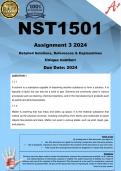
NST1501
Assignment 3 2024
Detailed Solutions, References & Explanations

Unique number:

Due Date: 2024
QUESTION 1

1.1.1

A solvent is a substance capable of dissolving another substance to form a solution. It is
typically a liquid, but can also be a solid or gas. Solvents are commonly used in various
processes such as cleaning, chemical reactions, and in the manufacturing of products such
as paints and pharmaceuticals.

1.1.2

Matter is anything that has mass and takes up space. It is the material substance that
makes up the physical universe, including everything from atoms and molecules to larger
objects like planets and stars. Matter can exist in various states, such as solid, liquid, gas,
and plasma.


Terms of use
By making use of this document you agree to:
• Use this document as a guide for learning, comparison and reference purpose,
• Not to duplicate, reproduce and/or misrepresent the contents of this document as your own work,
• Fully accept the consequences should you plagiarise or misuse this document.


Disclaimer
Extreme care has been used to create this document, however the contents are provided “as is” without
any representations or warranties, express or implied. The author assumes no liability as a result of
reliance and use of the contents of this document. This document is to be used for comparison, research
and reference purposes ONLY. No part of this document may be reproduced, resold or transmitted in any
form or by any means.


Reviews from verified buyers

Showing all reviews
1 year ago

5,0

1 reviews

5
1
4
0
3
0
2
0
1
0
Trustworthy reviews on Stuvia

All reviews are made by real Stuvia users after verified purchases.

Get to know the seller

Seller avatar
Reputation scores are based on the amount of documents a seller has sold for a fee and the reviews they have received for those documents. There are three levels: Bronze, Silver and Gold. The better the reputation, the more your can rely on the quality of the sellers work.
EduPal University of South Africa (Unisa)
View profile
Follow You need to be logged in order to follow users or courses
Sold
149194
Member since
7 year
Number of followers
35996
Documents
4345
Last sold
1 day ago

4,2

13562 reviews

5
7808
4
2689
3
1791
2
455
1
819

Recently viewed by you

Why students choose Stuvia

Created by fellow students, verified by reviews

Quality you can trust: written by students who passed their exams and reviewed by others who've used these notes.

Didn't get what you expected? Choose another document

No worries! You can immediately select a different document that better matches what you need.

Pay how you prefer, start learning right away

No subscription, no commitments. Pay the way you're used to via credit card or EFT and download your PDF document instantly.

Student with book image

“Bought, downloaded, and aced it. It really can be that simple.”

Alisha Student

Frequently asked questions

