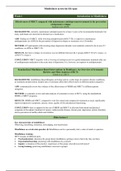
Summary #1 motivation/drive
Motivation
= internal state that induces a person to engage in particular behaviors
= conditions responsible for variations in intensity, persistence, quality & direction of
ongoing behavior.
Motivation is related to 3 dimensions
Direction: choice of behavior
Intensity: amount of effort exerted
Persistence: continuing engagement in a behavior
Motivation = concerned with the desire to acquire some goal
May be related to
- Wants
- Needs
- Desires
Many theories of motivation predict
- Choice of behavior
- Effort
- Persistence
Try to explain why some people perform better than others.
These theories may be valid under the assumption that there is sufficient ability & little
constraint.
Performance = (motivation X ability) – situational constraints
Many theories have been established integrate more theories
2 dimensions of theories
1. Distal theories: build upon motivators that are far from the specific behavior (e.g.
needs that may be fulfilled in many different ways)
2. Proximal theories: build upon motivators that are close to the specific behavior (e.g.
goals immediately direct specific behavior to reach the goal)
o Need theories
= motivation derives from people’s desires for certain things
Needs vary per person & so does motivation
No longer the most popular theories
Distal construct of behavior no strong relation with job performance (need may be
fulfilled in another aspect of life than work)
- Need hierarchy theory (Maslow, 1943)
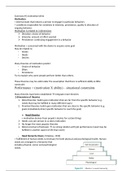
= Fulfillment of human needs is necessary for both physical and psychological health. Human
needs are arranged in a hierarchy that
includes physical, social, and psychological
needs.
, A need must be unmet to be motivating. Usually the lowest unmet need is the most
motivating and has to be fulfilled in order to be motivated by a higher order need.
There are however exceptions to this rule: these people prioritize higher order needs.
Little supporting evidence
Vague concepts that are hard to test
- Two-factor theory (Herzberg, 1968)
= motivation comes from the nature of the job itself (no external rewards/conditions). There
are two types of needs that need to be met:
1. Hygiene factors
= pay, policy, coworkers and other situational external factors that are comfortable.
These needs make a job more attractive and can eliminate dissatisfaction, but in itself
are not sufficient to motivate behavior
2. Motivator factors
= achievement, recognition, and other internal factors that can really spark
motivation/effort/satisfaction in employees
Not empirically supported
Influential focus on the meaning of work
o Reinforcement theory
= how rewards can affect behavior (is not internal but a response to the environment). The
theory states that behavior is a function of prior reward experiences (= reinforcement
history)
Law of effect: higher probability of repetition of behavior if it is followed by a reward.
Tangible rewards (e.g.; money)
Intangible rewards (e.g.; praise)
Incentives to reduce absence may be effective
Little insight into the motivational cognitive process (just relation between reward
and behavior)
Unethical form of manipulating the employee
Unpractical to have to monitor all performance and provide appropriate rewards
o Expectancy theories
= focused on internal cognitive states that cause motivation due to the expectancy of
reward.
High motivation and performance if
Reward is anticipated
One wants the reward
Motivation
= internal state that induces a person to engage in particular behaviors
= conditions responsible for variations in intensity, persistence, quality & direction of
ongoing behavior.
Motivation is related to 3 dimensions
Direction: choice of behavior
Intensity: amount of effort exerted
Persistence: continuing engagement in a behavior
Motivation = concerned with the desire to acquire some goal
May be related to
- Wants
- Needs
- Desires
Many theories of motivation predict
- Choice of behavior
- Effort
- Persistence
Try to explain why some people perform better than others.
These theories may be valid under the assumption that there is sufficient ability & little
constraint.
Performance = (motivation X ability) – situational constraints
Many theories have been established integrate more theories
2 dimensions of theories
1. Distal theories: build upon motivators that are far from the specific behavior (e.g.
needs that may be fulfilled in many different ways)
2. Proximal theories: build upon motivators that are close to the specific behavior (e.g.
goals immediately direct specific behavior to reach the goal)
o Need theories
= motivation derives from people’s desires for certain things
Needs vary per person & so does motivation
No longer the most popular theories
Distal construct of behavior no strong relation with job performance (need may be
fulfilled in another aspect of life than work)
- Need hierarchy theory (Maslow, 1943)
= Fulfillment of human needs is necessary for both physical and psychological health. Human
needs are arranged in a hierarchy that
includes physical, social, and psychological
needs.
, A need must be unmet to be motivating. Usually the lowest unmet need is the most
motivating and has to be fulfilled in order to be motivated by a higher order need.
There are however exceptions to this rule: these people prioritize higher order needs.
Little supporting evidence
Vague concepts that are hard to test
- Two-factor theory (Herzberg, 1968)
= motivation comes from the nature of the job itself (no external rewards/conditions). There
are two types of needs that need to be met:
1. Hygiene factors
= pay, policy, coworkers and other situational external factors that are comfortable.
These needs make a job more attractive and can eliminate dissatisfaction, but in itself
are not sufficient to motivate behavior
2. Motivator factors
= achievement, recognition, and other internal factors that can really spark
motivation/effort/satisfaction in employees
Not empirically supported
Influential focus on the meaning of work
o Reinforcement theory
= how rewards can affect behavior (is not internal but a response to the environment). The
theory states that behavior is a function of prior reward experiences (= reinforcement
history)
Law of effect: higher probability of repetition of behavior if it is followed by a reward.
Tangible rewards (e.g.; money)
Intangible rewards (e.g.; praise)
Incentives to reduce absence may be effective
Little insight into the motivational cognitive process (just relation between reward
and behavior)
Unethical form of manipulating the employee
Unpractical to have to monitor all performance and provide appropriate rewards
o Expectancy theories
= focused on internal cognitive states that cause motivation due to the expectancy of
reward.
High motivation and performance if
Reward is anticipated
One wants the reward