ELECTRIC CIRCUITS
EMF AND POTENTIAL DIFFERENCE
A BATTERY OF CELLS
A chemical reaction takes place within a cell to create a difference in electrical
potential difference between terminals of the cell
- A battery is a collection of cells
- Work done by battery = energy transferred to the charges
Emf – the total energy supplied per coulomb of charge by the battery
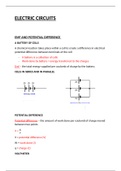
CELLS IN SERIES AND IN PARALLEL
POTENTIAL DIFFERENCE
Potential difference – the amount of work done per coulomb of charge moved
between two points
w
V= q
V = potential difference (V)
W = work done (J)
q = charge (C)
VOLTMETER
, Connected in parallel and measures potential difference
Does not affect current due to a very high resistance
EMF
The voltage measured across the terminals of a battery when no charge is
flowing through the battery
TERMINAL POTENTIAL DIFFERENCE
The voltage across the terminals of a battery when charge is flowing through
the battery
CURRENT
Current – the rate of flow of charge
q
I= t
I = current (A)
q = charge (C)
t = time (s)
CONVENTIONAL CURRENT
In metals electrons move from the negative terminal to the positive terminal.
This is electron flow
In electric circuits positive charge moves from the positive terminal to the
negative terminal. This is conventional current
AMMETER
Connected in series
Does not affect current due to a low resistance
RESISTANCE
EMF AND POTENTIAL DIFFERENCE
A BATTERY OF CELLS
A chemical reaction takes place within a cell to create a difference in electrical
potential difference between terminals of the cell
- A battery is a collection of cells
- Work done by battery = energy transferred to the charges
Emf – the total energy supplied per coulomb of charge by the battery
CELLS IN SERIES AND IN PARALLEL
POTENTIAL DIFFERENCE
Potential difference – the amount of work done per coulomb of charge moved
between two points
w
V= q
V = potential difference (V)
W = work done (J)
q = charge (C)
VOLTMETER
, Connected in parallel and measures potential difference
Does not affect current due to a very high resistance
EMF
The voltage measured across the terminals of a battery when no charge is
flowing through the battery
TERMINAL POTENTIAL DIFFERENCE
The voltage across the terminals of a battery when charge is flowing through
the battery
CURRENT
Current – the rate of flow of charge
q
I= t
I = current (A)
q = charge (C)
t = time (s)
CONVENTIONAL CURRENT
In metals electrons move from the negative terminal to the positive terminal.
This is electron flow
In electric circuits positive charge moves from the positive terminal to the
negative terminal. This is conventional current
AMMETER
Connected in series
Does not affect current due to a low resistance
RESISTANCE