MOMENTUM AND IMPULSE
MOMENTUM
All objects have mass, when an object is moving it has momentum
Momentum – the product of the mass and velocity of an object
P=mv
P = momentum
m = mass
m = velocity
Momentum is a vector it has direction
Direction of momentum = direction of velocity
COLLISIONS
Collision – an isolated event in which two or more moving bodies exert forces
on each other over a relatively short time
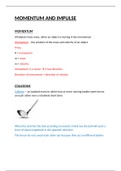
When the club hits the ball according to newton’s third law the ball will exert a
force of equal magnitude in the opposite direction
The forces do not cancel each other out because they act on different bodies
, The force acting on an object during a collision is not constant
Therefore we use an average force
CHANGE IN MOMENTUM
In most cases velocity changes therefore momentum will change
ΔP = mvi – mvf
ΔP = m(vi – vf)
ΔP = change in momentum
m = mass
vi = initial velocity
vf = final velocity
NEWTONS SECOND LAW IN TERMS OF MOMENTUM
ΔPP
Fnet = ΔPt
Newton’s second law (in terms of momentum) – the net force acting on an
object is equal to the rate of change of momentum
APPLYING NEWTONS SECOND LAW
MOMENTUM
All objects have mass, when an object is moving it has momentum
Momentum – the product of the mass and velocity of an object
P=mv
P = momentum
m = mass
m = velocity
Momentum is a vector it has direction
Direction of momentum = direction of velocity
COLLISIONS
Collision – an isolated event in which two or more moving bodies exert forces
on each other over a relatively short time
When the club hits the ball according to newton’s third law the ball will exert a
force of equal magnitude in the opposite direction
The forces do not cancel each other out because they act on different bodies
, The force acting on an object during a collision is not constant
Therefore we use an average force
CHANGE IN MOMENTUM
In most cases velocity changes therefore momentum will change
ΔP = mvi – mvf
ΔP = m(vi – vf)
ΔP = change in momentum
m = mass
vi = initial velocity
vf = final velocity
NEWTONS SECOND LAW IN TERMS OF MOMENTUM
ΔPP
Fnet = ΔPt
Newton’s second law (in terms of momentum) – the net force acting on an
object is equal to the rate of change of momentum
APPLYING NEWTONS SECOND LAW