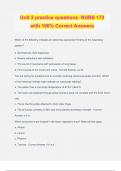
Unit 2 practice questions: NURS 172 with 100% Correct Answers
Unit 2 practice questions: NURS 172 with 100% Correct Answers Which of the following indicates an abnormal assessment finding of the respiratory system? a. Symmetrical chest expansion b. Muscle retractions with inhalation c. The sound of resonance with percussion of lung tissue d. Pink mucosa of the mouth and nares - Correct Answer ️️ -B You are caring for a patient who is currently receiving continuous pulse oximetry. Which of the following findings might indicate an inaccurate reading? a. The patient has a core body temperature of 97.8 F (36.6 C) b. The heart rate obtained through pulse oximetry does not correlate with the ECG heart rate c. The pt has the probe attached to their index finger d. The pt's pulse oximetry is 95% and the pt denies shortness of breath - Correct Answer ️️ -b Which structures is/are located in the lower respiratory tract? Select all that apply a. Alveoli b. Larynx c. Pharynx d. Trachea - Correct Answer ️️ -a,d Which diagnostic test/exam would best measure a client's level of hypoxemia? a. Chest x-ray b. Pulse oximeter reading c. Arterial blood gas d. Peak expiratory flow rate - Correct Answer ️️ -c Which of the following is not a function of the respiratory system? a. Acid-base balance b. Temperature regulation c. Fluid balance d. Tissue perfusion - Correct Answer ️️ -d. Explanation: The circulatory system is responsible for tissue perfusion, not the respiratory system. Acid/base balance, temperature regulation, and fluid balance are all functions of the respiratory system. Why is nasal breathing more effective than mouth breathing is? - Correct Answer ️️ - More effective in cleaning, filtering and warming your air then the mouth does Which of the following structures actively participates in gas exchange? a. Bronchi b. Visceral pleura c. Respiratory bronchioles d. Terminal bronchioles - Correct Answer ️️ -c. Explanation: The respiratory bronchioles participate in the princess of gas exchange (respiration). The other structures are involved in the process of ventilation or movement of oxygen to the level of the alveoli. Which of the following indicates an abnormal assessment finding of the respiratory system? a. Symmetrical chest expansion b. Muscle restrictions with inhalation c. The sound of resonance with percussion of lung tissue d. Pink mucosa of the mouth and nares - Correct Answer ️️ -b. Explanation: Muscle retractions during inhalation indicate that significant respiratory effect is being demanded and thus use of the accessory muscles is required. All of the other assessment findings are normal assessment findings. You are caring for a patient who is currently receiving continuous pulse oximetry. Which of the following findings might indicate inaccurate readings? a. The patient has a core body temperature of 94 F (34.5 C) b. The heart rate obtained through pulse oximetry correlates with the electrocardiogram heart rate. c. The patient has the probe attached to her earlobe d. The patient's pulse oximetry is 95% and the patient denies shortness of breath - Correct Answer ️️ -a. Explanation: Pulse oximetry values obtained in individuals whose core body temperature is below normal levels should be interpreted cautiously because hypothermia is known to affect pulse oximetry values. All of the other findings are appropriate and do not impact the accuracy of the pulse oximetry reading. Which of the following is included in an arterial blood gas analysis? a. End-tidal CO2 b. Hemoglobin c. PaCO2 d. Sodium - Correct Answer ️️ -C. Explanation: PaCO2 is the partial pressure of carbon dioxide and is included in all arterial blood gas analysis. The other laboratory values are not included in an arterial blood gas. Which of the following is a finding attributable to age related changes? a. Kyphosis b. AP to lateral diameter of 1:1 c. PaCO2 of 47 on an ABG d. PaCO2 of 60 on an ABG - Correct Answer ️️ -d. Explanation: Aging procedures many changes in the respiratory system. Kyphosis and a barrel chest are expected in older adults due to changes in the thoracic cage, loss of lung compliance, and changes in vertebrae from osteoporosis. Older adults may experience hypercapn
Written for
- Institution
- NUR 172
- Course
- NUR 172
Document information
- Uploaded on
- June 5, 2024
- Number of pages
- 235
- Written in
- 2023/2024
- Type
- Exam (elaborations)
- Contains
- Questions & answers
Subjects
-
unit 2 practice questions nurs 172 with 100 corr

Document also available in package deal