
Mathematics 114
Number systems
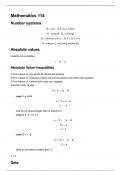
R : real : 12, 3/4, pi, 1.3333
N : natural : (1, inf inity)
Q : rational, a/b, a ∈ K, b ∈ K, b ≠ 0
K : integer, (−inf inity, inf inity)0
Absolute values
negative turns positive
| − a| = a
Absolute Value Inequalities
1.Find values of x for which all values are positive
2.Find values of x between where one part is positive and other part negative
3.Find values of x where both parts are negative
4.Do the union of sets
|x + 2| > |x − 6|
case 1: x >= 6
x + 2 > x − 6
2 > −6
true for all values bigger than or equal to 6
case 2: 6 -2 <=x < 6
x + 2 > −(x − 6)
2x > 4
x > 4
case 3: x < -2
−(x + 2) > −(x − 6)
−2 > 6
false for all values smaller than -2
x>4
Sets
, #definition A set is a unordered collection of unique items
The set containing {1,2,3} is the same as {1,2,3,2,1,3,2,1}
(a,b) : all values between a and b : not inclusive
[a,b] : all values between a and b : inclusive
#definition a set is a subset of another set when it contains all the elements of the other set
eg: {1} ⅽ {1,2,3}
Set Builder Notation
A set can be expressed as the set of the variable where certain conditions are met
A = { a | predicate }
eg: A = {a | a ∈ R}
A is the set of all Real numbers
eg: B = {b | b ∈ N | b > 5 }
B is the set of all natural numbers higher than 5
Intersection and Union
The elements in one set and another
A∩B
The elements in one set or another
A∪B
Compliment
The set of all items not in a set
A / B = { x ∈ A | x ∉ B}
eg: {1,2,3} / {2,3} = {1}
Multiplication of Sets
The product of two sets A and B, denoted by A × B, is the set of all ordered pairs (a, b) where
a is in A and b is in B
eg: if A = {1, 2} and B = {a, b}, then A × B = {(1, a), (1, b), (2, a), (2, b)}.
Logic
A => B
Number systems
R : real : 12, 3/4, pi, 1.3333
N : natural : (1, inf inity)
Q : rational, a/b, a ∈ K, b ∈ K, b ≠ 0
K : integer, (−inf inity, inf inity)0
Absolute values
negative turns positive
| − a| = a
Absolute Value Inequalities
1.Find values of x for which all values are positive
2.Find values of x between where one part is positive and other part negative
3.Find values of x where both parts are negative
4.Do the union of sets
|x + 2| > |x − 6|
case 1: x >= 6
x + 2 > x − 6
2 > −6
true for all values bigger than or equal to 6
case 2: 6 -2 <=x < 6
x + 2 > −(x − 6)
2x > 4
x > 4
case 3: x < -2
−(x + 2) > −(x − 6)
−2 > 6
false for all values smaller than -2
x>4
Sets
, #definition A set is a unordered collection of unique items
The set containing {1,2,3} is the same as {1,2,3,2,1,3,2,1}
(a,b) : all values between a and b : not inclusive
[a,b] : all values between a and b : inclusive
#definition a set is a subset of another set when it contains all the elements of the other set
eg: {1} ⅽ {1,2,3}
Set Builder Notation
A set can be expressed as the set of the variable where certain conditions are met
A = { a | predicate }
eg: A = {a | a ∈ R}
A is the set of all Real numbers
eg: B = {b | b ∈ N | b > 5 }
B is the set of all natural numbers higher than 5
Intersection and Union
The elements in one set and another
A∩B
The elements in one set or another
A∪B
Compliment
The set of all items not in a set
A / B = { x ∈ A | x ∉ B}
eg: {1,2,3} / {2,3} = {1}
Multiplication of Sets
The product of two sets A and B, denoted by A × B, is the set of all ordered pairs (a, b) where
a is in A and b is in B
eg: if A = {1, 2} and B = {a, b}, then A × B = {(1, a), (1, b), (2, a), (2, b)}.
Logic
A => B


