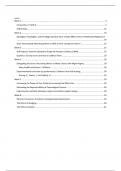
Index
Week 1: .................................................................................................................................................... 3
Chrysochou, P. (2017). ......................................................................................................................... 3
A/B testing ......................................................................................................................................... 16
Week 2 ................................................................................................................................................... 19
Spotlights, Floodlights, and the Magic Number Zero: Simple Effects Tests in Moderated Regression
........................................................................................................................................................... 19
Does Personalized Advertising Work as Well as Tech Companies Claim? ......................................... 23
Week 3 ................................................................................................................................................... 25
Self-Reports: How the Questions Shape the Answers Schwarz (1999) ............................................. 25
Qualtrics: Survey errors and how to address them. .......................................................................... 28
Week 5 ................................................................................................................................................... 30
Delegating Decisions: Recruiting Others to Make Choices We Might Regret; .................................. 30
Mary Steffel and Elanor F. Williams ............................................................................................... 30
Experimentation and start-up performance: Evidence from A/B testing;......................................... 34
Koning, R., Hasan, S., & Chatterji, A............................................................................................... 34
Week 7 ................................................................................................................................................... 39
Increasing the Power of Your Study by Increasing the Effect Size ..................................................... 39
Estimating the Reproducibility of Psychological Science ................................................................... 46
Experimental methods: Between-subject and within-subject design............................................... 50
Week 8 ................................................................................................................................................... 54
Why Do Consumers Condemn and Appreciate Experiments ............................................................ 54
The Ethics of Nudging ........................................................................................................................ 58
The Ethics Checklist ........................................................................................................................... 61
,
,Week 1:
Chrysochou, P. (2017).
This paper provides a basic overview of the types of consumer research one can do, with the
advantages of disadvantages of each. We want you to understand differences between primary &
secondary data, as well as qualitative & quantitative research, and how that links to other aspects
discussed in this course. We won't ask you to for example list the things to consider when doing a
focus group (e.g., the list on p413-414); but we can ask you to explain why a focus group could be (or
could not be suited to study a particular research question (for which knowing these components can
help). So make sure you know the pros and cons of all these methods, but especially
understand why these are pros and cons based on the other things we learn in this course.
1. Historical Context:
o Consumer behavior research has evolved alongside marketing thought.
o Early research focused on data collection, analytical techniques, and measuring
consumer characteristics.
o The 1970s saw advancements in computing, shifting the focus to analytical methods.
o In the early 2000s, the emphasis shifted to understanding the meaning behind data
for marketing decisions.
o The latest phase explores new data sources (e.g., big data, social media) and
emphasizes internal and external validity.
2. Research Project Design:
o Researchers follow general steps:
▪ Research objectives: Define objectives, research questions, and hypotheses
based on theory and prior research.
▪ Research design: Choose appropriate research methods to answer
questions.
▪ Sampling plan: Determine the sample size and selection criteria.
▪ Data collection: Collect relevant data.
▪ Data analysis: Analyze data using appropriate techniques.
▪ Reporting: Communicate findings.
An important consideration in the overall process of the research design is ethical issues that may
arise. Such ethical issues may relate to data collection (e.g. protect participants and respecting their
privacy, acquiring an informed
2.1
1. Primary Research:
o Definition: Primary research involves collecting original new data directly from the
field.
o Nature of Data: Researchers gather data themselves, often through methods like
surveys, focus groups, physiological measurements, or ethnographic research.
o Qualitative vs. Quantitative: Primary research can be further categorized into
qualitative (exploratory, descriptive) and quantitative (statistical, numerical)
methods.
, o Examples:
▪ Qualitative: Conducting in-depth interviews with consumers to understand
their motivations.
▪ Quantitative: Administering a survey to measure consumer preferences.
o Advantages: Provides fresh insights, tailored to specific research questions.
o Challenges: Requires time, effort, and resources for data collection.
2. Secondary Research:
o Definition: Secondary research relies on existing data that others have collected.
o Sources: Researchers analyze data from sources such as published studies, reports,
databases, or historical records.
o Examples:
▪ Literature reviews: Summarizing findings from previous studies.
▪ Data mining: Extracting patterns from large datasets.
o Advantages: Saves time and resources, especially when existing data is relevant.
o Challenges: Limited control over data quality and relevance.
3.
The choice of a primary research method mainly depends on whether the study attempts to measure
behavior or explore opinions (e.g. attitudes, perceptions, beliefs).
- If the study attempts to measure opinions and the aim is to get a deep understanding of the
phenomenon, methods such as focus groups and in-depth interviews could be used.
- If the aim is more to get an overview and not explore in-depth the phenomenon, then survey
methods should be preferred.
- If the study attempts to measure behavior and the behavior can be assessed in its natural
environment, then appropriate methods are observations, ethnography and panel data.
- If the behavior cannot be assessed in its natural environment then experiments and
physiological measures could be used instead. Primary research methods can be qualitative
or qualitative in nature.
Primary research methods can be qualitative or quantitative in nature. Qualitative research aims to
provide insight and in-depth understanding of the problem, while quantitative research aims to
quantify the data by applying some form of statistical analysis
Week 1: .................................................................................................................................................... 3
Chrysochou, P. (2017). ......................................................................................................................... 3
A/B testing ......................................................................................................................................... 16
Week 2 ................................................................................................................................................... 19
Spotlights, Floodlights, and the Magic Number Zero: Simple Effects Tests in Moderated Regression
........................................................................................................................................................... 19
Does Personalized Advertising Work as Well as Tech Companies Claim? ......................................... 23
Week 3 ................................................................................................................................................... 25
Self-Reports: How the Questions Shape the Answers Schwarz (1999) ............................................. 25
Qualtrics: Survey errors and how to address them. .......................................................................... 28
Week 5 ................................................................................................................................................... 30
Delegating Decisions: Recruiting Others to Make Choices We Might Regret; .................................. 30
Mary Steffel and Elanor F. Williams ............................................................................................... 30
Experimentation and start-up performance: Evidence from A/B testing;......................................... 34
Koning, R., Hasan, S., & Chatterji, A............................................................................................... 34
Week 7 ................................................................................................................................................... 39
Increasing the Power of Your Study by Increasing the Effect Size ..................................................... 39
Estimating the Reproducibility of Psychological Science ................................................................... 46
Experimental methods: Between-subject and within-subject design............................................... 50
Week 8 ................................................................................................................................................... 54
Why Do Consumers Condemn and Appreciate Experiments ............................................................ 54
The Ethics of Nudging ........................................................................................................................ 58
The Ethics Checklist ........................................................................................................................... 61
,
,Week 1:
Chrysochou, P. (2017).
This paper provides a basic overview of the types of consumer research one can do, with the
advantages of disadvantages of each. We want you to understand differences between primary &
secondary data, as well as qualitative & quantitative research, and how that links to other aspects
discussed in this course. We won't ask you to for example list the things to consider when doing a
focus group (e.g., the list on p413-414); but we can ask you to explain why a focus group could be (or
could not be suited to study a particular research question (for which knowing these components can
help). So make sure you know the pros and cons of all these methods, but especially
understand why these are pros and cons based on the other things we learn in this course.
1. Historical Context:
o Consumer behavior research has evolved alongside marketing thought.
o Early research focused on data collection, analytical techniques, and measuring
consumer characteristics.
o The 1970s saw advancements in computing, shifting the focus to analytical methods.
o In the early 2000s, the emphasis shifted to understanding the meaning behind data
for marketing decisions.
o The latest phase explores new data sources (e.g., big data, social media) and
emphasizes internal and external validity.
2. Research Project Design:
o Researchers follow general steps:
▪ Research objectives: Define objectives, research questions, and hypotheses
based on theory and prior research.
▪ Research design: Choose appropriate research methods to answer
questions.
▪ Sampling plan: Determine the sample size and selection criteria.
▪ Data collection: Collect relevant data.
▪ Data analysis: Analyze data using appropriate techniques.
▪ Reporting: Communicate findings.
An important consideration in the overall process of the research design is ethical issues that may
arise. Such ethical issues may relate to data collection (e.g. protect participants and respecting their
privacy, acquiring an informed
2.1
1. Primary Research:
o Definition: Primary research involves collecting original new data directly from the
field.
o Nature of Data: Researchers gather data themselves, often through methods like
surveys, focus groups, physiological measurements, or ethnographic research.
o Qualitative vs. Quantitative: Primary research can be further categorized into
qualitative (exploratory, descriptive) and quantitative (statistical, numerical)
methods.
, o Examples:
▪ Qualitative: Conducting in-depth interviews with consumers to understand
their motivations.
▪ Quantitative: Administering a survey to measure consumer preferences.
o Advantages: Provides fresh insights, tailored to specific research questions.
o Challenges: Requires time, effort, and resources for data collection.
2. Secondary Research:
o Definition: Secondary research relies on existing data that others have collected.
o Sources: Researchers analyze data from sources such as published studies, reports,
databases, or historical records.
o Examples:
▪ Literature reviews: Summarizing findings from previous studies.
▪ Data mining: Extracting patterns from large datasets.
o Advantages: Saves time and resources, especially when existing data is relevant.
o Challenges: Limited control over data quality and relevance.
3.
The choice of a primary research method mainly depends on whether the study attempts to measure
behavior or explore opinions (e.g. attitudes, perceptions, beliefs).
- If the study attempts to measure opinions and the aim is to get a deep understanding of the
phenomenon, methods such as focus groups and in-depth interviews could be used.
- If the aim is more to get an overview and not explore in-depth the phenomenon, then survey
methods should be preferred.
- If the study attempts to measure behavior and the behavior can be assessed in its natural
environment, then appropriate methods are observations, ethnography and panel data.
- If the behavior cannot be assessed in its natural environment then experiments and
physiological measures could be used instead. Primary research methods can be qualitative
or qualitative in nature.
Primary research methods can be qualitative or quantitative in nature. Qualitative research aims to
provide insight and in-depth understanding of the problem, while quantitative research aims to
quantify the data by applying some form of statistical analysis