7. Membrane Structure and Function
Cellular membranes are fluid mosaics of lipids and proteins
• Describe the properties of phospholipids and their arrangement in cellular membranes.
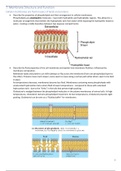
Phospholipids are amphipathic molecules – have both hydrophilic and hydrophobic regions. This allows for a
molecular arrangement that shelters the hydrophobic tails from water while exposing the hydrophilic heads to
water, creating a stable boundary between two aqueous compartments.
• Describe the fluid properties of the cell membrane and explain how membrane fluidity is influenced by
membrane composition.
Membrane lipids and proteins can shift sideways or flip across the membrane (from one phospholipid layer to
the other). Proteins move much slower; some seem to move along a certain path while others seem to be held
in place.
As temperatures decrease, membranes become less fluid. Membranes containing many phospholipids with
unsaturated hydrocarbon tails remain fluid at lower temperatures - compared to those with saturated
hydrocarbon tails - due to the “kinks” in the tails that prevent tight packing.
Cholesterol is wedged between the phospholipid molecules in the plasma membranes of animal cells. At high
temperatures, cholesterol restrains phospholipid movement. At low temperatures, cholesterol prevents tight
packing. Cholesterol can be seen as a “fluidity buffer” for membranes.
1
,• Describe how proteins and carbohydrates are spatially arranged in cell membranes and how they contribute to
membrane function.
PROTEINS
Proteins determine most of a membrane’s functions. There are 2 major populations of membrane proteins.
Integral Proteins penetrate the hydrophobic interior of the lipid bilayer. Peripheral Proteins are loosely bound
to the surface of a membrane, often to exposed parts of the integral proteins. Some membrane proteins are
held in place by attachment to the cell’s cytoskeleton and others may attach to materials outside the cell.
CARBOHYDRATES
Some membrane carbohydrates are covalently bonded to lipids, forming glycolipids. Most are covalently
bonded to proteins, forming glycoproteins. Membrane carbohydrates function as markers that distinguish one
cell from another – example: blood types reflect variation in the carbohydrate part of glycoproteins on the
surface of the red blood cells. They are important for sorting cells into tissues and organs, rejection of foreign
cells by the immune system, etc.
2
, Membrane structure results in selective permeability
• Describe factors that affect the selective permeability of membranes.
The nature of molecules passing through: Nonpolar molecules are hydrophobic, like lipids. Therefor they can
dissolve in the lipid bilayer of the membrane and cross it easily. Hydrophilic substances (polar molecules and
specific ions) can avoid contact with the lipid bilayer by passing through transport proteins that span the
membrane.
The size of molecules passing through: Molecules that are too large will not be able to freely pass through
membranes. They can only pass through membranes through endocytosis.
Temperature: Too high temperatures will denature the proteins that make up the membrane, therefor
destroying the selective permeability.
• Describe the locations and functions of transport proteins.
Transport proteins span the membrane. Channel proteins have a hydrophilic channel through the membrane.
Carrier proteins hold onto their passengers and change shape in a way that shuttles them across the membrane.
A transport protein is specific for the substance it transports, allowing only certain substances across the
membrane.
Passive transport is diffusion of a substance across a membrane with no energy investment
• Define diffusion.
Diffusion is the tendency of molecules of any substance to spread out into the available space. The net passive
movement of particles (atoms, ions or molecules) from a region in which they are in higher concentration to
regions of lower concentration.
• Explain what causes diffusion and why it is a spontaneous process.
In the absence of other forces, a substance will diffuse from where it is more concentrated to where it is less
concentrated. Diffusion is a spontaneous process since it needs no energy input.
• Explain what regulates the rate of passive transport.
The concentration gradient of the substances and the permeability of the membranes involved.
• Explain why a concentration gradient across a membrane represents potential energy.
Substances diffuse down their concentration gradient, the region along which the density of a chemical
substance increases or decreases. No work must be done to move substances down the concentration gradient.
The diffusion of a substance across a biological membrane is passive transport because no energy is expended
by the cell to make it happen. However, it represents potential energy because it drives diffusion.
• Distinguish between hypertonic, hypotonic and isotonic solutions.
Hypertonic: A solution which consists of more solutes and less water and when it is put in a cell, it will cause a
cell to lose water.
Hypotonic: A solution which consists of less solutes and more water and when it is put in a cell, it will cause a
cell to take up water.
Isotonic: A solution which has a balanced water and solutes concentration and will not cause the net movement
of water into or out of a cell.
• Define osmosis and predict the direction of water movement based on differences in solute concentrations.
Osmosis is the diffusion of free water across a selectively permeable membrane.
• Describe how living cells with and without walls regulate the balance of water content.
Living cells with walls will expand only so much before it exerts a back pressure on the cell that opposes further
water uptake. Cells without walls can tolerate neither excessive uptake nor excessive loss of water.
• Explain how transport proteins are similar to enzymes.
Transport proteins help speed up the transport of a solute by providing efficient passage through the
membrane without altering the direction of transport, just as enzymes speed up the reaction rate without
altering/taking part in the reaction itself.
• Explain how transport proteins facilitate diffusion.
Transport proteins are membrane spanning proteins that help polar molecules and ions, in-bedded in the lipid
bilayer of the membrane, passively diffuse.
3
Cellular membranes are fluid mosaics of lipids and proteins
• Describe the properties of phospholipids and their arrangement in cellular membranes.
Phospholipids are amphipathic molecules – have both hydrophilic and hydrophobic regions. This allows for a
molecular arrangement that shelters the hydrophobic tails from water while exposing the hydrophilic heads to
water, creating a stable boundary between two aqueous compartments.
• Describe the fluid properties of the cell membrane and explain how membrane fluidity is influenced by
membrane composition.
Membrane lipids and proteins can shift sideways or flip across the membrane (from one phospholipid layer to
the other). Proteins move much slower; some seem to move along a certain path while others seem to be held
in place.
As temperatures decrease, membranes become less fluid. Membranes containing many phospholipids with
unsaturated hydrocarbon tails remain fluid at lower temperatures - compared to those with saturated
hydrocarbon tails - due to the “kinks” in the tails that prevent tight packing.
Cholesterol is wedged between the phospholipid molecules in the plasma membranes of animal cells. At high
temperatures, cholesterol restrains phospholipid movement. At low temperatures, cholesterol prevents tight
packing. Cholesterol can be seen as a “fluidity buffer” for membranes.
1
,• Describe how proteins and carbohydrates are spatially arranged in cell membranes and how they contribute to
membrane function.
PROTEINS
Proteins determine most of a membrane’s functions. There are 2 major populations of membrane proteins.
Integral Proteins penetrate the hydrophobic interior of the lipid bilayer. Peripheral Proteins are loosely bound
to the surface of a membrane, often to exposed parts of the integral proteins. Some membrane proteins are
held in place by attachment to the cell’s cytoskeleton and others may attach to materials outside the cell.
CARBOHYDRATES
Some membrane carbohydrates are covalently bonded to lipids, forming glycolipids. Most are covalently
bonded to proteins, forming glycoproteins. Membrane carbohydrates function as markers that distinguish one
cell from another – example: blood types reflect variation in the carbohydrate part of glycoproteins on the
surface of the red blood cells. They are important for sorting cells into tissues and organs, rejection of foreign
cells by the immune system, etc.
2
, Membrane structure results in selective permeability
• Describe factors that affect the selective permeability of membranes.
The nature of molecules passing through: Nonpolar molecules are hydrophobic, like lipids. Therefor they can
dissolve in the lipid bilayer of the membrane and cross it easily. Hydrophilic substances (polar molecules and
specific ions) can avoid contact with the lipid bilayer by passing through transport proteins that span the
membrane.
The size of molecules passing through: Molecules that are too large will not be able to freely pass through
membranes. They can only pass through membranes through endocytosis.
Temperature: Too high temperatures will denature the proteins that make up the membrane, therefor
destroying the selective permeability.
• Describe the locations and functions of transport proteins.
Transport proteins span the membrane. Channel proteins have a hydrophilic channel through the membrane.
Carrier proteins hold onto their passengers and change shape in a way that shuttles them across the membrane.
A transport protein is specific for the substance it transports, allowing only certain substances across the
membrane.
Passive transport is diffusion of a substance across a membrane with no energy investment
• Define diffusion.
Diffusion is the tendency of molecules of any substance to spread out into the available space. The net passive
movement of particles (atoms, ions or molecules) from a region in which they are in higher concentration to
regions of lower concentration.
• Explain what causes diffusion and why it is a spontaneous process.
In the absence of other forces, a substance will diffuse from where it is more concentrated to where it is less
concentrated. Diffusion is a spontaneous process since it needs no energy input.
• Explain what regulates the rate of passive transport.
The concentration gradient of the substances and the permeability of the membranes involved.
• Explain why a concentration gradient across a membrane represents potential energy.
Substances diffuse down their concentration gradient, the region along which the density of a chemical
substance increases or decreases. No work must be done to move substances down the concentration gradient.
The diffusion of a substance across a biological membrane is passive transport because no energy is expended
by the cell to make it happen. However, it represents potential energy because it drives diffusion.
• Distinguish between hypertonic, hypotonic and isotonic solutions.
Hypertonic: A solution which consists of more solutes and less water and when it is put in a cell, it will cause a
cell to lose water.
Hypotonic: A solution which consists of less solutes and more water and when it is put in a cell, it will cause a
cell to take up water.
Isotonic: A solution which has a balanced water and solutes concentration and will not cause the net movement
of water into or out of a cell.
• Define osmosis and predict the direction of water movement based on differences in solute concentrations.
Osmosis is the diffusion of free water across a selectively permeable membrane.
• Describe how living cells with and without walls regulate the balance of water content.
Living cells with walls will expand only so much before it exerts a back pressure on the cell that opposes further
water uptake. Cells without walls can tolerate neither excessive uptake nor excessive loss of water.
• Explain how transport proteins are similar to enzymes.
Transport proteins help speed up the transport of a solute by providing efficient passage through the
membrane without altering the direction of transport, just as enzymes speed up the reaction rate without
altering/taking part in the reaction itself.
• Explain how transport proteins facilitate diffusion.
Transport proteins are membrane spanning proteins that help polar molecules and ions, in-bedded in the lipid
bilayer of the membrane, passively diffuse.
3