

INTRODUCTION TO BUSINESS MANAGEMENT
CHAPTER 4: THE BUSINESS ENVIRONMENT
The business environment and change:
• Change = moving from one system or situation to another.
• Change refers to any alteration in the status quo. This implies a change from a condition of stability to one
instability, a shift from predictable of from know to unknown.
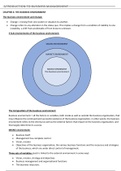
3 Sub-environments of the business environment:
MACRO ENVIRONMENT
MARKET ENVIRONMENT
MICRO EVIRONMENT
The business environment
The Composition of the business environment:
Business environment = all the factors or variables, both inside as well as outside the business organisation, that
may influence the continued and successful existence of the business organisation, in other words, the business
environment refers to the internal as well as the external factors that impact on the business organisation, and
that largely determine its success.
MICRO-environment:
• Business itself
• Management has complete control
• Vision, mission
• Objectives of the business organisation, the various business functions and the resources and strategies
of the business, which are under direct control of management.
Three sets of variables: (each is linked to the external environment in some way)
• Vision, mission, strategy and objectives
• Business management and organisational functions
• The business resources.
, Vision statement: what do we want to become?
Mission statement: developed after the vision statement and answer the question: What is our business?
• Can be described as the reason why an organisation is in business and is used to distinguish one business
from other similar firms.
• Serves as the foundation for the development of long-term objectives, which are the specific results an
organisation seeks to achieve.
An organisation’s vision and mission statement are influenced by the external environment.
Resources:
• Tangible resources: Production facilities, raw materials, financial resources, property.
• Intangible resources: Brand names, patents, trademarks, the company reputation, technical knowledge,
organisational morale and accumulated experience.
• Organisational capabilities: the ability to combine resources, people and processes in particular ways.
MARKET-environment:
• Encountered immediately outside the business organisation.
• Determine the nature and strength of competition in any industry.
• Key variables in this environment:
o Consumers: Customers with a buying power and behaviour who buys the products and services of
the business.
o Competitors: including new and potential competitors who wants to maintain or improve their
position in the marketplace.
o Labour market and labour unions: aspect such as the availability of skilled labour and the impact
of strikes on businesses are well-known variables in South Africa and must be considered by
business.
o Intermediaries: compete to handle the business’s products to get it to the consumer.
o Suppliers: who comply, or do not wish to supply, raw materials, products, services and finance to
the business organisation to enable it to manufacture the products and services that the
consumer requires.
• All these variables give rise to opportunities and threats.
• Task environment: Top management must take note of changes and anticipate their impact on the
business.
• Management has no control over the components of the market environment, management may
influence the variables concerned through its strategy.
• “The Market”: People who have needs to satisfy and the financial means to do so.
• Management also must understand that the conditions in the customer marketplace are directly
influenced by variables in the macro-environment.
• The consumer market can further be subdivided as follows, according to the products that are bought:
o Durable products (furniture, cars)
o Semi-durable products (food, tobacco)
o Services (insurance, rental)
Suppliers: A business organisation is regarded as a system that receives inputs from the environment and
converts these into outputs in the form of products or services for sale in the market environment. A business
organisation depends not only on suppliers of raw materials, but also on suppliers of Capital, Banks and
Shareholders are such as Suppliers.
Labour markets and labour unions: Supply of human resources.
CHAPTER 4: THE BUSINESS ENVIRONMENT
The business environment and change:
• Change = moving from one system or situation to another.
• Change refers to any alteration in the status quo. This implies a change from a condition of stability to one
instability, a shift from predictable of from know to unknown.
3 Sub-environments of the business environment:
MACRO ENVIRONMENT
MARKET ENVIRONMENT
MICRO EVIRONMENT
The business environment
The Composition of the business environment:
Business environment = all the factors or variables, both inside as well as outside the business organisation, that
may influence the continued and successful existence of the business organisation, in other words, the business
environment refers to the internal as well as the external factors that impact on the business organisation, and
that largely determine its success.
MICRO-environment:
• Business itself
• Management has complete control
• Vision, mission
• Objectives of the business organisation, the various business functions and the resources and strategies
of the business, which are under direct control of management.
Three sets of variables: (each is linked to the external environment in some way)
• Vision, mission, strategy and objectives
• Business management and organisational functions
• The business resources.
, Vision statement: what do we want to become?
Mission statement: developed after the vision statement and answer the question: What is our business?
• Can be described as the reason why an organisation is in business and is used to distinguish one business
from other similar firms.
• Serves as the foundation for the development of long-term objectives, which are the specific results an
organisation seeks to achieve.
An organisation’s vision and mission statement are influenced by the external environment.
Resources:
• Tangible resources: Production facilities, raw materials, financial resources, property.
• Intangible resources: Brand names, patents, trademarks, the company reputation, technical knowledge,
organisational morale and accumulated experience.
• Organisational capabilities: the ability to combine resources, people and processes in particular ways.
MARKET-environment:
• Encountered immediately outside the business organisation.
• Determine the nature and strength of competition in any industry.
• Key variables in this environment:
o Consumers: Customers with a buying power and behaviour who buys the products and services of
the business.
o Competitors: including new and potential competitors who wants to maintain or improve their
position in the marketplace.
o Labour market and labour unions: aspect such as the availability of skilled labour and the impact
of strikes on businesses are well-known variables in South Africa and must be considered by
business.
o Intermediaries: compete to handle the business’s products to get it to the consumer.
o Suppliers: who comply, or do not wish to supply, raw materials, products, services and finance to
the business organisation to enable it to manufacture the products and services that the
consumer requires.
• All these variables give rise to opportunities and threats.
• Task environment: Top management must take note of changes and anticipate their impact on the
business.
• Management has no control over the components of the market environment, management may
influence the variables concerned through its strategy.
• “The Market”: People who have needs to satisfy and the financial means to do so.
• Management also must understand that the conditions in the customer marketplace are directly
influenced by variables in the macro-environment.
• The consumer market can further be subdivided as follows, according to the products that are bought:
o Durable products (furniture, cars)
o Semi-durable products (food, tobacco)
o Services (insurance, rental)
Suppliers: A business organisation is regarded as a system that receives inputs from the environment and
converts these into outputs in the form of products or services for sale in the market environment. A business
organisation depends not only on suppliers of raw materials, but also on suppliers of Capital, Banks and
Shareholders are such as Suppliers.
Labour markets and labour unions: Supply of human resources.


