Topic: psychology- introduction to memory: coding, capacity, duration
Key points/ Notes/Diagrams:
Main Ideas/
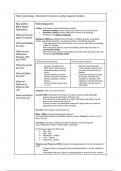
Coding- The format in which information is stored.
Questions: - Acoustic coding involves coding info in terms of the way it sounds
- Semantic coding involves coding info in terms of its meaning.
What are the two - Coding can be similar or dissimilar.
types of coding?
Baddeley (1966) gave different lists of words to 4 different groups: acoustically
similar, acoustically dissimilar, semantically similar, semantically dissimilar.
What did Baddley - They were asked to recall the words in the correct order either immediately
find out? or after 20 minutes.
- When they were asked to recall immediately (STM) they did worse on
acoustically similar.
What are the - When they were asked to recall after 20 minutes (LTM) they did worse with
differences something semantically similar.
between LTM
and STM?
STM (short term memory) LTM (long term memory)
What did Jacobs - Acoustic (encoding info) - Semantic (encoding info)
find out? - STM doesn’t last very long - It has unlimited capacity and
- Rehearsal keeps a memory can store memories up to a
active lifetime.
What did Miller - Verbal rehearsal can allow - Cannot be tested as it would
find out? memory to become long term be heavily unrealistic and
- Without rehearsal, memory unethical so therefore LTM
What did decays. capacity is naturally assumed.
- 18-30 seconds memory loss - LTM holds a vast amount of
Peterson & - 7 (+/-) 2 information.
Peterson find
out? Capacity- How much can be stored.
What did Bahrick Jacobs (1887) developed a technique to measure memory called digit span.
- Assess how much information STM can hold.
et al Find out? - The researcher briefly presents 4 digits, participants are asked to recall
these in the correct order out loud.
- If recall is correct, the researcher reads out 5 digits, and so on until the
participant can't recall the order correctly.
Duration- How long the memory lasts for.
Miller (1956) reviewed psychological research.
He found that the span of immediate memory is about 7 items (a bit more or a bit
less) “7 +/- 2”
Chunking- naturally we group information together to improve memory.
(e.g a telephone number, number plates, postcodes).
Psychosexual Approach Mnemonic
● Old - Oral
● Age - Anal
● Pensioners - Phallic
● Love - Latency
● Gardening - Genital
Peterson and Peterson (1959)- Tested 24 undergraduates to find out the duration of
STM.
- A trigram (three consonants) will be presented briefly on screen. Read this
aloud.
- Immediately after this, begin counting backward in threes from the number
Key points/ Notes/Diagrams:
Main Ideas/
Coding- The format in which information is stored.
Questions: - Acoustic coding involves coding info in terms of the way it sounds
- Semantic coding involves coding info in terms of its meaning.
What are the two - Coding can be similar or dissimilar.
types of coding?
Baddeley (1966) gave different lists of words to 4 different groups: acoustically
similar, acoustically dissimilar, semantically similar, semantically dissimilar.
What did Baddley - They were asked to recall the words in the correct order either immediately
find out? or after 20 minutes.
- When they were asked to recall immediately (STM) they did worse on
acoustically similar.
What are the - When they were asked to recall after 20 minutes (LTM) they did worse with
differences something semantically similar.
between LTM
and STM?
STM (short term memory) LTM (long term memory)
What did Jacobs - Acoustic (encoding info) - Semantic (encoding info)
find out? - STM doesn’t last very long - It has unlimited capacity and
- Rehearsal keeps a memory can store memories up to a
active lifetime.
What did Miller - Verbal rehearsal can allow - Cannot be tested as it would
find out? memory to become long term be heavily unrealistic and
- Without rehearsal, memory unethical so therefore LTM
What did decays. capacity is naturally assumed.
- 18-30 seconds memory loss - LTM holds a vast amount of
Peterson & - 7 (+/-) 2 information.
Peterson find
out? Capacity- How much can be stored.
What did Bahrick Jacobs (1887) developed a technique to measure memory called digit span.
- Assess how much information STM can hold.
et al Find out? - The researcher briefly presents 4 digits, participants are asked to recall
these in the correct order out loud.
- If recall is correct, the researcher reads out 5 digits, and so on until the
participant can't recall the order correctly.
Duration- How long the memory lasts for.
Miller (1956) reviewed psychological research.
He found that the span of immediate memory is about 7 items (a bit more or a bit
less) “7 +/- 2”
Chunking- naturally we group information together to improve memory.
(e.g a telephone number, number plates, postcodes).
Psychosexual Approach Mnemonic
● Old - Oral
● Age - Anal
● Pensioners - Phallic
● Love - Latency
● Gardening - Genital
Peterson and Peterson (1959)- Tested 24 undergraduates to find out the duration of
STM.
- A trigram (three consonants) will be presented briefly on screen. Read this
aloud.
- Immediately after this, begin counting backward in threes from the number