Topic: psychology- statistical testing and the sign test
Key points/ Notes/Diagrams:
Main Ideas/
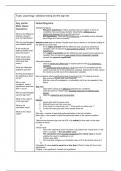
Statistical analysis
Questions: - Research hypothesis- HIstory students will score higher in terms of
sociability than psychology students. Essentially a difference or a
What is the difference relationship between the IV and DV will occur.
between research - Null hypothesis- There will be no difference in sociability scores between
and null hypothesis? psychology and history students.
Why do psychologists Statistics tests help us decide if results occur due to chance or not (when looking at
use statistics tests? the difference in the mean.
- If it is highly probable that the difference was caused by extraneous
If the results are variables, then we assume it was caused by chance. (accept the null
highly probable what hypothesis)
does that mean? - If it's highly improbable that the difference was caused by the extraneous
variable, then we assume it was caused by the independent variable.
If the results were (accept the research hypothesis)
highly improbable
what does that Inferential statistics
mean? - Used to identify the differences in results based on the IV or extraneous
variables.
What are inferential - The significance level is set at p < 0.05 (less than 5% probability that the
statistics used for? results occurred due to the extraneous variables. Researcher is 95% certain
the results occurred due to the independent variable).
At what percentage is
the significance level Rare occasions where significance level is less than 0.01 (1% chance of error)
set at? - May involve a human cost- new drug trial
- May be a one-off investigation, no possibility that it can be repeated in the
Why in rare future.
occasions does a
significance level less Sign test
than 1 occur? - Used when looking at a difference between two conditions
- Used for paired or related data (repeated measures or matched pairs
Why do psychologists design)
use the sign test? - Used for categorical and nominal data.
↓
What is the method
Method:
of the sign test?
1. Ignore ppts with the same score
2. Subtract score one from score two
What is the
3. If the result is a minus then use “-” if the result is positive use “+”
calculated value?
4. Count how many plus and minus results there are.
What is the critical ↓
value? Plus sign = number of ppts that performed better in the first condition
Minus sign = the number of ppts that performed better in the second condition.
↓
Take the less frequent sign and call it S → (s value) In this case it is the total
number of minus.
↓
Critical value
- Once the statistical test has been calculated the researcher is left
with a number → the calculated value.
- The calculated value must be compared to the critical value to decide
whether the result is significant or not.
- Critical value table.
- We must also compare our calculated value of S to the critical value of S
↓
Calculated S value must be equal to or less than Critical S value for there to be
significance.
If higher = not significant = accept null hypothesis.
Key points/ Notes/Diagrams:
Main Ideas/
Statistical analysis
Questions: - Research hypothesis- HIstory students will score higher in terms of
sociability than psychology students. Essentially a difference or a
What is the difference relationship between the IV and DV will occur.
between research - Null hypothesis- There will be no difference in sociability scores between
and null hypothesis? psychology and history students.
Why do psychologists Statistics tests help us decide if results occur due to chance or not (when looking at
use statistics tests? the difference in the mean.
- If it is highly probable that the difference was caused by extraneous
If the results are variables, then we assume it was caused by chance. (accept the null
highly probable what hypothesis)
does that mean? - If it's highly improbable that the difference was caused by the extraneous
variable, then we assume it was caused by the independent variable.
If the results were (accept the research hypothesis)
highly improbable
what does that Inferential statistics
mean? - Used to identify the differences in results based on the IV or extraneous
variables.
What are inferential - The significance level is set at p < 0.05 (less than 5% probability that the
statistics used for? results occurred due to the extraneous variables. Researcher is 95% certain
the results occurred due to the independent variable).
At what percentage is
the significance level Rare occasions where significance level is less than 0.01 (1% chance of error)
set at? - May involve a human cost- new drug trial
- May be a one-off investigation, no possibility that it can be repeated in the
Why in rare future.
occasions does a
significance level less Sign test
than 1 occur? - Used when looking at a difference between two conditions
- Used for paired or related data (repeated measures or matched pairs
Why do psychologists design)
use the sign test? - Used for categorical and nominal data.
↓
What is the method
Method:
of the sign test?
1. Ignore ppts with the same score
2. Subtract score one from score two
What is the
3. If the result is a minus then use “-” if the result is positive use “+”
calculated value?
4. Count how many plus and minus results there are.
What is the critical ↓
value? Plus sign = number of ppts that performed better in the first condition
Minus sign = the number of ppts that performed better in the second condition.
↓
Take the less frequent sign and call it S → (s value) In this case it is the total
number of minus.
↓
Critical value
- Once the statistical test has been calculated the researcher is left
with a number → the calculated value.
- The calculated value must be compared to the critical value to decide
whether the result is significant or not.
- Critical value table.
- We must also compare our calculated value of S to the critical value of S
↓
Calculated S value must be equal to or less than Critical S value for there to be
significance.
If higher = not significant = accept null hypothesis.