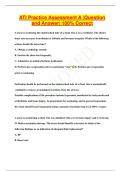
ATI Practice Assessment A |Question and Answer| 100% Correct
ATI Practice Assessment A |Question and Answer| 100% Correct A nurse is suctioning the endotracheal tube of a client who is on a ventilator. The client's heart rate increases from 86/min to 110/min and becomes irregular. Which of the following actions should the nurse take? A. Obtain a cardiology consult. B. Suction the client less frequently. C. Administer an antidysrhythmic medication. D. Perform pre-oxygenation prior to suctioning. *Ans* D. Perform pre-oxygenation prior to suctioning Suctioning should be performed on the endotracheal tube of a client who is mechanically ventilated to remove accumulated secretions from the airways. Possible complications of the procedure include hypoxemia, manifested by tachycardia and arrhythmia, and tissue injury.. In preparation for suctioning, and to prevent hypoxemia, the client should be pre-oxygenated using a manual resuscitator bag set at 100% oxygen. A nurse is monitoring a client who was admitted with a severe burn injury and is receiving IV fluid resuscitation therapy. The nurse should identify a decrease in which of the following findings as an indication of adequate fluid replacement? A. BP B. Heart rate C. Urine output D. Weight *Ans* B. Heart rate When a client's circulating fluid volume is low, the heart rate increases to maintain adequate blood pressure. Therefore, the nurse should identify a decrease in heart rate as in indication of adequate fluid replacement. A nurse is caring for a client who has a cardiopulmonary arrest. The nurse anticipates the emergency response team will administer which of the following medications if the client's restored rhythm is symptomatic bradycardia? A. Epinephrine B. Magnesium C. Atropine D. Sodium bicarbonate *Ans* C. Atropine The team administers atropine during CPR if the client has symptomatic bradycardia, or is hemodynamically unstable. - The team administers epinephrine during CPR to clients who have systole or pulseless electrical activity. - The team administers magnesium during CPR for clients who have torsade de pointes, which is a specific type of ventricular tachycardia. - The team administers sodium bicarbonate to correct metabolic acidosis that does not improve with CPR. A nurse is assessing a group of clients for hospice services. The nurse should recommend hospice care for which of the following clients? A. A client who has diabetes mellitus and is having difficulty self-administering insulin because of poor eye sight B. A client who has terminal cancer and needs assistance with pain management C. A client who is recovering from a stroke and needs someone to provide care while his spouse is at work D. A client who has dementia and needs help with activities of daily living *Ans* B. A client who has terminal cancer and n
Written for
- Institution
- ATI
- Course
- ATI
Document information
- Uploaded on
- May 29, 2024
- Number of pages
- 26
- Written in
- 2023/2024
- Type
- Exam (elaborations)
- Contains
- Questions & answers
Subjects
-
ati practice assessment a question and answer 1

Document also available in package deal