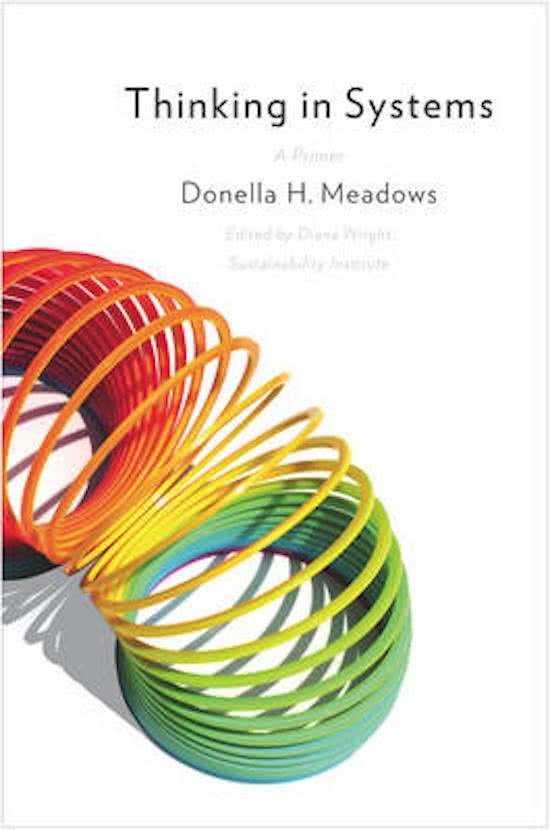
Thinking in systems
Donella Meadows
Table of Contents
Introduction............................................................................................................................................2
Chapter 1 The basics...............................................................................................................................3
Chapter 2 A brief visit to the systems zoo..............................................................................................5
One-stock systems..............................................................................................................................5
Two stock systems..............................................................................................................................7
Chapter 3 Why systems work so well.....................................................................................................8
Chapter 4 Why systems surprise us......................................................................................................10
Chapter 5 System traps and opportunities...........................................................................................12
Chapter 6 Leverage points – places to intervene in a system...............................................................16
Chapter 7 Living in a world of systems.................................................................................................17
1
,Introduction
Toy on the cover of the book is called a ‘slinkey’. It serves as a personification of system thinking;
once we see the relationship between structure and behavior, we can begin to understand how
systems work, and how to shift into better behavior patterns. System thinking allows to identify root
causes of problems and see new opportunities.
System: a set of things – people, cells, molecules, etc. – interconnected in such a way that they
produce their own pattern of behavior over time. The system causes its own behavior, potentially
unleashed by an outside event.
Over the years, we have been able to solve problems by focusing on external agents (e.g. preventing
smallpox). But as these problems are part of larger systems, they have created new problems. There
are also problems rooted in the internal structure of complex systems that refused to go away (e.g.
poverty, chronic disease, etc.).
System problems: undesirable behaviors characteristic of the system structures that produce them.
Systems happen all at once; they are connected in many directions simultaneously.
The behavior of a system cannot be known just by knowing the elements of which the system is
made.
2
, Chapter 1 The basics
System: A set of elements or parts that is coherently organized and interconnected in a pattern or
structure that produces a characteristic set of behaviors, often classified as its function or purpose.
Examples of systems: digestive system, football team, school, city, factory, earth, galaxy, etc.
Systems can thus be embedded in other systems.
Something is NOT a system when there are no interconnections or there is no function.
There is an integrity or wholeness about a system and an active set of mechanisms to maintain that
system. Therefore, a system is more than the sum of its parts. Systems can change, adapt, organize,
and repair.
The elements of a system can be noticed as they are visible, often tangible (e.g. elements of a tree, a
university) but not necessarily physical (intangible) (e.g. university’s academic prowess). It is easier to
learn about a system’s elements than its interconnections.
The interconnections are the relationships that hold the elements together (e.g. physical flows and
chemical reactions in a tree; standards of admission, examinations and graders, communication of
knowledge, etc. at a university). Some interconnections are physical flows (e.g. flow of water,
students progressing through university), many are flows of information (e.g. consumer decision
making). Information-based relationships are hard to see, but functions and purposes are even
harder.
Purposes are deducted from behavior, not from rhetoric or stated goals. We use function for a non-
human system, and purpose for a human system. But this is not absolute as many systems have
human and non-human elements. As systems can exist within bigger systems, so can purposes. An
essential function of successful systems is to keep sub-purposes and overall system purposes in
harmony.
The elements of systems gradually change slowly if at all, but still stays the same system – as long as
the interconnections and purpose remains in tact (e.g. changing players of a football team, is still a
football team).
If the interconnections change, the system may be greatly altered even if the elements stay the same
(e.g. adjust the rules of a football game).
A change in purpose/function changes the system profoundly even if the elements and
interconnections stay the same (e.g. change the goal of a football game from winning to losing).
All 3 are essential to a system! But the purpose/function is the most crucial determinant of the
system’s behavior. The elements are least important in defining the unique characteristics of the
system (unless a change in element results in change in relationship or purpose).
Stock: a foundation of a system; the elements that you can see, feel, or measure. Physical or non-
physical. They change over time through actions of a flow.
Flow: material or information that enters or leaves a stock over a period of time.
A stock is the memory of the history of changing flows within the system. pages 18-19
System diagrams containing flows and stocks are simplified versions of the real world (e.g. bathtub).
System diagrams’ stocks or flows can be visualized in a behavior-over-time graph (see page 20). The
horizontal axis is the time axis, the vertical axis the characteristic of the stock or flow.
Dynamic equilibrium: the condition in which the state of a stock is steady and unchanging, despite
inflows and outflows. This is possible when all inflows equal all outflows (e.g. filling a bathtub at the
same amount of water as is flowing out; page 21).
3
Donella Meadows
Table of Contents
Introduction............................................................................................................................................2
Chapter 1 The basics...............................................................................................................................3
Chapter 2 A brief visit to the systems zoo..............................................................................................5
One-stock systems..............................................................................................................................5
Two stock systems..............................................................................................................................7
Chapter 3 Why systems work so well.....................................................................................................8
Chapter 4 Why systems surprise us......................................................................................................10
Chapter 5 System traps and opportunities...........................................................................................12
Chapter 6 Leverage points – places to intervene in a system...............................................................16
Chapter 7 Living in a world of systems.................................................................................................17
1
,Introduction
Toy on the cover of the book is called a ‘slinkey’. It serves as a personification of system thinking;
once we see the relationship between structure and behavior, we can begin to understand how
systems work, and how to shift into better behavior patterns. System thinking allows to identify root
causes of problems and see new opportunities.
System: a set of things – people, cells, molecules, etc. – interconnected in such a way that they
produce their own pattern of behavior over time. The system causes its own behavior, potentially
unleashed by an outside event.
Over the years, we have been able to solve problems by focusing on external agents (e.g. preventing
smallpox). But as these problems are part of larger systems, they have created new problems. There
are also problems rooted in the internal structure of complex systems that refused to go away (e.g.
poverty, chronic disease, etc.).
System problems: undesirable behaviors characteristic of the system structures that produce them.
Systems happen all at once; they are connected in many directions simultaneously.
The behavior of a system cannot be known just by knowing the elements of which the system is
made.
2
, Chapter 1 The basics
System: A set of elements or parts that is coherently organized and interconnected in a pattern or
structure that produces a characteristic set of behaviors, often classified as its function or purpose.
Examples of systems: digestive system, football team, school, city, factory, earth, galaxy, etc.
Systems can thus be embedded in other systems.
Something is NOT a system when there are no interconnections or there is no function.
There is an integrity or wholeness about a system and an active set of mechanisms to maintain that
system. Therefore, a system is more than the sum of its parts. Systems can change, adapt, organize,
and repair.
The elements of a system can be noticed as they are visible, often tangible (e.g. elements of a tree, a
university) but not necessarily physical (intangible) (e.g. university’s academic prowess). It is easier to
learn about a system’s elements than its interconnections.
The interconnections are the relationships that hold the elements together (e.g. physical flows and
chemical reactions in a tree; standards of admission, examinations and graders, communication of
knowledge, etc. at a university). Some interconnections are physical flows (e.g. flow of water,
students progressing through university), many are flows of information (e.g. consumer decision
making). Information-based relationships are hard to see, but functions and purposes are even
harder.
Purposes are deducted from behavior, not from rhetoric or stated goals. We use function for a non-
human system, and purpose for a human system. But this is not absolute as many systems have
human and non-human elements. As systems can exist within bigger systems, so can purposes. An
essential function of successful systems is to keep sub-purposes and overall system purposes in
harmony.
The elements of systems gradually change slowly if at all, but still stays the same system – as long as
the interconnections and purpose remains in tact (e.g. changing players of a football team, is still a
football team).
If the interconnections change, the system may be greatly altered even if the elements stay the same
(e.g. adjust the rules of a football game).
A change in purpose/function changes the system profoundly even if the elements and
interconnections stay the same (e.g. change the goal of a football game from winning to losing).
All 3 are essential to a system! But the purpose/function is the most crucial determinant of the
system’s behavior. The elements are least important in defining the unique characteristics of the
system (unless a change in element results in change in relationship or purpose).
Stock: a foundation of a system; the elements that you can see, feel, or measure. Physical or non-
physical. They change over time through actions of a flow.
Flow: material or information that enters or leaves a stock over a period of time.
A stock is the memory of the history of changing flows within the system. pages 18-19
System diagrams containing flows and stocks are simplified versions of the real world (e.g. bathtub).
System diagrams’ stocks or flows can be visualized in a behavior-over-time graph (see page 20). The
horizontal axis is the time axis, the vertical axis the characteristic of the stock or flow.
Dynamic equilibrium: the condition in which the state of a stock is steady and unchanging, despite
inflows and outflows. This is possible when all inflows equal all outflows (e.g. filling a bathtub at the
same amount of water as is flowing out; page 21).
3