Key words notes questions
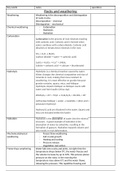
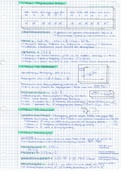
Rocks and weathering
Weathering Weathering is the decomposition and disintegration
of rocks in situ.
Decomposition – chemical
Disintegration – mechanical
Chemical weathering - Carbonation
- Hydrolysis
- Hydration
Carbonation
Carbonation is the process of rock minerals reacting
with carbonic acid. Carbonic acid is formed when
water combines with carbon dioxide. Carbonic acid
dissolves or breaks down minerals in the rock.
CO2 + H2O → H2CO3
(carbon dioxide + water → carbonic acid)
CaCO3 + H2CO3 → Ca2+ + 2HCO3-
(calcite + carbonic acid → calcium + bicarbonate)
Hydrolysis Hydrolysis is a chemical reaction caused by water.
Water changes the chemical composition and size of
minerals in rock, making them less resistant to
weathering. It is most effective on granite because
granite contains, quartz, mica, and feldspar.
Hydrolysis impacts feldspar as feldspar reacts with
water and form kaolin (china clay).
2KAISi3O8 + 2H+ + 9H20 → H4Al2Si2O9 + 4H4SiO4 + 2K+
(orthoclase feldspar + water → kaolinite + silicic acid +
potassium hydroxyl)
Hydroxyl & acid are dissolved in the water, Quartz and
mica are included within the kaolin
Hydration Hydration is the absorption of water into the mineral
structure. A good example of hydration is the
absorption of water by anhydrite, resulting in the
formation of gypsum. Hydration expands volume and
also results in rock deformation.
Mechanical/physical - Freeze thaw weathering
weathering - Salt crystal growth
- Heating and cooling
- Pressure release
- Vegetation root action
Freeze thaw weathering Water falls into cracks and joints. At night time the
temperature drops below 0C, the water freezes and
the volume increase by up to 10%. This process places
pressure on the rocks. In the morning the
temperature rises above 0C and the water thaws,
releasing the pressure. This repetitive freezing and
Rocks and weathering
Weathering Weathering is the decomposition and disintegration
of rocks in situ.
Decomposition – chemical
Disintegration – mechanical
Chemical weathering - Carbonation
- Hydrolysis
- Hydration
Carbonation
Carbonation is the process of rock minerals reacting
with carbonic acid. Carbonic acid is formed when
water combines with carbon dioxide. Carbonic acid
dissolves or breaks down minerals in the rock.
CO2 + H2O → H2CO3
(carbon dioxide + water → carbonic acid)
CaCO3 + H2CO3 → Ca2+ + 2HCO3-
(calcite + carbonic acid → calcium + bicarbonate)
Hydrolysis Hydrolysis is a chemical reaction caused by water.
Water changes the chemical composition and size of
minerals in rock, making them less resistant to
weathering. It is most effective on granite because
granite contains, quartz, mica, and feldspar.
Hydrolysis impacts feldspar as feldspar reacts with
water and form kaolin (china clay).
2KAISi3O8 + 2H+ + 9H20 → H4Al2Si2O9 + 4H4SiO4 + 2K+
(orthoclase feldspar + water → kaolinite + silicic acid +
potassium hydroxyl)
Hydroxyl & acid are dissolved in the water, Quartz and
mica are included within the kaolin
Hydration Hydration is the absorption of water into the mineral
structure. A good example of hydration is the
absorption of water by anhydrite, resulting in the
formation of gypsum. Hydration expands volume and
also results in rock deformation.
Mechanical/physical - Freeze thaw weathering
weathering - Salt crystal growth
- Heating and cooling
- Pressure release
- Vegetation root action
Freeze thaw weathering Water falls into cracks and joints. At night time the
temperature drops below 0C, the water freezes and
the volume increase by up to 10%. This process places
pressure on the rocks. In the morning the
temperature rises above 0C and the water thaws,
releasing the pressure. This repetitive freezing and