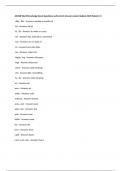
FLETC Written Exam 4 Questions and Answers 100% Verified!!
Three Types of Explosions - ANSWER-Mechanical Chemical Nuclear High Explosive - ANSWER-Explosive which normally requires a blasting cap for initiation and once initiated produces a supersonic detonation with a shattering or brisant effect Detonate without confinement, doesn't need container Low Explosive - ANSWER-Explosive, which when unconfined, responds to initiation by deflagration or burning and produces a pushing effect Transitions from deflagration to detonation when confined Incendiary Explosive - ANSWER-Explosive designed to start fires or destroy sensitive equipment Detonation - ANSWER-Supersonic combustion that propagates through shock compression generating exothermic heat and an accompanying blast wave Deflagration - ANSWER-A subsonic combustion that propagates through thermal conductivity Effects of an Explosion - ANSWER-Thermal Blast Pressure Fragmentation Thermal Effect - ANSWER-Usually seen as a bright flash or fireball at the moment of detonation May cause localized ignition of highly combustible materials Generally least damaging of the three effects Blast Pressure Effect - ANSWER-Very hot gasses (between 3,000 and 7,000 degrees Fahrenheit) expand out from the point of detonation at supersonic velocities (up to 20,000 mph) The further the pressure wave travels, the less power it has Most powerful and destructive/deadly of the effects When taking place in a confined area, it can amplify the original blast wave Two Phases of Blast Pressure - ANSWER-Positive Phase Negative Phase Positive Phase of Blast Pressure - ANSWER-Pressure wave moving outward from the point of detonation Negative Phase of Blast Pressure - ANSWER-Partial vacuum is created near the epicenter due to the outward movement of air and the consumption of oxygen from the combustion process 4 Types of Injuries Sustained During a Blast - ANSWER-Primary Blast Injury Secondary Blast Injury Tertiary Blast Injury Quaternary Injury Primary Blast Injury - ANSWER-Caused by direct effects of blast Secondary Blast Injury - ANSWER-Caused by propelled fragmentation (most deadly) Tertiary Blast Injury - ANSWER-Occurs when a casualty's body is propelled by the blast against the ground or stationary objects Quaternary Injury - ANSWER-Any
Written for
- Institution
- FLETC Ve
- Course
- FLETC Ve
Document information
- Uploaded on
- May 21, 2024
- Number of pages
- 27
- Written in
- 2023/2024
- Type
- Exam (elaborations)
- Contains
- Questions & answers
Subjects
-
fletc written exam 4 questions and answers 100 ve
-
fletc written exam 4 stuvia
-
three types of explosions answer mechanical che
-
high explosive answer explosive which normally r

Document also available in package deal