I. Phylum: Porifera (Sponges also known as pore-bearers)
✓ Are completely aquatic
✓ Have opening known as pores on the external surface of their
bodies
✓ They do not have muscles-are sessile
✓ External reproduction using water to disperse gametes
✓ Do not have teeth or gut
✓ Lack of nervous system-act via cellular response only
✓ Porifera have a very high diversity and many different shapes
✓ They have structures that help them maintain their shapes
✓ Sponges produce spicules which forms a network; skeleton
✓ Spicules are made of calcium, silicon and/or protein
✓ Size: <1mm
✓ Sponges feed via filter feeding
✓ Water is sucked in through pores, filtered and then eliminated
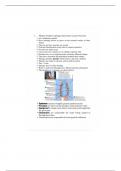
✓ The structure of a sponge is as shown below:
✓ Epidermis consists of tightly packed epidermal cells
✓ Porocytes are pores on the sponges; entry point for water
✓ Spongoco
Spongocoel
el is a large cavity where water passes through after
the porocytes
✓ Choanocyte
Choanocytess are responsible for water being sucked in
through porocytes
✓ Choanocytes are responsible for food particle collection
,✓ Flagellum beats → creates water current → water is sucked
into pores→ food particles in the water are trapped by the
collar → small particles pass through the collar; large
particles trapped on the collar→Large ones are vacuolised
and passed through the amoebocyte.
, II. Phylum: Cnidaria
✓ Organisms such as anemones, corals, jellyfish, bluebottles,
hydras etc.
✓ More complex than phylum porifera
✓ They have no mechanical hard parts such as teeth
✓ Do not have highly specialised tissues- organs
✓ Alternation of generations between polyps and medusa
✓ Purely aquatic
✓ Locomotive- they have nerves and muscles
✓ Have hydrostatic skeleton
✓ Cnidarians are radially symmetrical
✓ They have no head end; there is an oral end and an aboral
end
✓ The figure above shows the types of symmetry normally
observed, and their differences
✓ There are two body morphs of cnidaria in its life cycle:
polyploid and medusoid
✓ In the polyploid stage they are sessile, cannot move
✓ In the medusoid stage, they are free in water and move
around- resemblance to jellyfish
✓ Cnidarians are diploblastic- two cellular body layers
✓ The figure below demonstrates the two different body
morphs and their structures
✓ Are completely aquatic
✓ Have opening known as pores on the external surface of their
bodies
✓ They do not have muscles-are sessile
✓ External reproduction using water to disperse gametes
✓ Do not have teeth or gut
✓ Lack of nervous system-act via cellular response only
✓ Porifera have a very high diversity and many different shapes
✓ They have structures that help them maintain their shapes
✓ Sponges produce spicules which forms a network; skeleton
✓ Spicules are made of calcium, silicon and/or protein
✓ Size: <1mm
✓ Sponges feed via filter feeding
✓ Water is sucked in through pores, filtered and then eliminated
✓ The structure of a sponge is as shown below:
✓ Epidermis consists of tightly packed epidermal cells
✓ Porocytes are pores on the sponges; entry point for water
✓ Spongoco
Spongocoel
el is a large cavity where water passes through after
the porocytes
✓ Choanocyte
Choanocytess are responsible for water being sucked in
through porocytes
✓ Choanocytes are responsible for food particle collection
,✓ Flagellum beats → creates water current → water is sucked
into pores→ food particles in the water are trapped by the
collar → small particles pass through the collar; large
particles trapped on the collar→Large ones are vacuolised
and passed through the amoebocyte.
, II. Phylum: Cnidaria
✓ Organisms such as anemones, corals, jellyfish, bluebottles,
hydras etc.
✓ More complex than phylum porifera
✓ They have no mechanical hard parts such as teeth
✓ Do not have highly specialised tissues- organs
✓ Alternation of generations between polyps and medusa
✓ Purely aquatic
✓ Locomotive- they have nerves and muscles
✓ Have hydrostatic skeleton
✓ Cnidarians are radially symmetrical
✓ They have no head end; there is an oral end and an aboral
end
✓ The figure above shows the types of symmetry normally
observed, and their differences
✓ There are two body morphs of cnidaria in its life cycle:
polyploid and medusoid
✓ In the polyploid stage they are sessile, cannot move
✓ In the medusoid stage, they are free in water and move
around- resemblance to jellyfish
✓ Cnidarians are diploblastic- two cellular body layers
✓ The figure below demonstrates the two different body
morphs and their structures