LECTURE 12: MULTI-LEVEL POLITICS OF WAR
LECTURE NOTES:
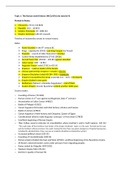
Patterns of war: are war’s incidence and deadliness rising or falling?
Interstate: armed conflict between two sovereign states.
Extra-state wars: armed conflict between a state and a non-state group outside its territory
to retain control
Non-state: armed conflict between two or more non-state groups.
Non-internationalised intrastate: civil armed conflict between a state and one or more non-
state actors in the state’s territory (no military involvement by extra-state actors).
Internationalised intrastate war: civil armed conflict between a state and one or more non-
state actors in a state’s territory with military involvement by one or more extra-state actors.
Militarised International Disputes (MIDs): threats, displays, or uses of force involving states,
where deadliness of ‘use’ falls short of war definitions.
Two more reasons to be sceptical of the Long-Peace claim:
• Downward trends in the proportional deadliness of wars/conflicts partly reflect
improvements in medical care.
• Wars are rare events, and their politics ‘stochastic’… so wars might be on the horizon.
Patterns:
1. Proportional decline: Decline, particularly among Great Powers and particularly since
WWII, in war and conflict as proportions of states, and war deaths as proportion of
population.
2. Absolute Non-decline: BUT no statistically significant secular decline in absolute
incidence or deaths (let alone potential deadliness of war).
3. Rise of civil wars and internationalised civil wars: Significant increase in civil wars
relative to inter-state wars, and recent big rise in internationalised civil wars (with
major involvement of external actor(s)).
4. Some regions and countries have much more conflict and war-suffering than others
(e.g. Americas versus Africa, Syria versus Tanzania; Ghana versus Congo).
5. War’s ‘victims’ go way beyond battlefield deaths (and vary also hugely across time
and space).
Explaining patterns of war
1. Material bases of power balancing and security dilemmas: material conditions
shaping clarity and stability of power distributions and commitments.
1
,(Debate 1: realism; Debate 2: realism; Debate 3: material position; Debate 4:
positivism/rationalism)
a. Polarity (bipolarity vs. multipolarity)
b. Alliance complexity (simple and clear vs. complex and ambiguous)
c. Nuclear weapons (yes or no; ‘mutually-assured-destruction’ or not)
d. (Other) military technologies favouring offence or defence (e.g. drones, anti-tank Javelin)
• Help explain Long Peace: Post-WWII (Cold War) bipolarity, clearer alliances, nuclear
weapons and technology all focus and clarify security commitments and can diminish
security dilemmas.
• Help explain possibly also increasing civil wars: Cold War and nuclear weapons
displace international to proxy/civil wars (continuation of policy as other means)
(Kalyvas and Balcels);
• Help explain more recent patterns of increase: Post-Cold War multipolarity, US-China
change in the balance of power, ambiguity in commitments, strengthen Putin’s hand
(among others), and this in turn yields contagion (e.g. Azerbaijan vs Armenia).
2. Domestic and international (security) institutions shape representation of people bearing
costs of war, and shape also ‘transaction costs’ (enforce agreements, improve transparency,
etc.) of negotiation, together shaping security commitments.
(Debate 1: idealism; Debate 2: liberalism; Debate 3: institutions; Debate 4:
positivism/modernist constructivism)
a. Democratic peace: liberal democratic institutions foster preferences and capacities for
peace.
b. International institutional peace: Many international institutions foster coordination and
cooperation, build trust, etc.
• Help explain Long Peace:
o Spreading and consolidating of democracy fostered peaceable political action
(at least between democracies).
o Post WW2 (Cold War) institutions distinctly and enduringly diminished
security dilemmas, and deepened cooperation.
• Help explain recent spikes in the incidence of war/conflict:
o Stalling and backsliding of democracy erodes peaceable political action.
o Recent ‘post-post Cold War’ erosion of capacities of international institutions
awaken security dilemmas and undermine cooperation.
3. Globalisation changes sovereignty and global interactions of political actors, creates
opportunity costs of conflict that raise the value of peace vs war, and can transform security
and wealth calculations. (Kant, Gartzke, Kaldor, etc.)
(Debate 1: idealism; Debate 2: liberalism/marxism; Debate 3: material interests; Debate 4:
positivism)
2
,a. Economic interdependence: Flows and openness to trade, capital, and production
undergird preferences and capacities for peace and foster contact, cooperation, trust, etc.,
but also create losers, not just winners, hence can spark xenophobic backlashes.
b. Socio-cultural and political globalisation: speeds up and deepens transport of ideas,
resources, organisation, and hence contagion mechanisms.
• Help explain Long Pease
o Kantian capitalist peace
o Cosmopolitan peace
• Help explain possibly also increasing civil wars, particularly internationalised civil
wars:
o Global connectedness fosters proxy wars and transnational flows of
arms/ideas/organisations.
o Backlashes emerge that show up first as intense internal inequalities and
frictions.
• Help explain recent spikes in the incidence of war/conflict:
o Various economic and political backlashes against many faces of globalisation
(trade, investments, immigration, IGOs like EU) foster retreat from global
security cooperation, stronger nationalist isolationism and ‘othering’.
4. Leadership ideas, norms, and interactions shape responses to anarchy and other material
conditions. Anarchy and other material constraints are what norm-sensitive states, leaders
and their interactions make of them.
Help explain Long Peace:
- Key major leaders understood and sought to shape the Cold War security dilemma
(e.g. Krushchev/Kennedy; Gorbachev), facilitating stabilisation and later of the Cold
War).
- Norms on human rights and propriety of rules-based global order constrained Great
Power behaviour.
Help explain recent spikes in war/conflict, including internationalised civil conflict:
- Key major leaders understood and sought/seek to shape post-Cold War and game
the security dilemma (e.g. Putin; Jinping).
- Norms on human rights and rules-based order have been strongly undermined (e.g.
Iraq war, Georgia/Ukraine/Belorussia, Rwanda).
Multi-level global politics of war = How war at one level is fought by taking action at
another level.
Democratic Peace (Kant conjecture): democracies tend not to go to war with one another.
Capitalist Peace (Kant-Gartze): capitalist countries tend not to go to war with one another.
Tilly Conjecture 2: State-making as organised crime): Stoking international war to
consolidate one’s national power.
The complexity, contingency and chaos of New Wars = New wars as involving key non-
realpolitiek causes:
• Ethnic differences, interactions and clashes.
3
, • Clashes of worldviews and civilisations
• Arms trade fueling conflicts
• Natural-resource-fueled conflict: clashes possibly made and maintained due to
natural resources.
• Environmental conflicts: clashes over scarce resources or climate change.
Complexity: e.g. a given ‘cause’ relevant only in combination with other factors, such as
horizontal inequality (ethnic-based inequality).
Contingency: e.g. Many core ‘causes have conflict effects moderated by other, third factors.
KALDOR
New type of organised violence developed during the last decades of the 20th century: new
war.
Blurs distinctions between war, organised crime, and large-scale violations of human
rights.
Blurs distinctions between external/internal, aggression (attack from abroad) and
repression (from inside), local/global etc.
Have to be understood in the context of globalisation = intensification of global
interconnectedness and changing character of political authority.
The impact of globalisation is visible: international reporters, mercenary troops and
military advisers, diaspora volunteers, and NGOs or international organisations.
A central issue concerns the implications of global interconnectedness for the future of
territorially based sovereignty ⇒ Wars occur in a context of erosion of the monopoly of
legitimate organised violence.
• Erosion from above
o The capacity of states to use force unilaterally against other states has been
greatly weakened ⇒ the growing destructiveness of military technology and
the increasing interconnectedness of states.
• Erosion from below
o Privatisation.
o New wars occur in situations in which state revenues decline because of the
decline of the economy as well as the spread of criminality, corruption and
inefficiency.
o Violence is increasingly privatised both as a result of growing organised crime
and the emergence of paramilitary groups, and political legitimacy is
disappearing.
New wars can be contrasted with earlier wars in terms of:
• Their goals: identity politics rather than geopolitical goals of earlier wars = the claim
to power based on a particular identity (national, religious, linguistic etc.).
o New wave of identity politics is local, global, and national.
o It is also making use of the new technology ⇒ the speed of political
mobilisation is greatly increased.
4
LECTURE NOTES:
Patterns of war: are war’s incidence and deadliness rising or falling?
Interstate: armed conflict between two sovereign states.
Extra-state wars: armed conflict between a state and a non-state group outside its territory
to retain control
Non-state: armed conflict between two or more non-state groups.
Non-internationalised intrastate: civil armed conflict between a state and one or more non-
state actors in the state’s territory (no military involvement by extra-state actors).
Internationalised intrastate war: civil armed conflict between a state and one or more non-
state actors in a state’s territory with military involvement by one or more extra-state actors.
Militarised International Disputes (MIDs): threats, displays, or uses of force involving states,
where deadliness of ‘use’ falls short of war definitions.
Two more reasons to be sceptical of the Long-Peace claim:
• Downward trends in the proportional deadliness of wars/conflicts partly reflect
improvements in medical care.
• Wars are rare events, and their politics ‘stochastic’… so wars might be on the horizon.
Patterns:
1. Proportional decline: Decline, particularly among Great Powers and particularly since
WWII, in war and conflict as proportions of states, and war deaths as proportion of
population.
2. Absolute Non-decline: BUT no statistically significant secular decline in absolute
incidence or deaths (let alone potential deadliness of war).
3. Rise of civil wars and internationalised civil wars: Significant increase in civil wars
relative to inter-state wars, and recent big rise in internationalised civil wars (with
major involvement of external actor(s)).
4. Some regions and countries have much more conflict and war-suffering than others
(e.g. Americas versus Africa, Syria versus Tanzania; Ghana versus Congo).
5. War’s ‘victims’ go way beyond battlefield deaths (and vary also hugely across time
and space).
Explaining patterns of war
1. Material bases of power balancing and security dilemmas: material conditions
shaping clarity and stability of power distributions and commitments.
1
,(Debate 1: realism; Debate 2: realism; Debate 3: material position; Debate 4:
positivism/rationalism)
a. Polarity (bipolarity vs. multipolarity)
b. Alliance complexity (simple and clear vs. complex and ambiguous)
c. Nuclear weapons (yes or no; ‘mutually-assured-destruction’ or not)
d. (Other) military technologies favouring offence or defence (e.g. drones, anti-tank Javelin)
• Help explain Long Peace: Post-WWII (Cold War) bipolarity, clearer alliances, nuclear
weapons and technology all focus and clarify security commitments and can diminish
security dilemmas.
• Help explain possibly also increasing civil wars: Cold War and nuclear weapons
displace international to proxy/civil wars (continuation of policy as other means)
(Kalyvas and Balcels);
• Help explain more recent patterns of increase: Post-Cold War multipolarity, US-China
change in the balance of power, ambiguity in commitments, strengthen Putin’s hand
(among others), and this in turn yields contagion (e.g. Azerbaijan vs Armenia).
2. Domestic and international (security) institutions shape representation of people bearing
costs of war, and shape also ‘transaction costs’ (enforce agreements, improve transparency,
etc.) of negotiation, together shaping security commitments.
(Debate 1: idealism; Debate 2: liberalism; Debate 3: institutions; Debate 4:
positivism/modernist constructivism)
a. Democratic peace: liberal democratic institutions foster preferences and capacities for
peace.
b. International institutional peace: Many international institutions foster coordination and
cooperation, build trust, etc.
• Help explain Long Peace:
o Spreading and consolidating of democracy fostered peaceable political action
(at least between democracies).
o Post WW2 (Cold War) institutions distinctly and enduringly diminished
security dilemmas, and deepened cooperation.
• Help explain recent spikes in the incidence of war/conflict:
o Stalling and backsliding of democracy erodes peaceable political action.
o Recent ‘post-post Cold War’ erosion of capacities of international institutions
awaken security dilemmas and undermine cooperation.
3. Globalisation changes sovereignty and global interactions of political actors, creates
opportunity costs of conflict that raise the value of peace vs war, and can transform security
and wealth calculations. (Kant, Gartzke, Kaldor, etc.)
(Debate 1: idealism; Debate 2: liberalism/marxism; Debate 3: material interests; Debate 4:
positivism)
2
,a. Economic interdependence: Flows and openness to trade, capital, and production
undergird preferences and capacities for peace and foster contact, cooperation, trust, etc.,
but also create losers, not just winners, hence can spark xenophobic backlashes.
b. Socio-cultural and political globalisation: speeds up and deepens transport of ideas,
resources, organisation, and hence contagion mechanisms.
• Help explain Long Pease
o Kantian capitalist peace
o Cosmopolitan peace
• Help explain possibly also increasing civil wars, particularly internationalised civil
wars:
o Global connectedness fosters proxy wars and transnational flows of
arms/ideas/organisations.
o Backlashes emerge that show up first as intense internal inequalities and
frictions.
• Help explain recent spikes in the incidence of war/conflict:
o Various economic and political backlashes against many faces of globalisation
(trade, investments, immigration, IGOs like EU) foster retreat from global
security cooperation, stronger nationalist isolationism and ‘othering’.
4. Leadership ideas, norms, and interactions shape responses to anarchy and other material
conditions. Anarchy and other material constraints are what norm-sensitive states, leaders
and their interactions make of them.
Help explain Long Peace:
- Key major leaders understood and sought to shape the Cold War security dilemma
(e.g. Krushchev/Kennedy; Gorbachev), facilitating stabilisation and later of the Cold
War).
- Norms on human rights and propriety of rules-based global order constrained Great
Power behaviour.
Help explain recent spikes in war/conflict, including internationalised civil conflict:
- Key major leaders understood and sought/seek to shape post-Cold War and game
the security dilemma (e.g. Putin; Jinping).
- Norms on human rights and rules-based order have been strongly undermined (e.g.
Iraq war, Georgia/Ukraine/Belorussia, Rwanda).
Multi-level global politics of war = How war at one level is fought by taking action at
another level.
Democratic Peace (Kant conjecture): democracies tend not to go to war with one another.
Capitalist Peace (Kant-Gartze): capitalist countries tend not to go to war with one another.
Tilly Conjecture 2: State-making as organised crime): Stoking international war to
consolidate one’s national power.
The complexity, contingency and chaos of New Wars = New wars as involving key non-
realpolitiek causes:
• Ethnic differences, interactions and clashes.
3
, • Clashes of worldviews and civilisations
• Arms trade fueling conflicts
• Natural-resource-fueled conflict: clashes possibly made and maintained due to
natural resources.
• Environmental conflicts: clashes over scarce resources or climate change.
Complexity: e.g. a given ‘cause’ relevant only in combination with other factors, such as
horizontal inequality (ethnic-based inequality).
Contingency: e.g. Many core ‘causes have conflict effects moderated by other, third factors.
KALDOR
New type of organised violence developed during the last decades of the 20th century: new
war.
Blurs distinctions between war, organised crime, and large-scale violations of human
rights.
Blurs distinctions between external/internal, aggression (attack from abroad) and
repression (from inside), local/global etc.
Have to be understood in the context of globalisation = intensification of global
interconnectedness and changing character of political authority.
The impact of globalisation is visible: international reporters, mercenary troops and
military advisers, diaspora volunteers, and NGOs or international organisations.
A central issue concerns the implications of global interconnectedness for the future of
territorially based sovereignty ⇒ Wars occur in a context of erosion of the monopoly of
legitimate organised violence.
• Erosion from above
o The capacity of states to use force unilaterally against other states has been
greatly weakened ⇒ the growing destructiveness of military technology and
the increasing interconnectedness of states.
• Erosion from below
o Privatisation.
o New wars occur in situations in which state revenues decline because of the
decline of the economy as well as the spread of criminality, corruption and
inefficiency.
o Violence is increasingly privatised both as a result of growing organised crime
and the emergence of paramilitary groups, and political legitimacy is
disappearing.
New wars can be contrasted with earlier wars in terms of:
• Their goals: identity politics rather than geopolitical goals of earlier wars = the claim
to power based on a particular identity (national, religious, linguistic etc.).
o New wave of identity politics is local, global, and national.
o It is also making use of the new technology ⇒ the speed of political
mobilisation is greatly increased.
4