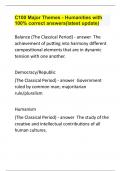
C100 Major Themes - Humanities with 100% correct answers(latest update)
Balance (The Classical Period) The achievement of putting into harmony different compositional elements that are in dynamic tension with one another. Democracy/Republic (The Classical Period) Government ruled by common man; majoritarian rule/pluralism Humanism (The Classical Period) The study of the creative and intellectual contributions of all human cultures. Polytheism (The Classical Period) A belief or religion based on more than one god. Truth/Reason (The Classical Period) The accurate and genuine reality of the world; that which is indisputably factual. rebirth of classicism (The Renaissance Period) During the Renaissance, there was a rebirth of classical ideals, mainly humanism, rationalism, and balance, based on the belief that classical literary, scientific, and philosophical works provided additional resources for learning and living. humanism (The Renaissance Period) An optimistic attitude that praises human abilities to be successful in their endeavors, whether in science, religion, art, politics, or behavior. The focus on humanity, human culture, and the human form was the impetus for the classical revival. Rationalism/scientific expansion (The Renaissance Period) Many people in the Renaissance embodied a strong interest in rationalism and scientific inquiry, leading to deeper understanding of the world and technological developments in such areas as medicine, transportation, and warfare. university system (The Renaissance Period) The Renaissance approach to education produced the ideal of the well-rounded individual who was not bound to any one discipline. As this system spread across Europe, it represented a significant change in epistemology. Individualism/self-fashioning (The Renaissance Period) During the Renaissance, artists sought public recognition and reputation. Artists and nobles represented their identity with choices in dress and behavior. Reformation (The Renaissance Period) Protestantism, sparked by Martin Luther's outspoken disagreement with many Church practices he believed were corrupt. Overall, reformation of the Roman Catholic Church was a very significant movement in the Renaissance that separated it from the Middle Ages. Skepticism (The Neoclassical Period) The school of "rational skepticism" was prominent during the Enlightenment to ensure that philosophers reached conclusions based on reason, not prejudice. Rationalism (The Neoclassical Period) The role of reason as the key to knowledge. Empiricism (The Neoclassical Period) First developed in the Renaissance by scientists such as Francis Bacon, defined as basing ideas and theories on the direct experience of the senses, including experimentation, as opposed to knowledge gained from books. Order (The Neoclassical Period) Enlightenment thinkers and leaders sought to design political and social order that reflected natural laws and God's will. Deism (The Neoclassical Period) A belief system that credits God as the original architect of the universe's natural laws but who does not currently oversee the events of the world. Classicism (The Neoclassical Period) In the arts, a resurgence of classical ideals like harmony, realism, and reason inspired the Neoclassical movement.
Written for
- Institution
- C100
- Course
- C100
Document information
- Uploaded on
- May 11, 2024
- Number of pages
- 16
- Written in
- 2023/2024
- Type
- Exam (elaborations)
- Contains
- Questions & answers
Subjects
-
c100 major themes humanities

Document also available in package deal