EXAM 1 INTRO TO SOCIAL WELFARE FINAL-QUESTIONS AND ANSWERS GRADED A+
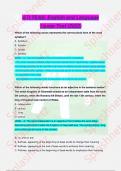
EXAM 1 INTRO TO SOCIAL WELFARE FINAL-QUESTIONS AND ANSWERS GRADED A+ Most media discussion of the problem of poverty in the United States focuses on the population known as: - ANSWER-the persistently poor, residual poor, "underclass" Those who remain in poverty over an extended period of time are referred to as the: - ANSWER-residual poor How much more likely are female-only headed households than married-couple households to be in poverty? - ANSWER-six times What do cultural explanations of poverty seek to do? - ANSWER-Individuals are viewed as possessing these characteristics because of the social situations they were born into and in which they were reared and educated Among the variables the Census Bureau uses to describe the poor are: - ANSWER-race, age and region People who are poor because the plant closed and they can't find another job are the: - ANSWER-transitional poor The concept of "multi-problem families" most closely aligns with: - ANSWER-the expectancy model. The term "cross section or snapshot data" implies that the data collected - ANSWER-provides a series of statistical pictures at certain points in time, but it does not tell us much beyond a general description of the situation at that time. What is the main difference between the marginal poor and the transitional poor? - ANSWER-For the marginal poor, the rising out of poverty and sinking back into it constitute a longterm pattern and the transitional poor are most likely experiencing a brief episode of poverty. New Structural Poverty is the theory that: - ANSWER-government welfare programs encourage able-bodied working-age persons to sink into a lifestyle of welfare dependency and consequently permanent poverty. Herrnstein and Murray, in their book The Bell Curve, posited that: - ANSWER-social standing is based on inherited differences. expectancy model is based on the theory that: - ANSWER-there is a relationship between confidence, a sense of control, & success. Those who are successful gain confidence, and this leads to a sense of control over their lives, which in turn results in more success. Human Capital - ANSWER-"An individual's productive skills, talents, and knowledge. It is measured in terms of the value of goods and services produced." In other words, how much is an individuals labor worth? transitional poor - ANSWER-those who experience poverty is only temporary and brief
Written for
- Institution
- SOCIAL WELFARE
- Course
- SOCIAL WELFARE
Document information
- Uploaded on
- May 7, 2024
- Number of pages
- 179
- Written in
- 2023/2024
- Type
- Exam (elaborations)
- Contains
- Questions & answers
Subjects
-
human capital
-
the statute of labourers
-
racism
-
liberals and radicals
-
cultural anthropology
-
human services
-
strategies to end poverty
-
kind
-
exam 1 intro to social welfare final
-
the feminization of poverty