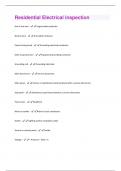
Residential Electrical inspection Hot or live wire - Ungrounded conductor Neutral wire - Grounded conductor Panel earth ground - Grounding electrode conductor Earth or ground wire - Equipment grounding conductor Grounding rod - Grounding Electrode Main disconnect - Service disconnect Main panel - Service or distribution electrical board with a service disconnect Sub-panel - distribution panel board without a service disconnect Panel cover - Deadfront Wires to outlets - Branch circuit conductors Outlet - Lighting and \or receptacle outlet Service to remote panel - Feeder Voltage - = Pressure = Volts = E Current - Is the flow of electrons driven by electromotive force through a given resistance. This is expressed as amps. = Flow rate= Amps = I Resistance - limits the conductor's ability to allow the flow of electrons, and is expressed in ohms. = pipe size = Ohms =R Amps - The rate at which electricity flows through a conductor. I=W/E Electrical power - Is the amount of work that the electrical flow can do. This is expressed as watts or kilowatts (1,000 watts). (W) = E(I) Ohms Law - are basically a series of mathematical models that show us how to work out safe working loads for conductors and electrical components. When evaluating a elecrical supply - we need to recognize that copper and aluminum conductors are not the same, copper inherently has less resistance to the flow of electrons than aluminum does. For this reason, aluminum conductors are always one to two sizes larger than the equivalent copper one for any given amperage Service 100 Amps - #2 Aluminium, #4 Copper Service 110 Amps - #1 Aluminium, #3 Copper Service 125 Amps - 1/0 Aluminium, #2 Copper Service 150 Amps - 2/0 Aluminium, #1 Copper Service 200 Amps - 4/0 Aluminium, 2/0 Copper Service 250 Amps - 300 kcmil Aluminium, 4/0 Copper Service 400 Amps - 600 kcmil Aluminium, 400 kcmil Copper Small conductors commonly seen by home inspectors - 15 amps = #14 Copper, #12 Aluminium 20 amps = #12 Copper 25 amps = #10 Aluminium 30 amps = #10 Copper, #8 Aluminium The typical electrical service for homes in North America is - 120/240 An electrical circuit requires a minimum of - Two wires through which electric current flows. Current is measured in amperes, which travels from a power source (such as the local utility), through the device it operates, called the load, and then back to the source to complete the circuit. In AC or alternating -current wiring, there are about 120 volts in the "hot" or energized wire. This voltage provides the momentum that forces the electrons to flow in the circuit. Most 120 -volt circuits are wired to deliver 15 or 20 amps of current. According to InterNACHI's Home Inspection S.O.P ., the inspector is not required to: - 1. measure or determine the amperage or voltage of the main service equipment; 2. remove panelboard cabinet covers or dead fronts; 3. insert any tool, probe or device into the main panelboard, sub -panels, distribution panelboards, or electrical fixtures; or 4. operate any electrical disconnect or over -current protection devices. warning signs that a panel, box, or the system in general may be compromised, - 1. scorch marks on the dead front or the panelboard door, indicating a past or recent arc flash; 2. rust, which indicates past or recent moisture intrusion; 3. missing or open breakers that cannot be confirmed to be de -energized;
Exam (elaborations)
Residential Electrical inspection Complete Questions And Answers With Verified Solutions
Rating
Sold
-
Pages
23
Grade
A+
Uploaded on
07-05-2024
Written in
2023/2024
Hot or live wire - Ungrounded conductor Neutral wire - Grounded conductor Panel earth ground - Grounding electrode conductor Earth or ground wire - Equipment grounding conductor Grounding rod - Grounding Electrode Main disconnect - Service disconnect Main panel - Service or distribution electrical board with a service disconnect Sub-panel - distribution panel board without a service disconnect Panel cover - Deadfront Wires to outlets - Branch circuit conductors Outlet - Lighting andor receptacle outlet Service to remote panel - Feeder Voltage - = Pressure = Volts = ECurrent - Is the flow of electrons driven by electromotive force through a given resistance. This is expressed as amps. = Flow rate= Amps = I Resistance - limits the conductor's ability to allow the flow of electrons, and is expressed in ohms. = pipe size = Ohms =R Amps - The rate at which electricity flows through a conductor. I=W/E Electrical power - Is the amount of work that the electrical flow can do. This is expressed as watts or kilowatts (1,000 watts). (W) = E(I) Ohms Law - are basically a series of mathematical models that show us how to work out safe working loads for conductors and electrical components. When evaluating a elecrical supply - we need to recognize that copper and aluminum conductors are not the same, copper inherently has less resistance to the flow of electrons than aluminum does. For this reason, aluminum conductors are always one to two sizes larger than the equivalent copper one for any given amperage Service 100 Amps - #2 Aluminium, #4 Copper Service 110 Amps - #1 Aluminium, #3 Copper Service 125 Amps - 1/0 Aluminium, #2 Copper Service 150 Amps - 2/0 Aluminium, #1 CopperService 200 Amps - 4/0 Aluminium, 2/0 Copper Service 250 Amps - 300 kcmil Aluminium, 4/0 Copper Service 400 Amps - 600 kcmil Aluminium, 400 kcmil Copper Small conductors commonly seen by home inspectors - 15 amps = #14 Copper, #12 Aluminium 20 amps = #12 Copper 25 amps = #10 Aluminium 30 amps = #10 Copper, #8 Aluminium The typical electrical service for homes in North America is - 120/240 An electrical circuit requires a minimum of - Two wires through which electric current flows. Current is measured in amperes, which travels from a power source (such as the local utility), through the device it operates, called the load, and then back to the source to complete the circuit. In AC or alternating-current wiring, there are about 120 volts in the "hot" or energized wire. This voltage provides the momentum that forces the electrons to flow in the circuit. Most 120-volt circuits are wired to deliver 15 or 20 amps of current. According to InterNACHI's Home Inspection S.O.P., the inspector is not required to: - 1. measure or determine the amperage or voltage of the main service equipment; 2. remove panelboard cabinet covers or dead fronts; 3. insert any tool, probe or device into the main panelboard, sub-panels, distribution panelboards, or electrical fixtures; or 4. operate any electrical disconnect or over-current protection devices. warning signs that a panel, box, or the system in general may be compromised, - 1. scorch marks on the dead front or the panelboard door, indicating a past or recent arc flash; 2. rust, which indicates past or recent moisture intrusion; 3. missing or open breakers that cannot be confirmed to be de-energized;4. overloading of the circuits with DIY wiring; 5. uninsulated wiring; 6. excessive dust, dirt and debris inside the panelboard; and/or 7. any signs of water inside, around or below the panelboard, which can lead to shock or electrocution.
Show more
Read less
Institution
Residential Electrical Inspection
Course
Residential Electrical inspection
Whoops! We can’t load your doc right now. Try again or contact support.
Written for
- Institution
- Residential Electrical inspection
- Course
- Residential Electrical inspection
Document information
- Uploaded on
- May 7, 2024
- Number of pages
- 23
- Written in
- 2023/2024
- Type
- Exam (elaborations)
- Contains
- Questions & answers
Subjects
-
residential electrical inspection
Content preview
R143,58
Get access to the full document:
100% satisfaction guarantee
Immediately available after payment
Both online and in PDF
No strings attached

Document also available in package deal
Package deal
Residential Electrician Verified Bundle With Complete Questions And Answers
10
2024
R 1.401,97
More info