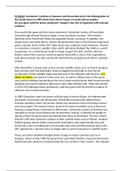
P2 ESSAY: Gorbachev’s policies of Glasnost and Perestroika led to the disintegration of
the Soviet Union in 1989 which had a direct impact on South African politics.
Do you agree with the above statement? Support your line of argument with relevant
evidence.
One would fully agree with the above statement. Gorbachev’s policy of Perestroika
(restructuring) allowed Russia to adopt a more socialistic economy. This however
backfired when Perestroika failed and degraded Russia’s economy. In addition, the
people were now freely able to criticize the government due to the Glasnost (openness)
policy, and due to the earlier SALT talks, Russia was unable to crush resistance. This led
to revolutions in Russia’s satellite states which ultimately disabled the USSR as a world
superpower. As a result Russia could no longer support the ANC, and the USA and
Britain could enforce serious sanctions against South Africa. Due to this, negotiations
took place between the ANC and the NP which directly changed South Africa’s political
climate.
After World War 2 Russia took control of many satellite states such as Poland, Hungary,
East Germany and Czechoslovakia. Russia struggled economically as they forced
communism in their satellite states and took part in the Cold War with America. $33
billion US dollars was spent in in the arms race, as well as millions more in the space
race and the building/maintaining of the Iron Curtain and the Berlin Wall. Russia became
bankrupt and was prompted to take part in SALT talks with the USA. These had started
in 1972-1979 between Nixon and Besnev, with the goal to strictly limit the numbers of
offensive arms in both countries.
In 1985 Gorbachev came into power with the goal to reform Russia. He implemented
the policies of Glasnost and Perestroika. Perestroika economically shifted Russia
towards capitalism where the private market was allowed to exist and foreign market
was encouraged. This however drove up prices for basic necessities such as food and
housing, causing Russia’s economy to deteriorate. Gorbachev’s policy of Glasnost was
intended to create a more democratic environment. Instead, it allowed the people to
openly criticize the government and spread their ideas of discontent. The firm control
that the USSR held, started to collapse as their satellite states such as Poland, revolted.
Political groups openly defied communistic domination and urged election boycotts.
Russia had a lack of funding due to Perestroika and a lack of militant power due to the
SALT agreements, and they were no longer able to control resistance in satellite states.
These successful rebellions brought about change in nearby countries such as in
Hungary, where in May 1989 the government permitted freedom of speech/movement,
held democratic elections and dismantled the Iron Curtain in their country. This allowed
the Soviet Union in 1989 which had a direct impact on South African politics.
Do you agree with the above statement? Support your line of argument with relevant
evidence.
One would fully agree with the above statement. Gorbachev’s policy of Perestroika
(restructuring) allowed Russia to adopt a more socialistic economy. This however
backfired when Perestroika failed and degraded Russia’s economy. In addition, the
people were now freely able to criticize the government due to the Glasnost (openness)
policy, and due to the earlier SALT talks, Russia was unable to crush resistance. This led
to revolutions in Russia’s satellite states which ultimately disabled the USSR as a world
superpower. As a result Russia could no longer support the ANC, and the USA and
Britain could enforce serious sanctions against South Africa. Due to this, negotiations
took place between the ANC and the NP which directly changed South Africa’s political
climate.
After World War 2 Russia took control of many satellite states such as Poland, Hungary,
East Germany and Czechoslovakia. Russia struggled economically as they forced
communism in their satellite states and took part in the Cold War with America. $33
billion US dollars was spent in in the arms race, as well as millions more in the space
race and the building/maintaining of the Iron Curtain and the Berlin Wall. Russia became
bankrupt and was prompted to take part in SALT talks with the USA. These had started
in 1972-1979 between Nixon and Besnev, with the goal to strictly limit the numbers of
offensive arms in both countries.
In 1985 Gorbachev came into power with the goal to reform Russia. He implemented
the policies of Glasnost and Perestroika. Perestroika economically shifted Russia
towards capitalism where the private market was allowed to exist and foreign market
was encouraged. This however drove up prices for basic necessities such as food and
housing, causing Russia’s economy to deteriorate. Gorbachev’s policy of Glasnost was
intended to create a more democratic environment. Instead, it allowed the people to
openly criticize the government and spread their ideas of discontent. The firm control
that the USSR held, started to collapse as their satellite states such as Poland, revolted.
Political groups openly defied communistic domination and urged election boycotts.
Russia had a lack of funding due to Perestroika and a lack of militant power due to the
SALT agreements, and they were no longer able to control resistance in satellite states.
These successful rebellions brought about change in nearby countries such as in
Hungary, where in May 1989 the government permitted freedom of speech/movement,
held democratic elections and dismantled the Iron Curtain in their country. This allowed