1
______________
Student Number
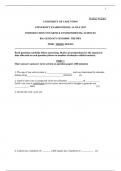
UNIVERSITY OF CAPE TOWN
UNIVERSITY EXAMINATIONS: 14 JULY 2017
INTRODUCTION TO EARTH & ENVIRONMENTAL SCIENCES
BSc GEOLOGY GEO1009F: THEORY
TIME: THREE HOURS
Read questions carefully before answering. Marks are proportional to the amount of
time allocated to each question (shown in number of minutes within brackets).
PART 1
Short answers (answers to be written on question paper) (100 minutes)
1. The age of our solar system is _____________________ and was determined by absolute
dating using _____________________________ elements. (1)
2. Earth’s inner core is composed of the two elements ____________ & ___________.
Earth’s out core is solid/liquid (circle correct answer) and is thought to generate our
____________ field. (2)
3. Sketch the rock cycle. (5)
4. Calcite has a hardness of _______ while quartz has a hardness of __________. (1)
, 2
5. Complete the following reactions: (2)
_____ + CaSiO3 = _______ + SiO2
CO2 + _______ = __________ + O2
6. Sea level was ____________ metres lower during the last glacial maximum. The glacial
rebound of continents since the ice sheets have melted is a result of ________________. (1)
7. The Table Mountain Group (TMG) is a potential source of underground fresh water
referred to as an _______________. The TMG is mostly made up of the rock type
______________ that has fractures called _______________, which give the rock a high
fracture ________________ capable of storing water. The rock formations above and below
the TMG are aquicludes having high/low porosity and a high/low permeability. (circle correct
answers) (3)
8. Name and draw a sketch of two sedimentary structures (2)
9. Fill in the blanks to the time line outlined below. (3)
Age Event
__________________________ End Cretaceous mass extinction
542 Million years ago _____________________
_________________________ Initial Northern Hemisphere Glaciation
13.8 billion years ______________________
_______________________ First fossil evidence of life
4.44 billion years _________________________
10. The amount of sunlight reflected back into space is called _____________ and an
increase in it provides a positive/negative (circle correct answer) feedback to global warming.
(1)
______________
Student Number
UNIVERSITY OF CAPE TOWN
UNIVERSITY EXAMINATIONS: 14 JULY 2017
INTRODUCTION TO EARTH & ENVIRONMENTAL SCIENCES
BSc GEOLOGY GEO1009F: THEORY
TIME: THREE HOURS
Read questions carefully before answering. Marks are proportional to the amount of
time allocated to each question (shown in number of minutes within brackets).
PART 1
Short answers (answers to be written on question paper) (100 minutes)
1. The age of our solar system is _____________________ and was determined by absolute
dating using _____________________________ elements. (1)
2. Earth’s inner core is composed of the two elements ____________ & ___________.
Earth’s out core is solid/liquid (circle correct answer) and is thought to generate our
____________ field. (2)
3. Sketch the rock cycle. (5)
4. Calcite has a hardness of _______ while quartz has a hardness of __________. (1)
, 2
5. Complete the following reactions: (2)
_____ + CaSiO3 = _______ + SiO2
CO2 + _______ = __________ + O2
6. Sea level was ____________ metres lower during the last glacial maximum. The glacial
rebound of continents since the ice sheets have melted is a result of ________________. (1)
7. The Table Mountain Group (TMG) is a potential source of underground fresh water
referred to as an _______________. The TMG is mostly made up of the rock type
______________ that has fractures called _______________, which give the rock a high
fracture ________________ capable of storing water. The rock formations above and below
the TMG are aquicludes having high/low porosity and a high/low permeability. (circle correct
answers) (3)
8. Name and draw a sketch of two sedimentary structures (2)
9. Fill in the blanks to the time line outlined below. (3)
Age Event
__________________________ End Cretaceous mass extinction
542 Million years ago _____________________
_________________________ Initial Northern Hemisphere Glaciation
13.8 billion years ______________________
_______________________ First fossil evidence of life
4.44 billion years _________________________
10. The amount of sunlight reflected back into space is called _____________ and an
increase in it provides a positive/negative (circle correct answer) feedback to global warming.
(1)