Project Management Lecture Summary
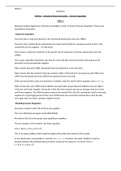
Lecture 1: Introduction to the course and to financial management
Financial management involves planning, directing, monitoring, organizing and controlling of the
monetary resources of an organization.
Finance: capital budgeting, financial ratios
Management accounting: cost structure and calculations, budget and variance analysis
Financial accounting: financial statements
Project management is the practise of initiating, planning, executing, controlling and closing the work
of a team to achieve specific goals and success criteria at the specified time
➔ Project scope, stakeholders, work breakdown structure, cost & time estimation, scheduling,
project management methodologies
Financial management and project management both serve related functions during projects
FPM Guest Lecture
Intuitive approach
Think-Pair-Share:
- What is a project?
Project = an organizational form: distinctions among organizational forms reflect social processes
and boundary creation
An organizational form is an entity comprising multiple people and resources with a particular
collective purpose/ goal/ aim. In any organizational form, mainly two aspects of work exist: on-
going operations and projects.
- What is/ are differences between a project and an organization?
,Projects are defined as unique, temporary endeavours with a specific beginning and end (they are
time-bound)
Operations constitute an organization’s on-going, repetitive activities such as accounting or
production.
➔ Permanent vs. Temporary
➔ Routine vs. Unique
- What is project management?
Project management is the process and activity of planning, organizing, motivating and
controlling resources, procedures and protocols to achieve specific goals.
The primary challenge is to achieve all the project goals and objectives while honouring the
preconceived constraints. The primary constraints are scope, time, quality and budget ( +
stakeholder satisfaction)
What is a PBO (Intra-Organizational) ?
PBO = project-based organization
➔ An independent
organizational form (an organization) in
which the project is the primary
organizational unit for economic or
societal activities (e.g. production)
➔ We can find them in private
manufacturing enterprises, also in
other organizations public and private
Typical characteristics of PBOs
▪ Appropriate for complex, non-routine tasks
▪ Competences and capabilities build from project to project
▪ Help to adapt to uncertain, risky and changing environments
▪ Populated by integrators (commercial & technical) and brokers
▪ Project managers have high status and control over functions, personnel and resources
▪ PBO is flexible and reconfigurable (large hierarchies)
, ▪ PBO = series of projects
▪ Often close user-production interaction
Advantages of PBO: well-suited for innovation and learning, coping with emerging properties &
demands from clients. Flexibility is high and response time to changing circumstances is relatively
low. High employee loyalty to project goals due to short lines with project manager.
Disadvantages:
- Ill-suited for coordination of resources and capabilities across projects, routine production
activities, achieving economies of scale
- Organizational learning often suffers
- Danger of resource duplication across multiple projects
- Due to across project mobility, careers and development of employees might suffer
Projects can be intra (in) or inter (between) organizational.
Projects as temporary systems can be described by 4 T’s: Time, Task, Team, Transition
Transition → focus on accomplishment & progression. Action orientation, two meanings of
transition:
1. Transforming input into output, change
2. How to transform (process): team mental models
Inter-organizational TO (IOTO) = temporary inter-organizational systems of legally autonomous but
functionally interdependent firms that interact to coordinate their efforts for the accomplishment of a
joint outcome in a limited amount of time (which is ex ante defined)
High relevance: service sector, NGOs, freelancers
Financial concepts
, ▪ Cash flow refers to the net balance of cash moving into and out of an organisation unit at a
specific point in time
➔ Example of inflow: euros coming in because of products sold
➔ Example of outflow: cash is moving out of the business; paying salaries to employees, paying
for rent
▪ Liquidity: indication of the extent to which an organization can meet its short-term financial
obligations (influenced by cash)
▪ Solvency: indication of the extent to which an organisation can meet its obligations towards
its creditors in the event of bankruptcy
Project Management
Lecture 1: Introduction to the course and to financial management
Financial management involves planning, directing, monitoring, organizing and controlling of the
monetary resources of an organization.
Finance: capital budgeting, financial ratios
Management accounting: cost structure and calculations, budget and variance analysis
Financial accounting: financial statements
Project management is the practise of initiating, planning, executing, controlling and closing the work
of a team to achieve specific goals and success criteria at the specified time
➔ Project scope, stakeholders, work breakdown structure, cost & time estimation, scheduling,
project management methodologies
Financial management and project management both serve related functions during projects
FPM Guest Lecture
Intuitive approach
Think-Pair-Share:
- What is a project?
Project = an organizational form: distinctions among organizational forms reflect social processes
and boundary creation
An organizational form is an entity comprising multiple people and resources with a particular
collective purpose/ goal/ aim. In any organizational form, mainly two aspects of work exist: on-
going operations and projects.
- What is/ are differences between a project and an organization?
,Projects are defined as unique, temporary endeavours with a specific beginning and end (they are
time-bound)
Operations constitute an organization’s on-going, repetitive activities such as accounting or
production.
➔ Permanent vs. Temporary
➔ Routine vs. Unique
- What is project management?
Project management is the process and activity of planning, organizing, motivating and
controlling resources, procedures and protocols to achieve specific goals.
The primary challenge is to achieve all the project goals and objectives while honouring the
preconceived constraints. The primary constraints are scope, time, quality and budget ( +
stakeholder satisfaction)
What is a PBO (Intra-Organizational) ?
PBO = project-based organization
➔ An independent
organizational form (an organization) in
which the project is the primary
organizational unit for economic or
societal activities (e.g. production)
➔ We can find them in private
manufacturing enterprises, also in
other organizations public and private
Typical characteristics of PBOs
▪ Appropriate for complex, non-routine tasks
▪ Competences and capabilities build from project to project
▪ Help to adapt to uncertain, risky and changing environments
▪ Populated by integrators (commercial & technical) and brokers
▪ Project managers have high status and control over functions, personnel and resources
▪ PBO is flexible and reconfigurable (large hierarchies)
, ▪ PBO = series of projects
▪ Often close user-production interaction
Advantages of PBO: well-suited for innovation and learning, coping with emerging properties &
demands from clients. Flexibility is high and response time to changing circumstances is relatively
low. High employee loyalty to project goals due to short lines with project manager.
Disadvantages:
- Ill-suited for coordination of resources and capabilities across projects, routine production
activities, achieving economies of scale
- Organizational learning often suffers
- Danger of resource duplication across multiple projects
- Due to across project mobility, careers and development of employees might suffer
Projects can be intra (in) or inter (between) organizational.
Projects as temporary systems can be described by 4 T’s: Time, Task, Team, Transition
Transition → focus on accomplishment & progression. Action orientation, two meanings of
transition:
1. Transforming input into output, change
2. How to transform (process): team mental models
Inter-organizational TO (IOTO) = temporary inter-organizational systems of legally autonomous but
functionally interdependent firms that interact to coordinate their efforts for the accomplishment of a
joint outcome in a limited amount of time (which is ex ante defined)
High relevance: service sector, NGOs, freelancers
Financial concepts
, ▪ Cash flow refers to the net balance of cash moving into and out of an organisation unit at a
specific point in time
➔ Example of inflow: euros coming in because of products sold
➔ Example of outflow: cash is moving out of the business; paying salaries to employees, paying
for rent
▪ Liquidity: indication of the extent to which an organization can meet its short-term financial
obligations (influenced by cash)
▪ Solvency: indication of the extent to which an organisation can meet its obligations towards
its creditors in the event of bankruptcy
Project Management